Category Archives: Dodo Chaplet

The Celestial Toymaker

Standard

Image

After the delight of watching a complete story on DVD for the first time in what seemed like an eternity, it was back to reconstructions for episodes one, two and three of The Celestial Toymaker.  Episode four is in the BBC Archives and was released on the Lost in Time DVD. This is perhaps an opportune time to discuss the incredible work done by Loose Cannon in reconstructing lost episodes of Doctor Who. Started in 1997 by Rick Brindell, Loose Cannon  Productions is a team of six very talented Doctor Who aficionados who have devoted their considerable energies to reconstructing lost episodes.  Some of their work, such as The Celestial Toymaker, could be more accurately described as a recreation because of the specifically created material contained within.  There being no telesnaps of The Celestial Toymaker missing episodes, Loose Cannon utilized authentic photos and screen grabs from the surviving episode four.  Large sections have been cleverly recreated such as Steven’s game of blind man’s bluff.  Here photos of a man hopping from block to block have been reimaged to appear as Steven.  It’s particularly well done and provides the viewer with a sense that they’re watching a much more animated production.  The use of extensive captions scrolling across the bottom of the screen provide a running commentary of the action and alerts the viewer to activity that still photos alone could not convey.

The Cover for Loose Cannon's The Celestial Toymaker.  Reproductions are only available on VHS tapes, although they can be viewed on YouTube.  Loose Cannon does not sell or profit financially from the sale of their reconstructions

The Cover for Loose Cannon’s The Celestial Toymaker. Reproductions are only available on VHS tapes, although they can be viewed on YouTube. Loose Cannon does not sell or profit financially from the sale of their reconstructions

Until the recovery of episode four and its release on video in 1991, The Celestial Toymaker had been held in generally high regard by Doctor Who fandom.   Based on the recollections of those who originally viewed the serial in 1966, The Target Books novelization and the audio soundtrack,  the serial had something of a mystique about it.  Sadly, once episode four was viewed opinion took a downward spiral.  This is unfortunate as I found the story very engaging and fascinating.  The concept of a world of make believe in which the characters are compelled to participate in childish games in order to retrieve the Tardis is both sinister and surreal. That I’m a great fan of the Second Doctor’s The Mind Robber probably evidences my idiosyncratic tendencies.  Both serials have a similar edge about them.

At last a story with some colour photographs!  The Toymaker, clowns and the Doctor

At last a story with some colour photographs! The Toymaker, clowns and the Doctor

Ballerinas block the companions path

Ballerinas block the companions path

The Celestial Toymaker had been commissioned by outgoing  producer John Wiles who had been frustrated by William Hartnell’s increasingly petulant behaviour. It had been his intention to write Hartnell out of Doctor Who and in doing so conceived of a plot line in which the Doctor would change his appearance.  Wiles’ plan to replace the lead character was vetoed and the new producer, Innes Lloyd, was compelled to retain Hartnell. Much of the storyline remained, however, with Hartnell absent from episodes two and three.  It appears that Hartnell had been sent away on holidays. In About Time 1, Tat Wood and Lawrence Miles argue that “from now on … Hartnell is on borrowed time”.

Tat Wood & Lawrence Miles About Time 1.  The Unauthorized Guide to Doctor Who 1963-1966 Seasons 1 to 3

Tat Wood & Lawrence Miles’ About Time 1. The Unauthorized Guide to Doctor Who 1963-1966 Seasons 1 to 3

Hartnell’s absence from half of the story was achieved by the ingenious ploy of making the Doctor firstly invisible, and then mute.  This required only the pre-recording of a few lines of script, the use of a hand double, and some very clever special effects for the mid 1960s. The Doctor is in battle with the Toymaker, an evil immortal who finds great joy in condemning others to a lifetime of playing puerile children’s games for his own gratification.  Even with the control of others so firmly in his grasp, the Toymaker is still bored with this dolls’ house existence.  He will not stop, however, as being vain and indignant he never likes to lose.   The Doctor is compelled to play a game of trilogic, a puzzle in which the ten pieces must be moved and restacked in exactly the correct 1023 moves.  Annoyed by the Doctor’s presence the Toymaker makes him incorporeal, leaving only his right hand visible. Not satisfied by the Doctor’s invisibility, the Toymaker then makes him mute. It is in this state that the Doctor stays until he is one move away from winning the game in episode four.

The Toymaker finds the Doctor's presence intolerable

The Toymaker finds the Doctor’s presence intolerable
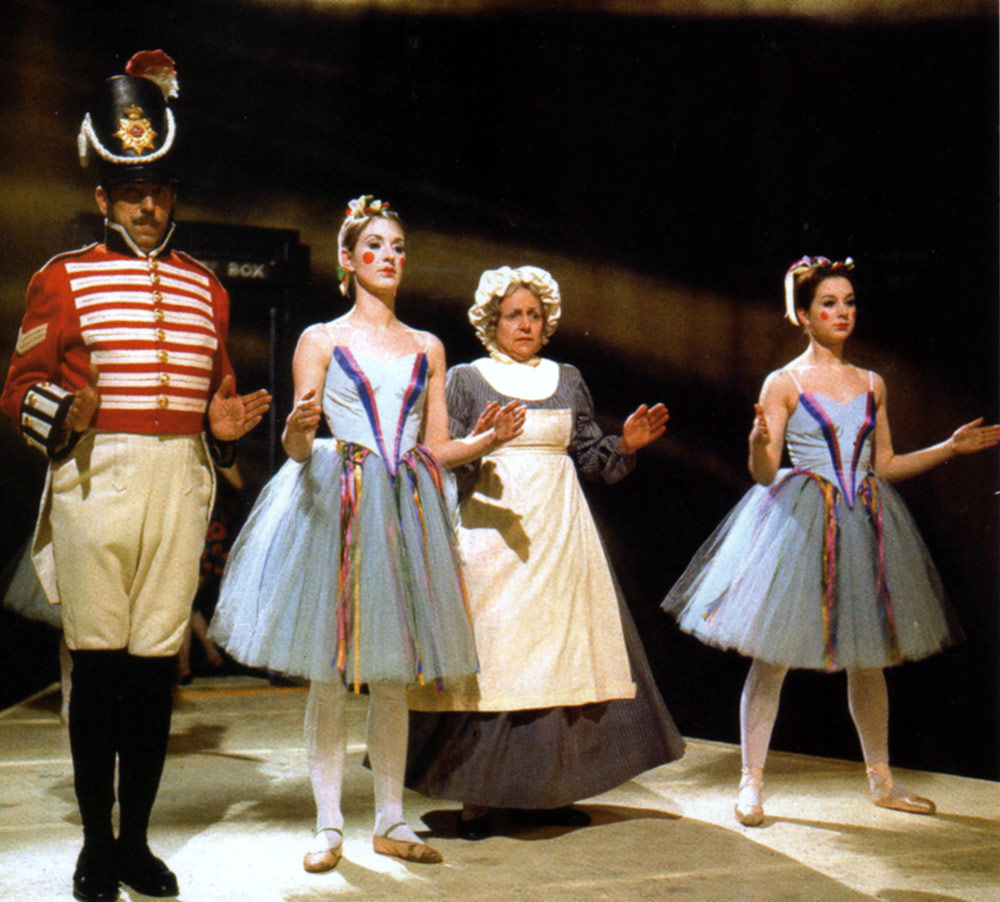
The sergeant, cook and ballerinas

The sergeant, cook and ballerinas

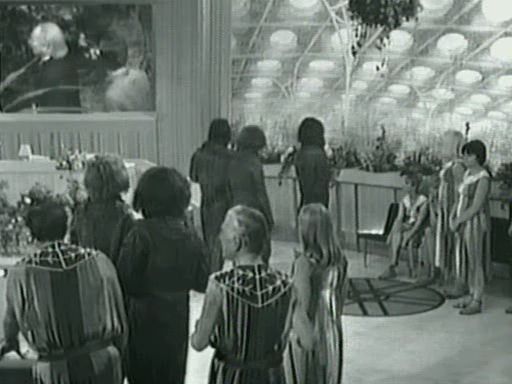
Meanwhile the Doctor’s companions, Steven and Dodo, are engaged in a surreal world of children’s games with clowns, playing cards, ballerinas, a cook, a sergeant, and a bratty school boy. None of the characters are real, however distancing herself emotionally from them is very difficult for Dodo. At the end of each episode a riddle is flashed onto the screen, the answer to which will guide Steven and Dodo in the successful completion of their tasks.  The Tardis has been taken by the Toymaker and to facilitate its return the companions must not only win the games, but do so prior to the Doctor completing his 1023 move game.

The Toymaker with a robot with a TV in its stomach
The Toymaker with a robot with a TV in its stomach

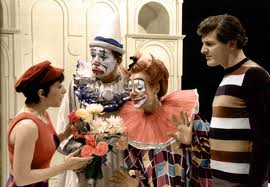
Dodo, Steven and the clowns

Dodo, Steven and the clowns

The particularly belligerent Steven and the childlike Dodo play blind man’s bluff,  musical chairs, avoid the dolls, find the key and a human board game, all with sinister obstacles. Sitting on the wrong chair, for example, may result in you being frozen solid or melted.  To fall from a space in the board game sees you electrocuted, and being caught by a ballerina results in you perpetually dancing.  Needless to say, our heroes are victorious . The Doctor beats the Toymaker by bluff and cunning and with their Tardis returned, the crew retire to it.  Having pocketed some hard lollies from Cyril, the superbly played “adult” school boy, Dodo shares them around.  Given that Cyril is not real, I was somewhat bemused to note that his sweet treats are.  Despite his “death” by electrocution, Cyril has the last laugh.  The Doctor breaks a tooth on the lolly, and so the scene is set for the next episode’s western shenanigans. If you’re up for a comedy musical with an extraordinarily repetitive sung narration, then join me when I next review The Gunfighters.
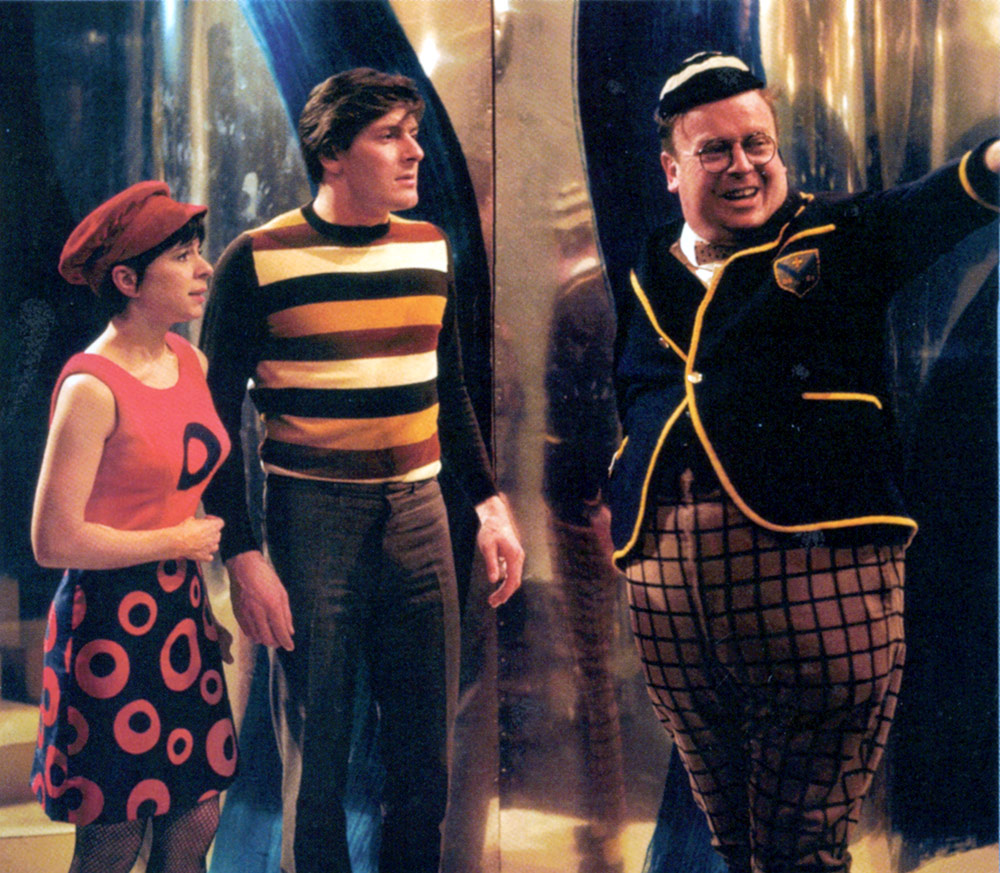
Dodo, Steven and Cyril the nasty "schoolboy"

Dodo, Steven and Cyril the nasty “schoolboy”
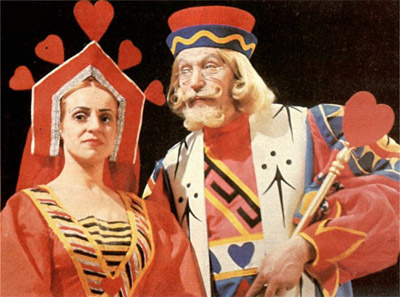
The King and Queen of Hearts

The King and Queen of Hearts

Episode 4 of The Celestial Toymaker is included in the Lost in Time triple DVD set. The Celestial Toymaker was originally broadcast in the UK between 2nd April and 23rd April 1966

Episode 4 of The Celestial Toymaker is included in the Lost in Time triple DVD set. The Celestial Toymaker was originally broadcast in the UK between 2nd April and 23rd April 1966

Vivien Fleming

©Vivien Fleming, 2013.

Reference

Tat Wood & Lawrence Miles, About Time. The Unauthorized Guide to Doctor Who. 1963-1966 Seasons 1 to 3. Mad Norweigan Press, Illinois, 2009.
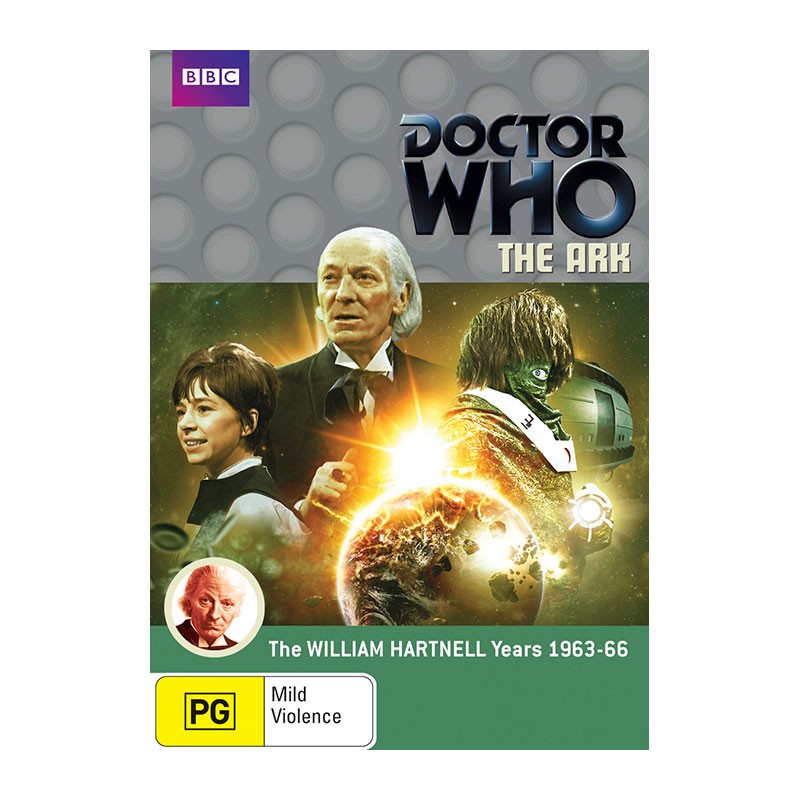
The Ark

Standard

Image

I let out an audible “Hooray” as I checked Mark Campbell’s Doctor Who: The Complete Series Guide and discovered that the next serial, The Ark,  was 100% complete.  For the first time since The Time Meddler, which was the last serial in Season 2, I could sit back and relax after I’d put the shiny DVD into the Blu Ray player. After two seasons with all but two serials alive, kicking and released on DVD, it came as somewhat of a drag to be confronted by an almost continuous stream of missing episodes and reconstructions.  The BBC did a superb job in reconstructing the three missing episodes of Galaxy 4  in condensed form which appeared, together with the recently found episode three, on The Aztecs Special EditionMission to the Unknown, The Myth Makers, the epic 12 part The Daleks Master Plan, and The Massacre were all viewed on YouTube using Loose Cannon’s splendid reconstructions.  Only three episodes in that 21 week run from Mission to the Unknown  to The Massacre are no longer lost and available for our viewing pleasure on Lost in Time, the triple DVD set of orphan First and Second Doctor episodes.

Mark Campbell's Doctor Who The Complete Series Guide provides a good introductory summary of each Doctor Who serial

Mark Campbell’s Doctor Who The Complete Series Guide provides a good introductory summary of each Doctor Who serial

It would be fair to say that The Ark doesn’t have the best reputation. Frequently dismissed as not a great  deal better than utter nonsense, it is nonetheless praised by some, such as Rob Shearman and Toby Hadoke, for its originality and brilliant direction by Michael Imison. It’s generally the second half of this four part story which attracts the greatest criticism and it has been posited  by Ian K McLachlan that the serial is actually “two two-part adventures stitched together.”

Monoids and Guardians together in the control room of the Ark

Monoids and Guardians together in the control room of the Ark

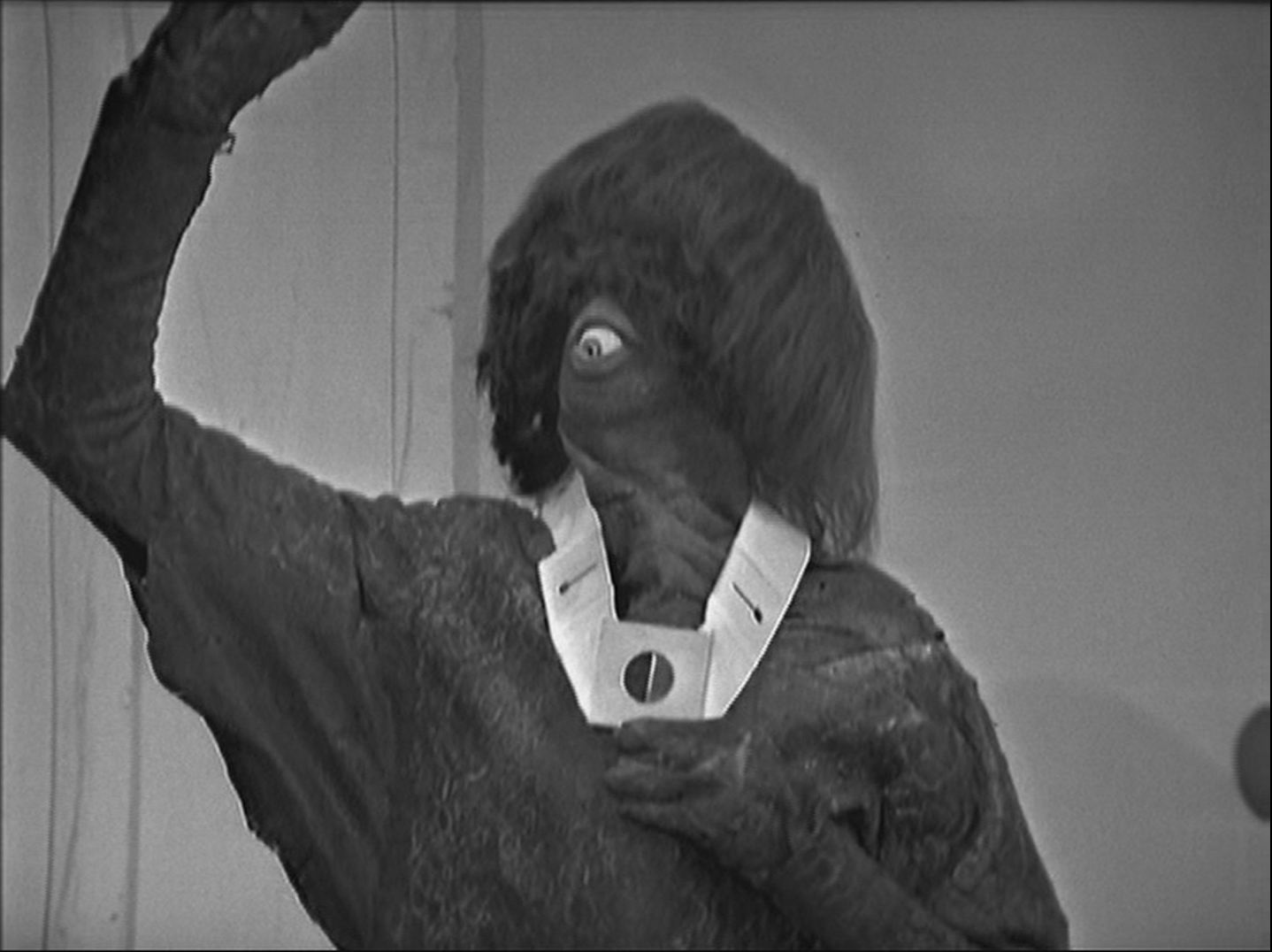
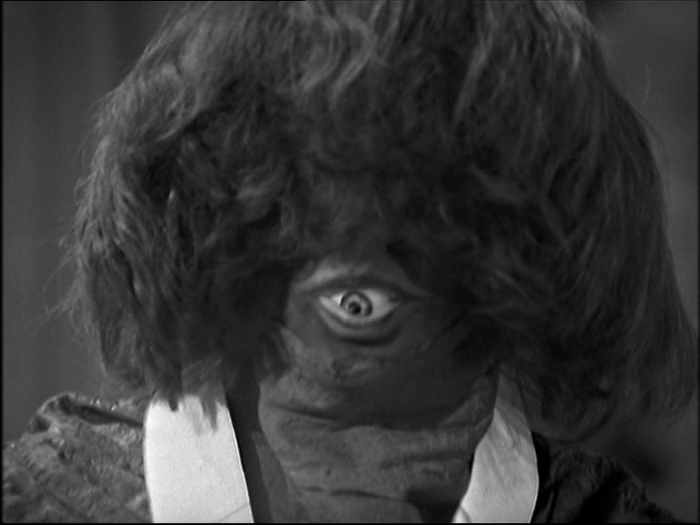
Episodes one and two of The Ark are set in the far future, the 57th segment of Time, on an enormous space ship (the Ark) headed for the planet Refusis 2.  The Doctor estimates that they may be up to 10 million years in the future. As was the case with all of the First Doctor’s adventures, the Doctor was unable to programme the Ship’s route and it landed slap bang in the middle of the Ark. On board the Ark are the sole survivors of Earth who have left the dying planet for the safe refuge of a new planet.  Refusis 2 is 700 years travel from Earth and yet the closest planet with similar atmosphere and vegetation.  To ensure the human race’s survival millions of humans have been miniaturized and stored on trays for reanimation upon arrival at Refusis 2. The humans are  not Christian, Jewish or Muslim as they do not know the story of Noah’s Ark.  Also travelling on the spaceship are an assortment of animals and the Monoids, a peculiar mute race whose most  distinctive feature is their one eye.  This single eye is in their mouths, or at least what would’ve been their mouths if they had human anatomy. These eyes are actually painted ping pong balls which the actors held in place with their mouths.  Now that’s ingenious small budget special effects for you!  On the top of their heads is a long Beatles style mop top wig, whilst the rest of their bodies are clothed in green ill fitting garb. They have webbed hands and feet and move slowly.

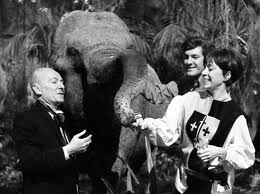
The Ark is so large that it even has a jungle full of a vast array of animals, including this elephant

The Ark is so large that it even has a jungle full of a vast array of animals, including this elephant

The Monoids are the servants of the human occupants of the spaceship.  The humans are referred to as the Guardians, so named for their responsibility maintaining the human race. Not surprisingly for the 1960s, all of the Guardians are white and hardly representative of the earth’s racial diversity.  One can only assume that there are non Caucasians miniaturized and stored for later reanimation.  In the eyes of Doctor Who they clearly can’t be trusted to staff a space craft. The Guardians are of the belief that they treat the servant Monoids with respect, however their inferior status is profoundly obvious when the common cold, introduced by the new companion, Dodo, begins to decimate the population. The common cold had been eradicated in the 20th Century and as such none of the occupants of the spaceship have an immunity to it. Such diseases are said to have been one of the contributing factors to the decimation of indigenous societies upon the arrival of Europeans.  Even Steven, who comes for several hundred years later than Dodo, has no immunity. Notwithstanding the earlier death of a Monoid, it isn’t until the first death of a Guardian that the humans take action against the perpetrators of this crime against them, the Doctor, Steven and Dodo.  It is only with the Doctor’s assistance that a cure for the common cold is found and both the humans and the Monoids saved from extinction.  The Doctor and his crew are quickly forgiven for the destruction that the cold virus had wrought.

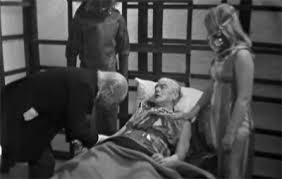
The Doctor tends to the ill Commander.  Beside him is the commanders daughter and a Mark 1  Monoid sans voice box

The Doctor tends to the ill Commander. Beside the Commander is his daughter and behind the Doctor is a Mark 1 Monoid sans voice box

A very obliging Mark 1 Monoid assists the Doctor as he attempts to find a cure for the common cold

A very obliging Mark 1 Monoid assists the Doctor as he attempts to find a cure for the common cold

Having effectively overcome the damage they had caused, the Doctor, Steven and Dodo depart the spaceship, which is now known affectionately as the Ark, at the end of episode two.  It is with surprise, therefore, that upon the Tardis materializing it is immediately evident that the Ship has landed in the very same spot it had left from. Making their way back to the control room of the Ark, the Tardis Crew are unable to find any of the Guardians. It is only upon seeing the enormous statue that the Guardians had been building that they realized that something was very wrong.  During their first visit to the Ark, our heroes had been advised that the massive statue would take 700 years to construct.  The statue which the Doctor and his companions were now staring at was not only complete, but had a head of a Monoid, rather than a human’s. At least 700 years have passed and the Ark must now be nearing its destination.

The statue, which took 700 years to carve, has been completed with a Monoid head

The statue, which took 700 years to carve, has been completed with a Monoid head

All is soon revealed. The Monoids can now talk.  Not having a voice box (presumably because they have an eye in their mouths) an artificial one was invented by the Guardians during their time as overlords.  The voice box looks not unlike a badly made paper necklace. The Monoids are now in control and their usurping of the Guardians was not, as one might expect, the consequence years of oppression but rather because of a mutation of the common cold which in same way had effected the will of the humans.  The Doctor and his companions, therefore, have more to answer for than originally thought.

A Monoid complete with voice box

A Monoid complete with voice box

The tables have been reversed and the humans are now enslaved by the Monoids.  Most have been killed, although a small number have been spared and are imprisoned in the “Security Kitchen.” That has to take the cake for the most imaginative portrayal of  a prison. In the Security Kitchen the humans cook for the Monoids, although preparation is now more efficient.  There’s no need for real potatoes as a tablet dropped into water immediately produces beautifully peeled ones.  The special effect is very well realized and made me wish for my own bottle of food producing tablets!  Any humans that are out of line are executed, without trial, by the Monoids’ heat guns.   The Monoids use of martial law evidences the deterioration of order in the society and their “payback” for the years of enslavement to the Guardians.  The manner in which they treat the humans is far harsher than the Guardian’s treatment of them previously.

The Guardians, with their appalling dress sense, are now slaves of the Monoids

The Guardians, with their appalling dress sense, are now slaves of the Monoids

So aggrieved are the Monoids at their past treatment that they intend to relocate to Refusis 2 without the humans, and to blow the humans and the Ark up with a bomb which has been hidden in the head of the statue.  In cute looking shuttles the Monoids and a few human slaves leave the Ark to scout out the previously unseen Refusis 2. Unknown to all, the planet is inhabited by benevolent (at least to humans) but invisible creatures.  Needless to say, the arrogance and aggressiveness of the Monoids soon sees them almost embark on a Civil War, with Steven contemplating that they might soon wipe themselves out.  From being rather quaint non-threatening creatures in episodes one and two, the Monoids have become the typical malicious monsters.  Perhaps because speech is such a new phenomena to them, the Monoids have the most annoying trait of explaining their devious plans out loud. Intelligent creatures they certainly aren’t.

The Monoids have placed a bomb in the head of the statue

The Monoids have placed a bomb in the head of the statue

Having won the confidence of a native Refusian, the Doctor has the invisible creature pilot one of the space shuttles back to the Ark.  It is there that the Refusian’s incredible strength comes in handy as he lifts the statue from the ground and throws it out of the escape chute.  It explodes in space shortly thereafter.  The humans have been saved from destruction, but how will they deal with  the murderous Monoids on Refusis 2?  The Refusian and the Doctor both offer the humans some advice.

Steven and Venussa.  The Doctor has advice to offer the Guardians

Steven and Venussa. The Doctor has advice to offer the Guardians

REFUSIAN: We’ll do everything we can to assist you in settling on our planet.

DASSUK: Thank you.

REFUSIAN: But one thing you must do.

VENUSSA: What’s that?

REFUSIAN: Make peace with the Monoids.

DOCTOR: He’s right.  A long time ago, your ancestors accepted responsibility for the welfare of these Monoids.  They were treated like slaves.  So no wonder when they got the chance the repaid you in kind.

REFUSIAN: Unless you learn to live together, there is no future for you on Refusis.

DASSUCK: We understand.

DOCTOR: Yes, you must travel with understanding as well as hope.  You know, I once said that to one of your ancestors, a long time ago.  However, we must be going.  Goodbye.

After facilitating peace our heroes depart

After facilitating peace our heroes depart.  Dodo, the Doctor and Steven.

And so ends The Ark.  The above was a succinct summary of the story’s moral however it was all rather unsophisticated and infantile.  We have no idea if the Monoids would accept the need to co-operate with their former overlords.  Given their actions in episodes three and four it’s just as likely that would maintain the rage and continue their devious plots for vengeance. One can only hope that the human’s enhanced understanding of stewardship will facilitate a reciprocal abatement of hostilities by the Monoids.

The Ark was originally broadcast in the UK between 5 March and 26 March 1966

The Ark was originally broadcast in the UK between 5 March and 26 March 1966

Vivien Fleming

©Vivien Fleming, 2013.

REFERENCES:

Mark Campbell, Doctor Who: The Complete Series Guide (Robinson, London: 2011).

Robert Shearman and Toby Hadoke, Running Through Corridors.  Rob and Toby’s Marathon Watch of Doctor Who (Mad Norwegian Press, Des Moines, Iowa: 2011),

The Massacre – Loose Cannon Reconstructions

Standard

Image

All four episodes of The Massacre were junked by the BBC and to date no copies have been returned to the BBC Archives. For the purposes of this marathon I viewed the Loose Cannon reconstructions, links to which are provided below for your viewing pleasure. Please note that none of the cliff-hangers were reprised in the following episodes so don’t worry, you haven’t chosen the wrong link!

The Massacre was originally broadcast in the UK between 5th February and 26th February 1966.

Loose Cannon’s The Massacre, episode 1 part 1

Loose Cannon’s The Massacre, episode 1 part 2

Loose Cannon’s The Massacre, episode 2 part 1

Loose Cannon’s The Massacre, episode 2 part 2

Loose Cannon’s The Massacre, episode 3 part 1

Loose Cannon’s The Massacre, episode 3 part 2

Loose Cannon’s The Massacre, episode 4 part 1

Loose Cannon’s The Massacre, episode 4 part 2

The Massacre

Standard

Image

After The Daleks’ Master Plan’s three months of chilling brutality, unforeseen companion deaths and occasional comic interludes, one might be excused for pining for a return of the triumphant Doctor of old. The Massacre, save for the last few minutes, was no such restoration. Again the Doctor was unable to liberate those around him and for his inaction he was rigorously reprimanded by his sole remaining companion, Steven. So mortified was Steven at the Doctor’s refusal to save the young Huguenot servant girl, Anne Chaplet, that he demanded to be let off at the next stop.  Threats to put people off the Ship had always been the Doctor’s prerogative, however Steven was the first companion to turn the tables on the Doctor.  It was lucky for Steven, as he stormed out of the Tardis, that the atmosphere was clean and the Ship had by sheer coincidence just landed at Wimbledon Common in the present day.

Anne Chaplet - the Huguenot servant girl that the Doctor refused to save

Anne Chaplet – the Huguenot servant girl that the Doctor refused to save

In the wake of Steven’s departure through the doors of the Tardis the Doctor uttered perhaps his best, and most heart wrenching, soliloquy.  It’s worth quoting verbatim.

“Even after all this time he cannot understand.  I dare not change the course of history.  Well, at least I taught him to take some precautions.  He did remember to look at the scanner before he opened the doors.  Now they’re all gone.  All gone.  None of them could understand.  Not even my little Susan, or Vicki.  And as for Barbara and Chatterton. Chesterton.  They were all too impatient to get back to their own time.  And now, Steven.  Perhaps I should go back home, back to my own planet.  But I can’t.  I can’t”.

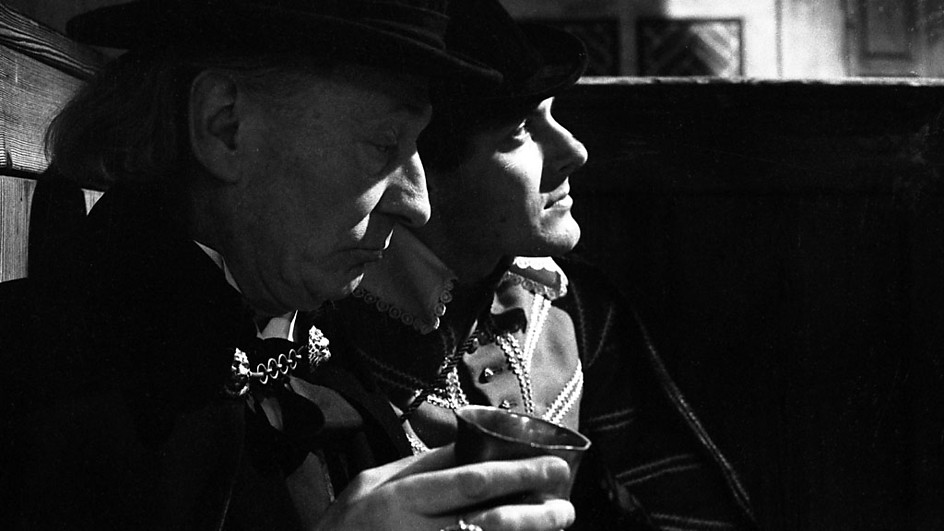
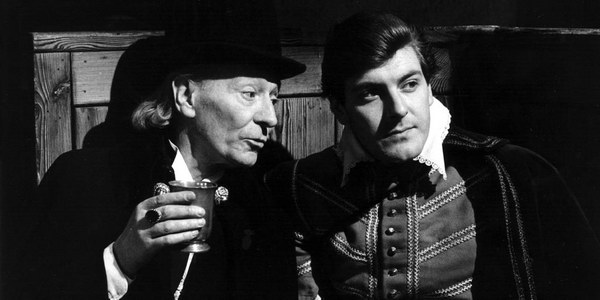
The Doctor and Steven enjoy a quiet ale at the pub

The Doctor and Steven enjoy a quiet ale at the pub

The course of history that the Doctor was unable to change on this occasion was the slaughter of thousands of French Protestants, known collectively as Huguenots, as a result of Roman Catholic mob violence.  Beginning on 23 August 1572, Massacre de la Saint-Barthélemy (the St. Bartholomew’s Day Massacre) came two days after the attempted assassination of the Huguenot leader, Admiral Gaspard de Coligny, and four days after the marriage of Protestant Henry III, King of Navarre, to Margaret, sister of King Henry III of France (Yes, I know all these Henry III’s are confusing!). King Henry of Navarre was to become King Henry IV of France in 1589.  Catherine de’ Medici, the mother of King Henry III of France, is commonly believed to have been the instigator of the violence which her son, the King, authorized by ordering the assassination of de Coligny and other Huguenot leaders.

A painting by Francois Dobois depicting the St. Bartholomew's Day Massacre.  Paintings such as these were used to represent the Massacre in the Doctor Who serial

A painting by Francois Dobois depicting the St. Bartholomew’s Day Massacre. Paintings such as these were used to represent the Massacre in the Doctor Who serial

The four part Doctor Who serial, The Massacre, takes place over the four days preceding the St. Bartholomew’s Day Massacre. Each episode of the serial is of one day’s duration – from morning to evening curfew.  Quite extraordinarily for Who, each episode’s cliff-hanger is not reprised at the start of the following episode.  I wish I’d known that before I’d made multiple aborted starts to the  Loose Cannon reconstructions thinking that the episodes were incorrectly labelled!

The Queen Mother, Italian noblewoman Catherine de' Medici

The Queen Mother, Italian noblewoman Catherine de’ Medici

Paul Cornell, Martin Day and Keith Topping in their seminal book The Discontinuity Guide describe The Massacre as “not only the best historical, but the best Hartnell, and, in its serious handling of dramatic material in a truly dramatic style, arguably the best Doctor Who story ever”.  That’s high praise indeed for a serial that is completely lost from the BBC Archives. It’s perhaps the tension that comes from the obscure nature of the historical events to English speaking audiences that makes this serial all that more compelling. Not only were the 1960’s TV audiences ignorant of the religious-political wars of 16th Century France, but so were our heroes in the serial.  The angst that Steven experienced because of the Doctor’s refusal  to take Anne with them was exacerbated when he learned the true nature of the unfolding events which he’d witnessed. Although Steven had inadvertently found himself amongst  Huguenots in Paris he was blindly unaware of the fate that would soon befall them.  In past historical dramas, such as The Romans, the Doctor and his companions knew enough about basic history to be cognisant of the fact that Rome would soon burn.  In The Reign of Terror, Susan stated that the French Revolution was the Doctor’s favourite period of Earth History. Barbara was a history teacher and knew the period well.  In The Massacre, however, the Protestant Steven knows absolutely nothing about the events and the Doctor, although literate in that era of French history, most extraordinarily failed to ascertain the exact date until sometime during episode four.  He was absent from the serial for all of episodes two and three, during which time Steven was the leading character.

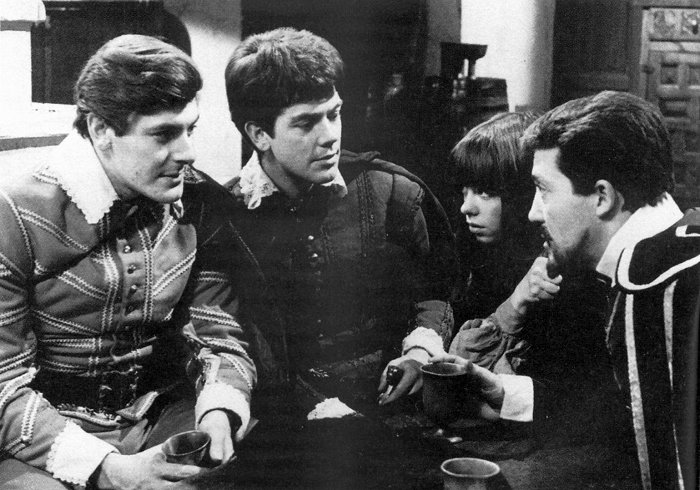
Steven, Anne and Huguenots

Steven, Anne and Huguenots

The story’s tension was heightened by the ingenious mystery of the Doctor’s disappearance and the Abbot of Amboise being an exact double of him. William Hartnell played both the Doctor and the Abbot of Amboise and never were the two characters seen on the screen together.  The Abbot is not introduced until after the Doctor has gone missing, and the Doctor does not return until after the Abbot’s death.  In the meantime, Steven is convinced that the Doctor is playing a game and masquerading as the Abbot, however he cannot reason why the Doctor would do so.  When the Abbot’s body is found in the street, the victim of a political assassination, Steven believes that the Doctor is indeed dead.  Given the recent deaths of companions, and the Doctor’s repeated failures, the audience would be sure to have believed the same thing.

William Hartnell as the Abbot of Amboise

William Hartnell as the Abbot of Amboise

Steven with the body of the Abbot of Amboise

Steven with the body of the Abbot of Amboise

The Massacre is definitely a cracking good story which continued the story arc begun with Mission to the Unknown.  The last ten minutes of the serial, however, abruptly changed tack and signalled a reversion to the Doctor Who of old.  No sooner has Steven departed the Tardis in justifiable anger at the Doctor’s apparent disregard for human life, than a young woman runs into the Tardis.  Dorothea Chaplet, known to her friends as Dodo, has mistaken the Ship for a genuine Police Box. Unlike all others before and after her, Dodo expresses not the slightest surprise at entering a spaceship which is larger on the inside. She’s only interested in where the telephone is so she can call for Police assistance. A little boy has been injured, she tells the Doctor.  The Doctor’s attempts to rid himself of the intruder are thwarted by the sudden return of Steven.  He had seen two Policemen walking over the common towards the Ship. Fearful that they’ll “want to use the telephone or something like that” the doors to the Tardis close and the Ship dematerializes. Unlike the last passengers that the Doctor abducted,  Barbara and Ian, Dodo shows not the slightest concern for her fate.  When Steven advises her that “this is no joyride you know.  You may never get home” she responds by stating that she doesn’t care.   She has no parents and lives with a great aunt who wouldn’t care if she never saw Dodo again. The lass with the Northern accent is a most peculiar young woman.  The Doctor thinks that Dodo looks quite like his grand-daughter Susan, whilst Steven is amazed that she shares the same surname as the girl Anne who was left behind in Paris.  As Dodo’s grand-father was French Steven ponders whether she may indeed be one of Anne’s descendants. “Very possible”, the Doctor responds as he welcomes Dodo aboard.

At last a companion who isn't surprised that the Tardis is bigger on the inside.  Dodo joins the Tardis Crew.

At last a companion who isn’t surprised that the Tardis is bigger on the inside. Dodo joins the Tardis Crew.

Vivien Fleming

©Vivien Fleming, 2013.

Reference:

Paul Cornell, Martin Day & Keith Topping, The Discontinuity Guide. Doctor Who Books, London, 1995.