Episodes one and four of The Underwater Menace are missing from the BBC Archives. Episode three has been released on the Lost in Time DVD, whilst episode two remains unreleased. For the purposes of this marathon I watched episodes one, two and four using Loose Cannon’s reconstructions, and episode three on the Lost in Time DVD. Episode two part two of Loose Cannon’s reconstructions is presently unavailable on YouTube. In lieu I watched an animated version uploaded by doctorwhoanimator.
Loose Cannon’s The Underwater Menace, Episode 1 Part 1
Loose Cannon’s The Underwater Menace, Episode 1 Part 2
Loose Cannon’s The Underwater Menace, Episode 2 Part 1
Doctorwhoanimator’s The Underwater Menace, Episode 2 Part 2
Loose Cannon’s The Underwater Menace, Episode 4 Part 1
Loose Cannon’s The Underwater Menace, Episode 4 Part 1
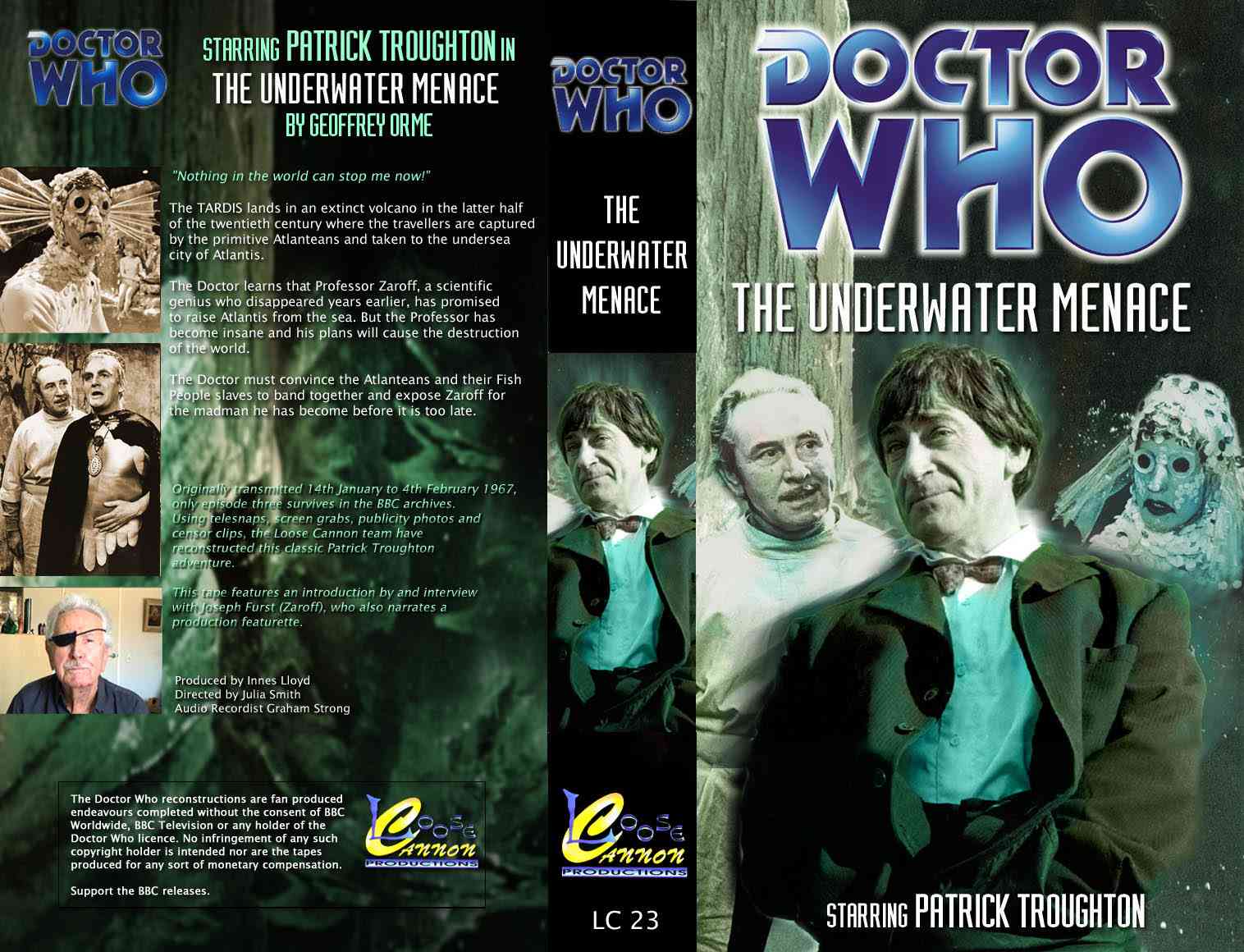
The Underwater Menacewas originally broadcast in the UK between 14 January and 4 February 1967. Episode 3 is available on the triple DVD set Lost in Time
In the 2009 Doctor Who Magazine Mighty 200 Poll of Doctor Who stories, The Underwater Menace was voted the seventh least popular. Coming in at an appalling 194, it was one story above another long derided Patrick Troughton serial, The Space Pirates. Throw in The Dominators at 191,and the Second Doctor has three of the ten least popular serials. That even beats Colin Baker’s Sixth Doctor and Sylvester McCoy’s Seventh Doctor, each of whom had two serials each in the bottom 10.
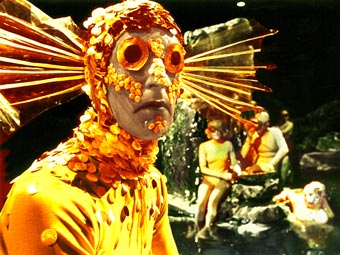
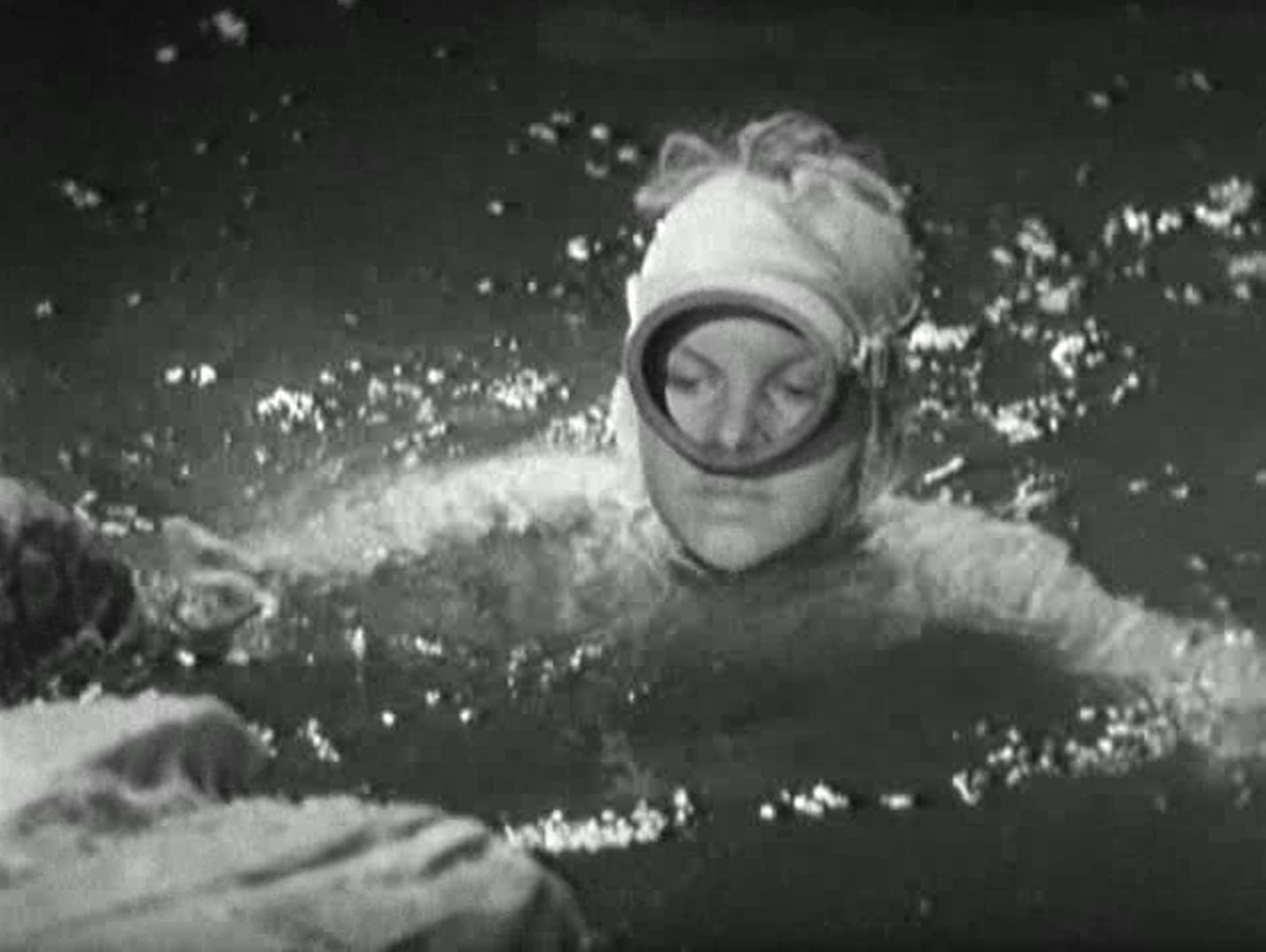
Two Fish People resplendent in their sequin costumes
So why is The Underwater Menace so lowly regarded? That until late 2011 only one of its four episodes were held in the BBC Archives may provide part of the answer. In fact, nearly two years after episode two’s return, it has yet to be released on DVD. Episode three was first released to the public on VHS cassette in 1998 and subsequently reissued on the 2004 DVD Lost in Time.
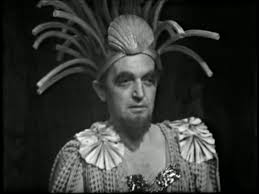
Damon in his funny head gear
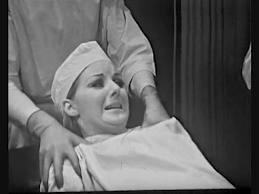
Without the context of the previous two episodes, episode three of The Underwater Menace must look extraordinarily bizarre to the casual viewer. The classic disparaging comments dished out to Doctor Who, including bad graphics, wobbly sets and atrocious acting might, to the uninitiated, appear spot on. The Fish People, who are enslaved by the Atlanteans, are surgically modified humans. Having gills, flippers and scales, which are none other than sequins stuck to their faces, the Fish People farm the plankton that they, and the Atlanteans, are reliant upon for food. Being apparently bereft of refrigeration, this food source lasts only several hours before deterioration, thereby requiring the slave labour force to work around the clock to provide a constant fresh supply of stock. Polly narrowly escapes being operated upon to become a Fish Person in the episode one cliff hanger, which thanks for the ever vigilant Australian Censorship Board, we still have for our viewing pleasure.
Polly narrowly escaped being turned into a Fish Person
Polly and Damon. Polly’s Atlantean gear is just fab
Almost universally condemned for their costuming, I personally think the Fish People look fabulous, in a trippy, 1960s sort of way. The Fish People swim around gracefully in an extended performance of synchronized swimming during episode three. I’m not entirely certain what the sequence’s purpose is however it looks completely wild. I can even excuse the trapeze wires that hold up the swimming Fish People up as they elegantly swoon around. Spotting the wires holding up space ships has always been one of my favourite parts of watching Doctor Who (there are some great strings to be spotted in The Dalek Invasion of Earth). This is just a logical extension of that peculiar interest! That the Fish People decide to go on strike after having their humanity questioned by some enslaved miners is a bit farfetched, but hey, the reverse logic worked.
A rare colour photo of the Fish People
Not all Fish People wore sequins. Given that The Underwater Menace went so over budget, the BBC mustn’t have been able to afford more sequins for this poor Fish Person
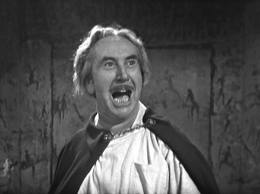
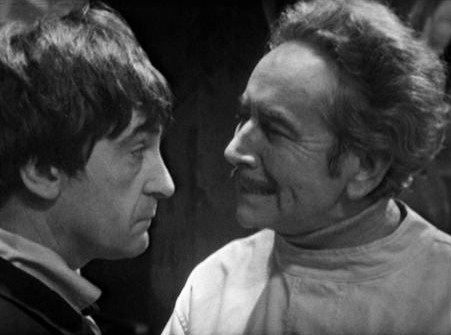
Joseph Furst’s acting as the insane Polish Professor Zaroff is frequently the source of criticism. Episode three ends with his classic manic cry of “Nothing in ze world can stop me now!” That Zaroff is a parody of the mad scientist, and clearly meant to be played in a hammy, over the top fashion, appears lost on most critics. Where’s everyone’s sense of humour gone? Zaroff’s plan to drain the oceans into the Earth’s molten core, thereby causing the planet’s explosion from overheated steam, is also dismissed as ludicrous. Sure, he only wants to destroy the Earth because he can, and will also die in the resultant explosion, but that’s what mad scientists do. They wouldn’t be mad scientists if their plans were rational. As Philip Sandifer states in Tardis Eruditorum, Zaroff’s scheme is no crazier an idea than the Daleks’ plan in The Dalek Invasion of Earth to drill the core out of the centre of the Earth and use the planet as a space ship. And that second Dalek serial isn’t dismissed out of hand as some form of corny atrocity.
The mad scientist Professor Zaroff. “Nothing in ze world can stop me now!”
The Doctor and Zaroff
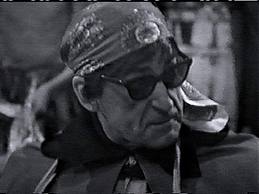
The Underwater Menace sees the Doctor take the lead in saving the Earth without recourse to dressing up continuously, although he does look rather cool when briefly dressed as some sort of tambourine playing hippy with sunglasses and bandanna. We are even afforded the opportunity to see a snippet of the Doctor’s good conscience when he decides that he just can’t let Zaroff drown at the end of episode four. A rock fall blocks the path to rescue, although at least the Doctor’s intentions are good. In this story the Doctor begins to display the characteristics that become his staple for the duration of his tenure.
The Doctor is disguised as a tambourine playing hippy
Polly, however, is denied the forthrightness of previous outings, and plays the screaming damsel far too often. Having been buoyed by her characterisation in The Highlanders, Polly’s inability to assertively take control of her own destiny in this serial was more than a little disappointing. She can, however speak “foreign”, as Ben refers to it, and is conversant in German, French and Spanish. Ben displays a good rapport with the Doctor and Jamie appears surprisingly unaffected by being dragged out of the 18th Century Scottish highlands, and into an underwater world of Fish People, temple worship and mad scientists. Ben and Jamie spend much of the time running around in black wetsuits. The synthetic rubber of the wetsuit must have been an unusual sensation against Jamie’s highland skin, but remarkably he is not seen to make a comment about it.
Jamie and Ben spend much of their time in black wet suits
The Underwater Menace ends with the mad scientist dead and the Atlanteans saved from Zaroff’s dastardly plan, although the city of Atlantis is flooded. No more Fish People will be made, and presumably they are freed from servitude. Religion, however, will be no more. Damon believes that priests, superstition and temples made the Atlanteans follow Zaroff’s crazy plans and the temple should be buried forever. Quite how this conclusion is reached is never stated and is certainly a very superficial solution to the Atlanteans’ problems. All told, however, The Underwater Menace is a fun romp and nowhere near as bad as its reputation. Watch it with an eye for the ridiculous and you won’t be disappointed.
The Underwater Menace was originally broadcast in the UK between 14 January and 4 February 1967. Episode 3 is available on the triple DVD set Lost in Time
Viewers who tuned into BBC One between 17th December 1966 and 7th January 1967 to watch Doctor Who must have really been left wondering exactly who or what the good Doctor had become. In the Power of the Daleks they saw a man with a completely different face who did his best to confound and confuse his companions by speaking in the third person. In The Highlandersthe Doctor appeared more interested in acting the clown, playing fancy dress and putting on fake accents. First he was a German physician named Doctor Von Wer, then dressed in drag as a Scottish washer woman, and finally he was a Cockney Redcoat soldier. Patrick Troughton was everything that William Hartnell wasn’t. What he didn’t appear to be playing was the Doctor.
One of the Doctor’s many disguises in The Highlanders was as a Scots washer woman
Whilst Patrick Troughton was being anything but the Doctor, Anneke Wills (Polly) and Michael Craze (Ben) were really allowed to shine. The character of Polly as been really growing on me, and I was not disappointed by her outing in The Highlanders. When the party disembark from the Tardis and discover a hot, old fashioned cannon ball, the Doctor is the first to want to leave. The Doctor who was always guaranteed to want to explore, and lead himself and his companions into trouble, was seemingly gone. Polly was dumbfounded and told him that they couldn’t leave as they looked like they were in England. When Polly added, “Doctor, you don’t want us to think you’re afraid, do you?” the Doctor’s quick retort was, “Why not?”
The companions, Polly and Ben, take prominent roles in The Highlanders
The Doctor and Ben are lucky not to be hanged
After meeting up with an injured Laird and his clansmen, Polly is dispatched with the Laird’s daughter, Kirsty, to fetch clean water to bathe the wound. Whilst the women are out Ben clumsily triggers off a gun and attracts the attention of the English redcoats, who are scouring the highlands for rebels following the Battle of Culloden (1746). Forced on the run after the men are captured, Polly has little time for the tears of her lassie companion. She calls Kirsty a peasant, berates her for always crying and storms off in a huff, only to then find herself trapped in an animal pit. Kirsty finds Polly however she promptly falls into the pit herself. Incredibly, the swinging 60’s girl is more resourceful than her 18th Century highland counterpart and is able to devise an escape plan.
Polly and Kirsty are forced to flee from the Redcoats
Upon almost being seen by the Redcoat patrol that have been sent to pursue the women, Polly pulls the commanding officer, Lt Algernon Thomas Alfred ffinch, into the pit with them. It’s here that Polly’s resourcefulness comes to the fore. Taking the officer’s ID, she playfully taunts the upper class Lieutenant with the affected surname. ffinch is spelt with two f’s and no capital so Polly promptly calls him f-finch. Well that’s when she’s not calling him Algy! Robbing ffinch of the vast sum of 20 guineas, they take a lock of his hair and his identification as bargaining tools should they be apprehended. The women have effectively blackmailed ffinch as they demand his silence for fear that he will be exposed as the victim of an assault and robbery at the hands of two women. Polly and Kirsty leave ffinch tied up in the pit as they continue their journey to Inverness where the Doctor, Ben and the highlanders have been taken as prisoners.
Polly seduces the hapless Lt ffinch
Polly, ffinch and Kirsty
Once in Inverness Polly again exhibits her shrewdness with an ingenuous plan to find the Doctor and Ben. Respectable women in 18th Century Scotland didn’t wander the streets alone, least of all enter taverns. Disguised as orange sellers, however, the women were afforded the opportunity enter the Sea Eagle Inn. Deemed to be orange wenches, or women of ill-repute, their plan quickly came to fruition when they ran into the Doctor, who was dressed in drag. Also in the tavern was the corrupt Solicitor Grey and his comic Clerk, Perkins. Grey was in command of rebel prisoners, although he was making money on the side by selling the robust highlanders into the slave trade.
Polly procures suitable clothing for her masquerade as an “orange wench”
Ben, the Laird and the highlanders had become victims of the trafficking scheme and found themselves in chains upon the ship Annabelle. The Doctor would have been in the same situation had he not ingenuously escaped earlier whilst impersonating the German physician von Wer. Following his escape from the dungeon in which the prisoners were held prior to their transfer to the ship, the Doctor had trussed up Grey and left him in a cupboard and pounded Perkins head into a table. Without fail every commentary I’ve read considers the Doctor’s “trick” with Perkins to be hilariously funny. Perhaps it’s because I’m not a man that I find the gratuitous violence uncalled for and decidedly unfunny. Ben displays his own ingenuity once onboard the Annabelle. Trussed up and dunked from the yardarm, he uses a Houdini trick to be able to free himself from his shackles and swim ashore.
The comic relief, Solicitor Grey’s Clerk named Perkins
All four episodes of The Highlanders are missing from the BBC Archives so not surprisingly a lot is lost in the translation to audio and telesnaps. The battle on board the Annabelle in which the highlanders wrest control of the ship, thanks to the weaponry provided by the Doctor, is hard to visualize. So too are the scenes in Culloden. We miss seeing the last Doctor Who historical adventure until 1982’s Black Orchard, and also Frazer Hines’ debut as Jamie McCrimmon. That being said, Jamie’s role is minor and a proper companion he does not become until the next serial, The Underwater Menace. Join me for my next review as I continue my journey through Doctor Who.
The VHS cover art for Loose Cannon’s The Highlanders reconstructions. The Highlanders was originally broadcast in the UK between 17 December 1966 and 7 January 1967
All six episodes of The Power of the Daleks are missing from the BBC Archives. For the purposes of this marathon I watched Loose Cannon’s reconstructions, links for which appear below.
Loose Cannon’s The Power of the Daleks, Episode 1 Part 1
Loose Cannon’s The Power of the Daleks, Episode 1 Part 2
Loose Cannon’s The Power of the Daleks, Episode 2 Part 1
Loose Cannon’s The Power of the Daleks, Episode 2 Part 2
Loose Cannon’s The Power of the Daleks, Episode 3 Part 1
Loose Cannon’s The Power of the Daleks, Episode 3 Part 2
Loose Cannon’s The Power of the Daleks, Episode 4 Part 1
Loose Cannon’s The Power of the Daleks, Episode 4 Part 2
Loose Cannon’s The Power of the Daleks, Episode 5 Part 1
Loose Cannon’s The Power of the Daleks, Episode 5 Part 2
Loose Cannon’s The Power of the Daleks, Episode 6 Part 1
Loose Cannon’s The Power of the Daleks, Episode 6 Part 2
“The Doctor was a great collector, wasn’t he”, the strange little man with the ill-fitting, improvised clothes said as he rummaged through the large chest. “But you’re the Doctor” exclaimed a confused Polly. “Oh, I don’t look like him” quipped the man.
So began the journey of the Second Doctor, Patrick Troughton, as he recovered from his “renewal” as though he’d been on an LSD trip. In fact, the reference to LSD comes directly from the production notes. This was 1966, of course. When Ben had told the “old Doctor” that the ordeal in the Cyberman ship was “all over” (The Tenth Planet) the Doctor had replied by saying “What did you say, my boy? It’s all over. It’s all over. That’s what you said. No, but it isn’t all over. It’s far from being all over”. The “new” Doctor had strangely chuckled “It’s over. It’s over” as he scrambled to his feet upon regenerating. Whilst the Doctor’s “renewal” may have been over, his journey to be understood by his companions was only beginning.
Upon renewal the Doctor is in a confused state, as if he’d been tripping on LSD
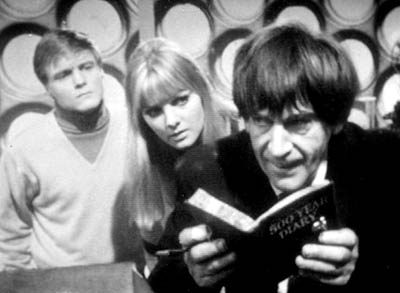
Quietly hostile and prone to referring to himself in the third person, the Doctor evaded answering uncomfortable questions by playing a recorder retrieved from the chest. The sceptic Ben was infuriated by the Doctor’s behaviour and didn’t believe the man before him to be the same person as the “old Doctor”. Polly, however, was more willing to believe and recalled the old Doctor’s comment to the effect that perhaps his old body was wearing a bit thin. No one had exited or entered the Tardis so surely this stranger must be the Doctor. It would take a Dalek to recognize the Doctor by sight, towards the end of episode two, for Ben to finally believe that the “new” Doctor was one of the same as the “old Doctor”.
Ben, Polly and the new Doctor with his 500 Year Diary
The Dalek’s recognition of the Doctor, and the Doctor’s visible fear of his oldest foe, was a superbly climatic scene which undoubtedly influenced Rob Shearman as he wrote Dalek, the pepper pots’ debut in Season 1 of the 2005 series. Watch the short clip from Dalek below and marvel at the Ninth Doctor’s fear when he hears the monotone voice of the Dalek say “Dock Toorrr”. The Doctor’s fear as he runs to the door is just palpable. Were The Power of the Daleks not lost and we could watch the serial in its full glory, then I suspect that the Second Doctor’s fear, as he backs into a chair as the Dalek focuses his eye stalk onto him, would be just as unmistakeable.
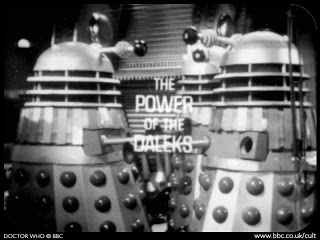
That The Power of the Daleks should be an influence on the writers of new series Whoshould come as no surprise. The serial is critically lauded as perhaps the best Dalek story ever and is undoubtedly held in higher regard as a consequence of its missing status. The soundtrack is smashing and the few fragment clips of the Daleks absolutely superb. You can even excuse the production team for the reasonably obvious cardboard cut-out Daleks used to swell the numbers in crowd scenes. We hear much chanting of “exterminate, annihilate, destroy” and “Daleks conquer and destroy”, whilst also seeing the construction of Daleks for the first time. Whilst proceeding down the conveyer belt their mutant insides are plonked inside and seen by viewers for the first time in their live state. The Dalek mutants seen in episode of 12 of the Daleks’ Master Plan were in a regressed form. What makes the Daleks all the more frightening is that they are initially so compliant and obliging.
The Power of the Daleks – Surviving Dalek clips
The similarity between the Series 5 episode Victory of the Daleks and The Power of the Daleks is remarkable. In both stories the Daleks originally portray themselves as servants of humans. In Power the Dalek chants “I am your servant”, whilst in Victory their incantation is “I am your soldier”. In both stories the Doctor is increasingly frustrated at everyone’s refusal to take his concerns about the Daleks seriously. Wildly cognisant of the Dalek’s evil reputation, similar fear and frustration would be instilled into the viewers as well. As Toby Hadokestated in Running Through Corridors, “… with us, the audience, more aware than most of the characters involved in this adventure just how deadly these creatures are. It’s like watching kids playing with a hand grenade, but being stuck behind soundproofed glass and unable to issue a warning”.
Victory of the Daleks Trailer
Victory of the Daleks’antecedents can be seen in The Power of the Daleks
Many of the humans in The Power of the Daleks are not particularly likeable. A rebel group within the community are planning a rebellion, however their grievances are unclear. Unlike the young double eye-browed rebels in The Space Museum whose oppression one could empathise with, even though they were the most useless revolutionaries ever portrayed on TV, these rebels are bullish and ignorant. Prepared to sacrifice anyone to achieve their ends, they make the Daleks in earlier episodes appear positively gentlemanly. Whereas the humans were unable to fathom the Cybermen’s lack of empathy in The Tenth Planet, it is in The Power of the Daleks that the monsters express the very same disbelief about the humans. A Dalek innocently asks, “Why do human beings kill human beings?”
It’s invariably the ignorance of humans, and the Rebels’ preparedness to co-opt the Daleks to their cause, which is the reason for their downfall. After using the humans to acquire the materials necessary to construct new Daleks, they have no further need for humans and destroy them. The Daleks are at their evil best and it’s a great shame that the visuals have been lost because the telesnaps make the massacre at the end look magnificent. Ultimately, however, the Doctor saves the day by destroying the Daleks. Or does he?
The Daleks are at their frightening best in The Power of the Daleks
What puzzled me was why the Daleks needed to be charged in Power of the Daleks whenever they were not on metal, yet the Daleks seen in The Chase and The Daleks’ Master Plan didn’t. Wood and Miles in About Time 2 posit cheekily that these Daleks must have been exhausted from their 200 years spent at the bottom of the mercury swamp or not fully-charged as they were fresh models straight off the production-line. One wonders how viewers can pick up these continuity discrepancies in the early years of Doctor Who, and yet the writers could not. Perhaps it was because the serial was written by David Whitaker and was the first Dalek serial in which Terry Nation had no input.
Loose Cannon’s VHS cover art for The Power of the Daleks. The Power of the Daleks was originally broadcast in the UK between 5 November and 10 December 1966
Known to most as the first Doctor Whoregeneration and the premiere appearance of the Cybermen, it has been persuasively argued by Phil Sandifer in Tardis Eruditorum that The Tenth Planet represents neither. Rather than signalling the First Doctor’s end, Sandifer states that it is rather the demise of the Doctor, per se. Save for his appearance in The Three Doctors, William Hartnell never played the role of the First Doctor. He was always merely “the Doctor” – the original, and some may say, the best. Killed by the energy draining force of the planet Mondas, the Doctor collapses to the floor in his terrifying end. Not only is it the death of the Doctor, but also the death of Doctor Who. Sandifer explains it thus:
The Tardis Crew are ready to brave the cold. Polly chooses a highly impractical mini skirt
“And this is part of being a Doctor Who fan. You are absolutely guaranteed to see the show die in front of you, and then get replaced with a strange, different show using the same name. Eventually, everything that Doctor Who is comes to a crashing halt and something new happens instead”.
The Doctor dies
The sense of the television series named Doctor Who dying would have been very real to viewers on 29 October 1966. Doctor Whowas William Hartnell and William Hartnell was the Doctor. There was no precedent for the change of the lead character in such a radical fashion. Certainly the actor playing a role in a show, whether it be on television or stage, may have changed, but the character remained roughly similar in respect of personality type and more often than not, physical appearance. The most frequently cited similarity, that of the film version of Ian Fleming’s James Bond, was still being played by the first actor to do so, Sean Connery. It would not be until 1969 that George Lazenby would have his one and only outing as 007. Incidentally, it was that very same year that the American series Bewitched saw the character of Darrin Stephens played by a different actor, also with the unfortunate name of Dick. Dick Sargent replaced Dick York, but as in the case of James Bond, Darrin remained ostensibly the same character.
The face of a stranger replaces the familiar form of The Doctor
Doctor Who was different, however. This wasn’t the case of a quick change of lead actor, with the series continuing unchanged. This was actually the death of the lead. Although the new lead actor played the role of a character bearing the same name, the Doctor, his personality was remarkably different. There was very much a sense of re-birth and complete renewal. This was particularly evident in The Tenth Planet’s setting. This was the first “base under siege” story, a genre which would come to dominate Patrick Troughton’s tenure as the Doctor. A “base under siege” involves circumstances where the Doctor and his companions find themselves caught in a confined space or remote geographic location and are confronted by monsters that threaten everyone’s lives, the “base’s” existence, or both. The Series Seven story Cold War, in which the Doctor and Clara find themselves on a Soviet era submarine confronted by an Ice Warrior, is a classic example of the “base under siege” genre.
The Series 7 episode Cold War is a classic example of a “Base under Siege” story
From its very opening sequence, where a rocket is launched, it is apparent that The Tenth Planet is a very different story. The Doctor and his companions are not seen until more than three and a half minutes after episode one’s commencement. Prior to that an array of international characters, not seen before in Doctor Who, are shown. Staffing the South Pole base are Americans, Italians and British, and manning the space shuttle are an Australian and a West Indian (or a resident of another Caribbean country). There’s a sense of confinement and it’s twenty years in the future – 1986. Once inside the base the Doctor is quick to be able identify a hitherto unknown planet hurtling towards the earth as Mondas, the Earth’s upside down twin. For the first time the Doctor shows that he knows not only the past’s history, but also its future. Five minutes before the episode’s conclusion we catch our first glimpse of a Mark 1 Cyberman and it’s on its harrowing features that the episode ends on a classic cliff hanger.
The Doctor and his companions find themselves in a base under siege
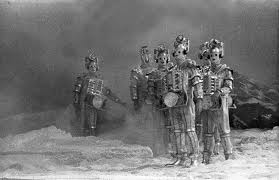
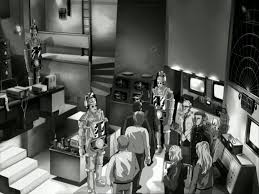
These are not the metal villains that the Cybermen are later portrayed as, but rather a far more frightening creation. A race of humanoids whose body parts have been replaced as they wear out, they still retain the vestiges of a human form. Their hands are human and ungloved, and their faces almost mummified in a cloth stocking. Instead of moving their lips as they speak, their featureless mouths open and their sing-song voices spew forth. There is no hint of the monotone voices of the later Cybermen, nor is there a predilection to shout one word threats such as “delete”. The Cybermen in The Tenth Planet are almost gentlemanly in their manners and until the fourth episode not intent on causing havoc to the Earth. Devoid of all emotions, they are entirely logical and see their transformation to Cybermen as a great advance. They are free from illness, heat and cold and wish the humans to travel to their home planet, Mondas, where “You will become like us”. The Cybermen are concerned only for survival, and a race for survival it is as Mondas careers towards the Earth. Only one planet can survive, but which will it be?
The Tenth Planet – A Cyberman extols the virtues of their form
Created by Kit Pedler, an unofficial scientific adviser to Doctor Who, the Cybermen arose from Pedler’s fear of humans being artificially transformed. A medical scientist by profession, Pedler wrote The Tenth Planet more than a year prior to the first heart transplant in December 1967. As displayed in the clip above, the Cybermen have their hearts removed. When Polly questions whether they have a heart at all, the response is entirely literal. That humans may one day become like the Cybermen was a genuine fear held by Pedler.
The Cybermen are at their frightening best as their humanoid antecedents are still evident
Cybermen through the ages
The selfish concern of American General Cutler for the well being of his astronaut son, Terry, is a particularly frightening aspect of The Tenth Planet. Cutler is prepared to detonate the Z Bomb and destroy Mondas merely to save his son’s life. Terry has been sent on a rescue mission by Geneva for the space shuttle which unbeknownst to the United Nations, has already disintegrated. The deaths of all on Mondas, and the possibility of immense radioactive damage to Earth, is of absolutely no concern to Cutler. The loud and bullying American makes the Cybermen and their quiet extolling of Mondas’ virtues appear almost palatable.
The American, General Cutler
Unfortunately illness caused William Hartnell to be absent for episode three. A stand-in faked his collapse to the floor and for the whole of the episode the Doctor is confined, unconscious, to quarters. Given his death in episode four, the Doctor’s absence in episode three provided a sense of continuity to the serial’s conclusion. Quite shocking and unexpected, the Doctor’s collapse upon his return to the Tardis otherwise bears very little reference to the rest of the story. In retrospect fans have read the events of previous serials into the Doctor’s weakening, although given the nature of Hartnell’s departure it’s just as likely that these “signs” were unintentional.
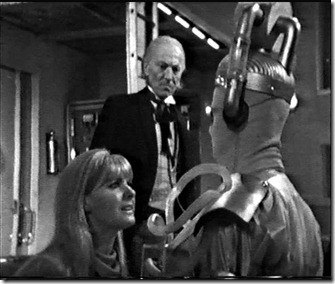
Polly tries unsuccessfully to reason with a Cyberman. The Doctor looks on
You may recall that the Doctor was subjected to the Daleks’ Time Destructor in episode 12 of The Daleks’ Master Plan. Although Sarah Kingdom aged quickly and died, the effects on the Doctor were not so great. He nonetheless suffered the Time Destructor’s effects to some degree, although these were reversed when Steven accidently discovered the means of reversing the Destructor. In The Celestial Toymaker the Doctor was rendered incorporeal by the Toymaker and in The Gunfighters he had a tooth removed by Doc Holliday. Finally in The War Machines an unsuccessful attempt was made to hypnotise him. Did these events precipitate the Doctor’s decline? It’s a question that is unlikely to be answered, although Phil Sandifer, whom we opened with, is adamant that the cause is without doubt the energy draining forces of the planet Mondas. When Polly asked the Doctor at the opening of episode four what had happened to him he responded by saying, “Oh, I’m not sure, my dear. Comes from an outside influence. Unless this old body of mine is wearing a bit thin”. It’s usually only the latter part of this answer that is remembered, rather than the “outside influence”.
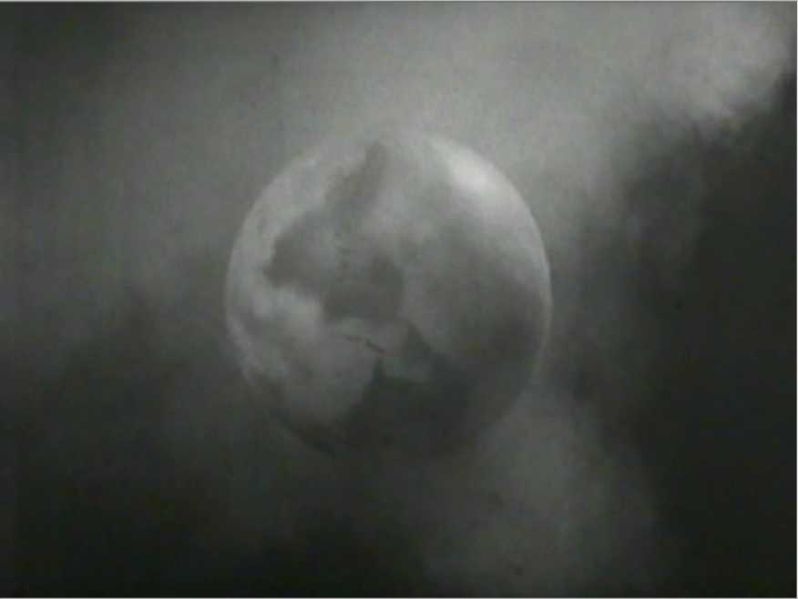
The planet Mondas is the Earth’s twin
I will really miss the irascible old Doctor as Who continues Season four with Patrick Troughton at the helm. Join me for my next review as Doctor Who enters a new era with The Power of the Daleks.
The Doctor collapsed on the floor of the Tardis
The Tenth Planet was originally broadcast in the UK between 8 October and 29 October 1966. The DVD of the three episodes held in the BBC Archives, together with an animation of missing episode four, is to released by the BBC in November 2013
All four episodes of The Smugglersare missing from the BBC Archives. For the purposes of this marathon I viewed Loose Cannon’s reconstructions, links for which appear below.
It’s somewhat bizarre to “watch” a serial in which all four episodes have been lost but miraculously, all the violence is intact as tiny snippets of film. Such is the case with the opening story of Season 4, The Smugglers. Always to the rescue in the event of missing episodes, Loose Cannon’s reconstruction is resplendent with John Cura’s famous telesnaps, authentic photos taken during production and snippets from an amateur film of the production. Most startling, however, are five short clips courtesy of Australia’s Commonwealth Film Censorship Board. Discovered in the National Archives of Australia in October 1996 by Doctor Who fans Damian Shanahan and Ellen Parry, the clips had been excised by the Film Censorship Board and retained as evidence of the edits. At some point they had been transferred to the National Archives, presumably in accordance with government agency retention policies.
Elroy Josephs, who played the pirate Jamaica, was the first black person to have a speaking part in Doctor Who
Always broadcast during children’s television times in Australia, Classic Series Doctor Who was subject to government classification prior to airing. Segments deemed too terrifying or violent for children were routinely cut. It was for this reason that The Daleks’ Master Plan was never broadcast in Australia. Who’s most violent story to that date, the cuts required to The Dalek’s Master Plan were so extensive as to make it incomprehensible to the ordinary viewer. Thanks to Shanahan and Perry’s research, together with the Censorship Board’s hardline policy of the 1960s, a number of clips from otherwise totally lost episodes and stories have now been returned to the BBC’s archives. Perhaps the most iconic of these clips is from 1968 Second Doctor serial, Fury from the Deep. A full 54 seconds of a clip survives in which Quill and Oak suffocate Mrs Harris by breathing deadly gas from their mouths. Stayed tuned for my review of that Season 5 Serial 6 story to see the outstanding film clip.
Once of the most iconic images from the Second Doctor’s lost adventure Fury from the Deep. Almost one minute of this clip survives thanks to the Australian Film Censorship Board
A listing of The Smugglers clips recovered from Australia can be accessed from this page of Loose Cannon’s website – http://www.recons.com/clips/clips-lc30.htm Particularly valuable is Steve Phillips’ “The Doctor Who Clips List”. Here you will find photographs and a short description of all recovered snippets – http://dwclips.steve-p.org/ An interview with Damian Shanahan is included amongst the special features of Lost in Time. Linked below for your viewing pleasure are The Smugglers clips, together with extracts from the amateur video.
The Smugglers – Missing clips and amateur film
The Smugglers was William Hartnell’s last historical story, and the first Doctor Whoserial requiring the cast and crew to embark on a journey to the seaside for location shooting. Filmed at Cornwell, the serial is sure to have looked superb. Without the visuals, however, it’s somewhat difficult to state much at all about the serial. Whilst perfectly enjoyable, The Smugglersis by no means extraordinary. The story of the Doctor and his new companions arriving on a late 17th Century Cornwell beach, and finding themselves immersed in the deadly games of piracy and smuggling, is profoundly simple. The story could’ve been taken from any Boys’ Own Adventure book. Save for the Doctor, Polly and Ben arriving and departing in the Tardis, there is no science fiction in the story. Nor is it based on a real, or even mythical, historical event.
Ben and Polly take their first trip in the Tardis
As many clichés as possible were thrown into The Smugglers’ mix, such as an evil pirate captain with a hook for a hand; the drunken former pirate who becomes a drunken church warden; the local Squire who’s actually a small time crook; and the locals being insanely superstitious. For the first time ever a black actor has a speaking part, although Jamaica, the pirate crew member, is quickly dispatched by the evil Captain Pike for allowing prisoners to escape. The pirates are more interested in drinking the smugglers’ loot than retrieving it for their Captain, and most interestingly, the Doctor drinks some wine with Captain Pike. It was only in The Gunfighters that the Doctor repeatedly vowed that he was a teetotaller.
The evil pirate, Captain Pike
Ben and Polly’s first trip in the Tardis provides from some comic interludes in the serial’s first part. Unsurprisingly the new companions have difficulty accepting that the Tardis travels through time, although they are less puzzled by the Ship’s ability to transport them from London to Cornwell in a matter of minutes. Convinced that they are still in 1966, Ben and Polly immediately set off to find a train station. Ben’s principal concern is returning to his boat in time. This is despite him stating in The War Machines that he was on 6 months’ shore leave. Perhaps the Crew had been put in a state of suspended animation for six months because in The Faceless Ones, Ben and Polly’s last story, they are returned to London on the same day that they left. Needless to say, our new companions soon realize that it is not the 20th Century and quickly lose their sense of astonishment. That is, of course, until Polly is repeatedly mistaken for a “lad” because she’s wearing trousers. Even being locked up in a cell after being charged with the murder of the church warden, Ben and Polly are still decidedly calm.
Ben and Polly find appropriate clothing for 17th Century Cornwell. Because she wears trousers Polly is mistaken for a “lad”
The Doctor, who is referred to as “Saw Bones” by the sailors, admits to his new companions that he is unable to control where and when the Tardis materializes. He displays a skill for tarot reading and a strong need to assist the local villagers. When Ben seeks to quickly depart in the Tardis the Doctor advises Ben that he has a moral obligation to save the villagers from the rampaging pirates. The Doctor’s ethics have changed considerably from his first adventures with Barbara, Ian and Susan. In The Daleks he placed his Crew at risk to satisfy his desire to explore the Dalek city, and was just as quickly prepared to decamp from it without Ian and Barbara. No longer entirely egocentric, the Doctor is slowly developing into the universe saving character that we all know and love.
Captain Pike and Jamaica, just prior to the Jamaica’s murder
Our next serial, The Tenth Planet, is Hartnell’s last journey in the Tardis as the Doctor. Join me for my next review in which the Cybermen make their premiere appearance and Doctor Who’s first regeneration unfolds before our confused eyes.
Loose Cannon’s VHS cover art for The Smugglers Reconstructions. The Smugglers was originally aired in the UK between 10 September and 1 October 1966.
The War Machines ushers in not only the end of Doctor Who’s third season, but also the hasty, and unceremonious, exit of perhaps the most derided of all the Doctor’s companions, Dodo. Having lost Steven only the previous week, when he decamped at the Doctor’s bidding to mediate a new world for the Savages and the Elders in The Savages, it looked for all of a minute that the Doctor might again be companion less. Although the Doctor’s ignorance seemingly lasted seven days until the next serial, The Smugglers, the audience well knew that Ben and Polly were new members of the Tardis Crew. The cycle of companions continued, but more of that later.
Dodo disembarks from the Tardis for the last time. The Doctor hangs an “Out of Order” sign on the Tardis lest it is mistaken for a real Police Box
The last of the First Doctor’s serials which is 100 percent complete, The War Machines, plays upon the increasing fear of the mid 1960s that computers would usurp humans. This was an era almost ten years before the introduction of the first personal computers and 15 years before the release of IBM’s first PC and Microsoft’s MS-DOS computer operating system in 1981. Although personal computers had made inroads into the business markets by the late 1980s (Microsoft Windows was released in 1985) it was not until the mid 1990s that home PCs became more affordable and popular. After borrowing friends’ unwieldy home-made computers to write my BA (Hons) thesis in mid 1980s, it was not until 1990 that I bought my first PC. A clone of the IBM XT, it had a mammoth 128 KB of RAM and a 5¼ inch floppy drive! An early adaptor of computer technology, the wonders of this piece of computer history came at an outrageous price of around $3,000.00.
An IBM XT. My first computer was a clone of this machine
At the time of The War Machines’ transmission, it was unlikely that more than a handful of viewers would have ever personally seen a computer. Computers were massive objects that frequently were the size of a room. Perhaps seen in educational documentaries or on science fiction shows, computers were a great unknown. The playthings of mad scientists and eccentric geniuses, the distance between computers and the general public was such that they were greatly shrouded with mystique. I went through the whole of my schooling in the 1970s without ever seeing a computer, and entered the “real world” under a misapprehension, that was most probably quite commonly shared, that computers were only the domain of mathematical geniuses.
Anyone thinking of computers in the 1960s would probably envisage a machine such as this – The Whirlpool Computer which was designed for strategic air defence applications. Photo courtesy of http://www.clavius.org/techcomp.html
Is it any wonder, therefore, that the ordinary Joe or Joy Bloggs might find a Doctor Who story set in present day London in 1966, about a computer intent on human domination, an altogether feasible possibility. Although plainly science fiction, there was a kernel of fear and mistrust among many that this may one day become science fact. Watching Classic Series Doctor Who with an eye to history exhibits time and again that science fiction sometimes does become reality. In Who’s first episode, An Unearthly Child, Susan predicts the UK’s conversion to decimal currency eight years prior to its eventual introduction in February 1971. “Spooky”, you might think, however The Time Machinesdid it again in mid 1966 when it foreshadowed the internet.
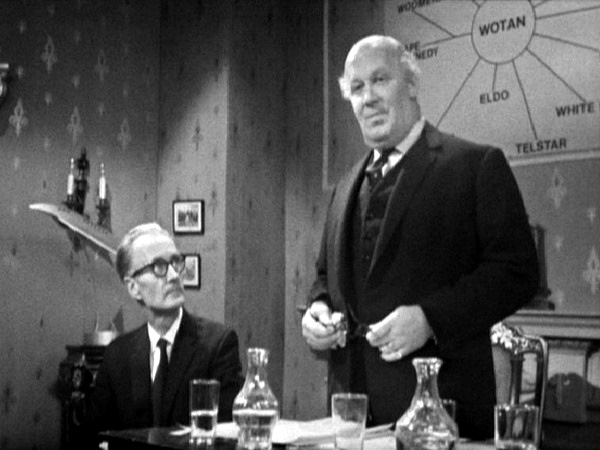
WOTAN, an acronym for Will Operated Thought ANalogue, is the most advanced computer in the world, although not necessarily the largest. It’s advanced technological capacities were a perfect companion for the building in which it was housed, the new Post Office Tower. Officially opened on the 15th July 1966 by the British Prime Minister, Harold Wilson, the Post Office Tower was the tallest building in London. Towering 177 metres from the ground (581 feet), it held that title until 1980. “C Day”, or Computer Day was set for 16th July 1966, the day after the Post Office Tower’s official opening. On that date all computers throughout the world were to be linked together under WOTAN’s (pronounced Votan) central control. The various sites to which WOTAN would be connected included the White House, Cape Kennedy, ELDO, TESTAR, RN, Woomera and EFTA.
Although not the world’s largest computer, WOTAN in the most intelligent
A media conference is held to outline WOTAN’s roll out. A graphic is displayed showing the computers which will be linked to WOTAN
TELSTAR was the name of various telecommunications satellites which were launched in the early 1960s. They provided the first transatlantic satellite television and telephone communications. So heralded was the launch of the first TELSTAR in 1962 that an instrumental tune by the British band The Tornados became the first number one hit in the United States for a UK band. Below, for your listening pleasure, is the Tornados with Telstar. ELDO was an acronym for the European Launcher Development Organisation (now the European Space Agency). RN is presumably the British Royal Navy, EFTA is the European Free Trade Association (formed in 1960), and Woomera is a weapons testing range in South Australia. Between 1946 and 1980 it was location for joint British and Australian weapons testing. The White House and Cape Kennedy require no explanation.
The Tornados – Telstar
The “C Day” linking of the world’s major computers foreshadowed the ARPANET, the first packet switching, in 1969. The Advanced Research Agencies Network (ARPANET) linked four university research centres together in the United States. The World Wide Web as we know it now, did not reach fruition until the early 1990s. It could perhaps be rightly claimed that this serial of Doctor Who was the first television show to predict the emergence of the web. Until I amended Wikipedia, a 1985 episode of Benson claimed to be the first such reference 🙂
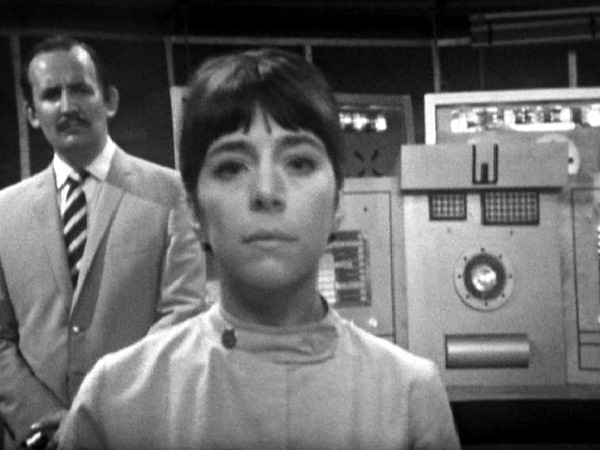
Professor Brett – the inventor of WOTAN. The super-computer was to link all the leading computers in the world together
Although the staff designated with WOTAN’s installation and roll-out were quick to dispel fears that the super-computer may eventually become destructive, it does not take long for the malignant nature of WOTAN to become evident. WOTAN can speak and is receptive to voice commands, although ordinarily its answers are printed on a dot matrix type printer. Computer monitors had clearly not been envisaged. More intelligent than humans, WOTAN knows the answer to all questions, including inexplicably, what TARDIS is an acronym for. WOTAN, however, has a hidden agenda. it believes that the world cannot possibly progress with humans at its helm and seeks to usurp them by mobile computer killing machines – the War Machines.
WOTAN has a secret agenda to usurp human control with its clumsy creations, the War Machines
WOTAN uses mind control through the emission of sonic sounds and the humble telephone, to hypnotise humans into its sinister plan. Dodo is amongst its first victims and is instructed to co-opt the Doctor. As luck would have it, his non-human form affords him protection from hypnosis, but not without him suffering physically nonetheless. The Doctor’s magic ring again comes to the rescue as he is able to put Dodo to sleep, and snap her out of her hypnotic trance, merely by waving his hand before her face five times. Upon waking Dodo is dispatched to the country to recuperate and never again seen. Her subsequent decision to remain in London is communicated to the Doctor via a message from the companions-in-waiting, Ben and Polly. A more pathetic companion departure had never been seen.
Dodo is hypnotised by WOTAN
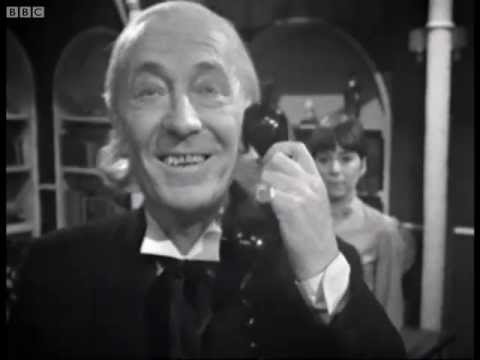
Hypnosis via the humble telephone is attempted on the Doctor. The already submissive Dodo looks on
WOTAN has its staff of hypnotised human slaves building a dozen War Machines in a disused warehouse in Covent Garden. Professor Brett, the computer scientist who invented WOTAN, is quickly a victim of WOTAN’s hypnosis, and dispatched to the warehouse to oversee construction. Polly, Brett’s secretary, also comes under WOTAN’s spell and is rescued by the Cockney sailor, Ben, who was sent on a mission by the Doctor to investigate. These War Machines were mobile computers but not in a form that we have today. Extraordinarily large, they were more like wartime tanks than the laptops, net books and tablets that we know today. Programmed by WOTAN, the War Machines are able to disable the firing mechanisms of Army guns and ammunition, and as such are seemingly unstoppable. In an Army raid of the warehouse, the single operational War Machine is able to effect the deaths of many personnel. On a rampage through the streets of Covent Garden, the War Machine is eventually outwitted by the Doctor’s cunning. After the stupendous cliff hanger of episode three where the Doctor comes face to face with the War Machine and stares it down, he eventually stops the machine in its tracks by setting up an electromagnetic field around it. An adept computer programmer, as he is of all manner of things scientific, the Doctor is able to reprogramme the War Machine. The machine is then sent on a mission to the Post Office Tower where it is able to reach the top floor, where WOTAN is housed, and destroy it. Commentators frequently joke about how the War Machine was able to fit in the lift, let alone press the floor buttons!
WOTAN’s slave labour force construct War Machines
Polly, Professor Brett’s secretary, is hypnotised by WOTAN
Save for the first episode of An Unearthly Child, in which you only see Coal Hill School and 76, Totter’s Lane, and Planet of Giants, where the Tardis Crew are miniaturized in a suburban back yard and house, this is the first time Doctor Who has been set in modern day London. It affords the opportunity for many shots of 1966 London and naturally, the most innovative building of the day, the Post Office Tower. There are a number of very interesting special features on the DVD including Now and Then, a look at the locations used in the making of the story in which those used in 1966 are compared with the present day; Blue Peter, which includes a compilation of segments on the War Machines, and One Foot in the Past, in which the Politician and ex-Postmaster General Tony Benn investigates the history of the Post Office Tower. It’s all fascinating stuff.
The Doctor stops the War Machine by creating an electro magnetic field around it
The War Machines has shots a-plenty of London in 1966
Perhaps the most visually memorable part of The War Machines is when the Doctor enters the Inferno nightclub via a flight of stairs. Resplendent in his cape, he enters the “hottest” night club in London, only to be told by one of the hipsters that his gear looked “fab”. It was not many episodes earlier that the Doctor had severely reprimanded Dodo for the use of the word “fab” and questioned if she could speak English properly. Times were a-changing for Doctor Who and this was even more evident by the new companions. Polly is a young London secretary who dresses in trendy clothes and is phenomenally forthright. Ben is a Cockney merchant sailor who breaks the hitherto unwritten rule that all major cast members of Doctor Who must speak in “BBC English” or Received Pronunciation. It was but a mere three months earlier that Dodo’s Manchurian accent lasted but 10 minutes. For the rest of Dodo’s tenure as a companion her accent changed from episode to episode and became increasingly more posh. As groundbreaking as it was to have a companion without an RP accent, it took until the Seventh Doctor’s incarnation in 1987 for the Doctor to have his first regional accent.
Ben and Polly in “The Inferno”, the hottest nightclub in London
The Doctor, in that amazing cape, stares down the War Machine in the episode 3 cliff hanger
Join me for my next review where you’ll encounter the predecessor to 2011’s The Curse of the Black Spot, The Smugglers, in which every conceivable pirate cliché is presented before us. It’s sure to be fun!
The Doctor is about to have two new companions. Dodo and Ben meet the Doctor to pass on a message from the departing Dodo
The War Machines was originally broadcast in the UK between 25th June and 16th July 1966
All four episodes of The Savages are missing from the BBC Archives. For the purposes of this marathon I viewed Loose Cannon’s reconstructions, the links for which are below.




























 The Doctor Who Mind Robber