Category Archives: Uncategorized

Daleks – Invasion Earth: 2150 A.D.

Standard

Image

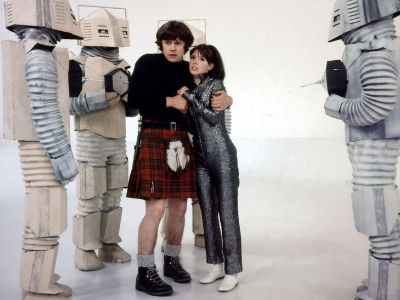
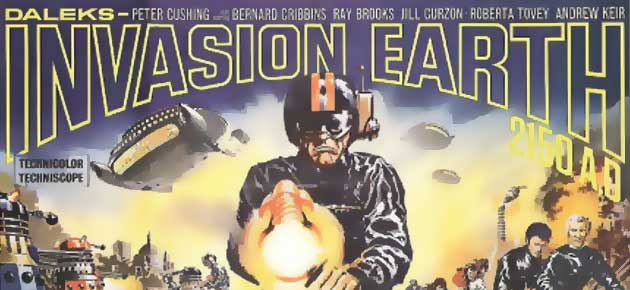
Again we take a quick digression from the canon of Doctor Who television to visit the second, and final, big screen Dalek movie.  Released in 1966, Daleks – Invasion Earth: 2150 A.D. was a colour reimaging of the second Dalek television serial, The Dalek Invasion of Earth.  The sequel to Dr. Who and the Daleks, it again featured Peter Cushing as Dr. Who and Roberta Tovey as his grand-daughter Susan.  Gone were the characters of Ian and Barbara, and in their place were Dr. Who’s niece, Louise, played by Jill Curzon, and a London Special Constable, Tom Campbell, played by Bernard Cribbins.

The main cast of "Daleks - Invasion Earth: 2150", Tom Campbell, Dr. Who, Louise, and Susan

The main cast of “Daleks – Invasion Earth: 2150”, Tom Campbell, Dr. Who, Louise, and Susan

Unlike the first Dalek movie, the screen play for Daleks – Invasion Earth: 2150 A.D. is credited to Terry Nation, Milton Subotsky and David Whitaker.  Was Terry Nation’s involvement in the screen play the reason for the many variations from the original television script?  It’s the many changes from the TV version that makes this movie substantially less palatable than Dr. Who and the Daleks.  Although liberties were certainly taken in the first movie and the major characters were tangibly reimaged, the dialogue of the movie was almost taken verbatim from Nation’s television script. Not so with Daleks  – Invasion Earth: 2150 A.D.  Much of the dialogue is new and more than a little played for laughs.
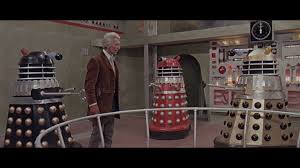
Splendid Daleks

Splendid Daleks

The younger version of Susan portrayed in the film necessarily meant that the relationship between Susan and David did not occur.  As this romance was Susan’s principal role in the TV serial, the movie Susan is left with a greatly reduced function.  This is a shame as Roberta Tovey’s role in Dr. Who and the Daleks was by no means disagreeable. Moreover, the movie equivalent of Barbara, niece Louise, does very little and appears only to be there for the “sex appeal”.  Ian’s replacement, Tom Campbell, is again a comedy parody.  That comedy, unfortunately, is less than rib tickling and in some circumstances wildly irrelevant to the script.  This is particularly true of the prolonged skit involving the Robomen eating.  Dr. Who remains the principal character, although in this film he is referred to almost universally as “the Doctor”.

The Robomen eating in a pantomime type skit

The Robomen eating in a pantomime type skit

Whilst somewhat critical of the role apportioned to Tom Campbell in Daleks- Invasion Earth: 2150 A.D.,  I have to admit to being charmed by seeing Bernard Cribbins as a young man. It was not for want of acting ability that Cribbin’s character was less than agreeable, but rather the consequence of a very ordinary script.  Cribbins played the recurring character of Wilf Mott, the grandfather of the Tenth Doctor’s companion, Donna Noble, in the new series of Doctor Who between 2007 and 2010.  Cribbins invariably stole the show in every episode in which he appeared, and has the distinction of being the only actor who has appeared in a Dalek movie and current era Who. It’s well worth watching Daleks – Invasion Earth: 2150 A.D. for that reason alone.
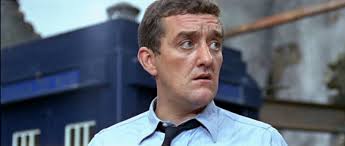
Bernard Cribbins as he appears in Daleks - Invasion Earth: 2150 A.D

Bernard Cribbins as he appears in Daleks – Invasion Earth: 2150 A.D
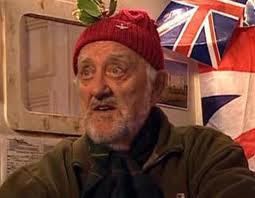
And as he does in Doctor Who, circa 2007

And as he does in Doctor Who, circa 2007

Vivien Fleming

©Vivien Fleming, 2013.
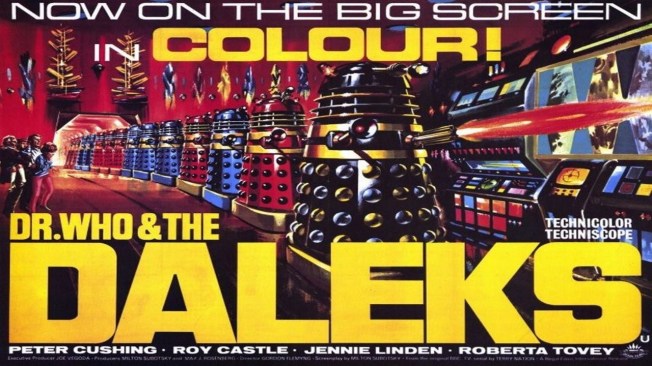
Dr. Who and the Daleks

Image

Doctor Who and the Daleks

Within 18 months of the broadcasting of the BBC serial, The Daleks, Dalekmania had gripped the UK. The Daleks were now to be seen in all their colourful glory on the big screen in this somewhat sanitized adaptation starring Peter Cushing.

A brief step sideways in our chronological journey through 50 years of Doctor Who takes us to the big screen colour remake of The Daleks. Quite unexpectedly the second Doctor Who serial brought forth an almost instantaneous wave of Dalekmania. Sydney Newman, the Canadian born BBC Head of Drama, had famously been quoted as saying that Who was to have “no bug eyed monsters”. Newman subsequently admitted his error of judgement and acknowledged that it was the Daleks that propelled Who to great success.

Dr. Who and the Daleks' Susan, Barbara, Doctor and Ian.

Dr. Who and the Daleks’ Susan, Barbara, Dr. Who and Ian.

Whilst the dialogue remained reasonably true to Terry Nation’s original script, the screen adaptation of The Daleks took considerable liberties in reimaging the central characters of The Doctor, Susan, Barbara and Ian. The Doctor is not an alien, but rather an eccentric grandfather who builds a Tardis in the backyard of his suburban home. He is referred to throughout as “Dr.Who” rather than The Doctor. His grand-daughter, Susan, is much younger than the television portrayal and is perhaps 8 or 9 years old. Barbara is not a 30ish school teacher but rather Dr. Who’s eldest grand-daughter who is in her late teens. Her new boyfriend, Ian, is not the mature, intelligent and resourceful (single) teacher we see in Who, but rather a babbling klutz. Ian’s principal role is to provide comic relief and couldn’t be further from William Russell’s portrayal of Ian as the moral compass of Who.

Some mighty fine looking Daleks.

Some mighty fine looking Daleks.

Characterization aside, Dr. Who and The Daleks is nonetheless a fun, if somewhat inane, romp and is undeniably beautifully realized in colour. The Daleks are spectacular in their colourful diversity and are of much more solid construction than their TV counterparts. Voiced by Who’s David Graham and Peter Hawkins, who unfortunately aren’t so credited, they thankfully sound totally authentic. The Thals also look spectacular, and somewhat camp, on screen with their blonde wigs, heavy bluish green eye shadow and yellow lipstick. Although lacking the darkness and depth of the original television serial Dr.Who and the Daleks is nonetheless worth a view for purely nostalgic purposes. Having now been released on Blu Ray it’s sure to look even more astounding.

The gorgeous Thals.

The gorgeous Thals.

Vivien Fleming

©Vivien Fleming, 2013.

Welcome to The Doctor Who Mind Robber

Image

Zoe Jamie Mind Robber

Welcome to The Doctor Who Mind Robber.  My challenge, should you care to join me, is to watch all the 800 televised episodes of Doctor Who from 1963 to 2013, in chronological order and in 50 weeks.  That’s right, 50 years of Who in 50 weeks, or an average of roughly 2.3 episodes per day.  If that isn’t enough, I’ll  then blog about it! This blog is named for my favourite Who serial, The Mind Robber.  Will this marathon so rob my mind?  Only time will tell!

My principal interest in this blog will not be reviewing the episodes, per se, but rather examining  the issues of politics, gender, religion and popular culture that arise from them. Special attention will be paid to character development, particularly in respect of the Doctor’s companions.  There are a plethora of blogs and review sites that provide excellent standard reviews of Who and I hope not to repeat their content here.  It’s my desire that that this blog, in focusing on social and cultural issues, will be a welcome addition to Whovian fandom.

A quick note on missing episodes and photos before we embark on our quest.  At the time of writing there are 106 episodes missing from 1960’s Doctor Who.  This is as a consequence of the BBC’s policy of junking or recycling tapes to save money and valuable storage space.  Thanks to the efforts of around half a dozen original fans, the BBC now has the audio of all missing episodes.  In the days prior to VCRs and the occasional repeat, the only way to experience Who after its initial airing was to read a novelization of the story, or if you were lucky, listen to the illegal tape that you made on your reel to reel tape recorder.  It is from these fan made audio recordings that the BBC has retrieved the valuable audio component of these missing episodes.

Eager to experience these lost episodes, fans have made reconstructions of the episodes utilizing the BBC retrieved and remastered audio together with telesnaps and other photographs from the productions.  Others have created complete animations of parts, or the whole, of missing episodes.  The ingenuity of dedicated fans defies description.  Many of these can be found on the internet and the BBC appears to have turned a blind eye to the obvious copyright infringements.  After all, it was the BBC that lost the episodes to start with and have the fans to thank for saving the audio!

With the exception of the two serials that the BBC has made its own reconstructions of, Marco Polo and Galaxy 4, it’s my intention to complete my marathon by watching these fan made clips.  I will also use the BBC produced Shada DVD to watch that never completed or broadcast Tom Baker serial. All Doctor Who serials will be viewed from BBC produced and distributed DVDs and Blu Rays and are contained in my private collection. Rather than resorting to illegal downloading I encourage all fans to watch the splendor of Who legally.

In respect of photographs on this blogs most, if not all, would be the copyright of the BBC.  No copyright infringement is intended and the photographs are displayed purely for illustrative purposes.

I hope you enjoy the journey and would appreciate your feedback.

Cheers

Vivien Fleming

©Vivien Fleming, 2013.