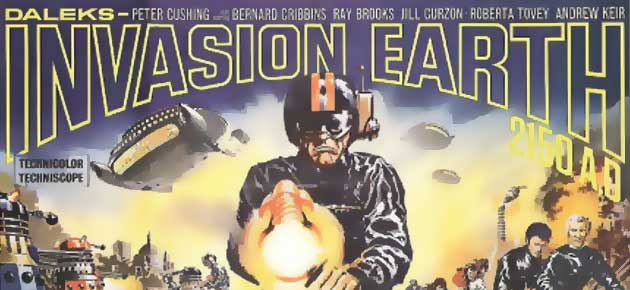
Again we take a quick digression from the canon of Doctor Who television to visit the second, and final, big screen Dalek movie. Released in 1966, Daleks – Invasion Earth: 2150 A.D. was a colour reimaging of the second Dalek television serial, The Dalek Invasion of Earth. The sequel to Dr. Who and the Daleks, it again featured Peter Cushing as Dr. Who and Roberta Tovey as his grand-daughter Susan. Gone were the characters of Ian and Barbara, and in their place were Dr. Who’s niece, Louise, played by Jill Curzon, and a London Special Constable, Tom Campbell, played by Bernard Cribbins.
The main cast of “Daleks – Invasion Earth: 2150”, Tom Campbell, Dr. Who, Louise, and Susan
Unlike the first Dalek movie, the screen play for Daleks – Invasion Earth: 2150 A.D. is credited to Terry Nation, Milton Subotsky and David Whitaker. Was Terry Nation’s involvement in the screen play the reason for the many variations from the original television script? It’s the many changes from the TV version that makes this movie substantially less palatable than Dr. Who and the Daleks. Although liberties were certainly taken in the first movie and the major characters were tangibly reimaged, the dialogue of the movie was almost taken verbatim from Nation’s television script. Not so with Daleks – Invasion Earth: 2150 A.D. Much of the dialogue is new and more than a little played for laughs.
Splendid Daleks
The younger version of Susan portrayed in the film necessarily meant that the relationship between Susan and David did not occur. As this romance was Susan’s principal role in the TV serial, the movie Susan is left with a greatly reduced function. This is a shame as Roberta Tovey’s role in Dr. Who and the Dalekswas by no means disagreeable. Moreover, the movie equivalent of Barbara, niece Louise, does very little and appears only to be there for the “sex appeal”. Ian’s replacement, Tom Campbell, is again a comedy parody. That comedy, unfortunately, is less than rib tickling and in some circumstances wildly irrelevant to the script. This is particularly true of the prolonged skit involving the Robomen eating. Dr. Who remains the principal character, although in this film he is referred to almost universally as “the Doctor”.
The Robomen eating in a pantomime type skit
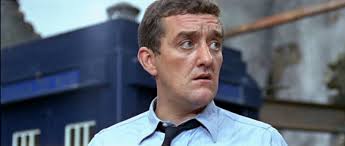
Whilst somewhat critical of the role apportioned to Tom Campbell inDaleks- Invasion Earth: 2150 A.D., I have to admit to being charmed by seeing Bernard Cribbins as a young man. It was not for want of acting ability that Cribbin’s character was less than agreeable, but rather the consequence of a very ordinary script. Cribbins played the recurring character of Wilf Mott, the grandfather of the Tenth Doctor’s companion, Donna Noble, in the new series ofDoctor Who between 2007 and 2010. Cribbins invariably stole the show in every episode in which he appeared, and has the distinction of being the only actor who has appeared in a Dalek movie and current era Who. It’s well worth watching Daleks – Invasion Earth: 2150 A.D. for that reason alone.
Bernard Cribbins as he appears in Daleks – Invasion Earth: 2150 A.D
With iconic imagery of London that would remain unmatched until the classic emergence of the Cybermen from St. Paul’s Cathedral in 1968’s The Invasion, The Dalek Invasion of Earth was a ground breaking serial in Doctor Who’shistory. The story was the subject of a number of significant firsts and lasts, including the earliest shots of the English capital’s tourist hotspots which are so celebrated that at least one has been reenacted for the forthcoming docudrama to celebrate Who’s 50th anniversary, An Adventure in Space and Time. The story was also the first to see the departure of a companion, Susan, and the first on screen kiss, between Susan and her fiancé, David. The Daleks made their only appearance with parabolic discs on their backs and the serial was also the second, and last, to be made into a feature film.
In the best tradition ofDoctor Who, The Dalek Invasion of Earth involved the wild and improbable premise that Daleks invaded earth on or about 2164. Six months prior to arriving in their now stereotypical looking flying saucers, the Daleks had sent meteors bearing the plague to the earth which had decimated the continents of Africa, South America and Asia. Countries were destroyed and the world became fragmented into small, independent communities. Although considering themselves “masters of Earth”, the Daleks interest in earth was not the domination of its human population, but rather to use it as a spacecraft. Drilling to the core of the earth in Bedfordshire, the Daleks planned to remove its magnetic core, de-gravitize it, and then replace the core with a power system of their own making. The Daleks then intended to steer the earth throughout the universe. One would have thought it easier for the Daleks just to make more of their flying saucers, but alas, a rollicking good yarn that would not have been!
Producer of Doctor Who, Verity Lambert, pictured with a parabolic disc Dalek. These Daleks were only ever seen in “The Dalek Invasion of Earth”.
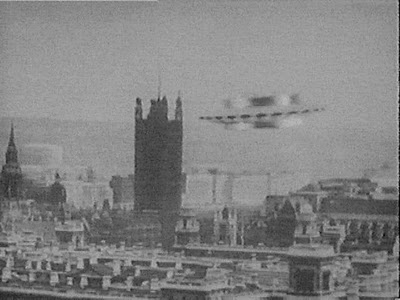
One of the Daleks’ less than realistic flying saucers
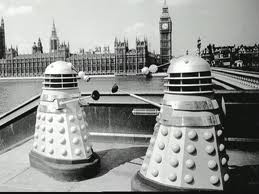
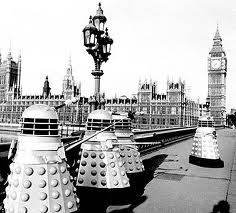
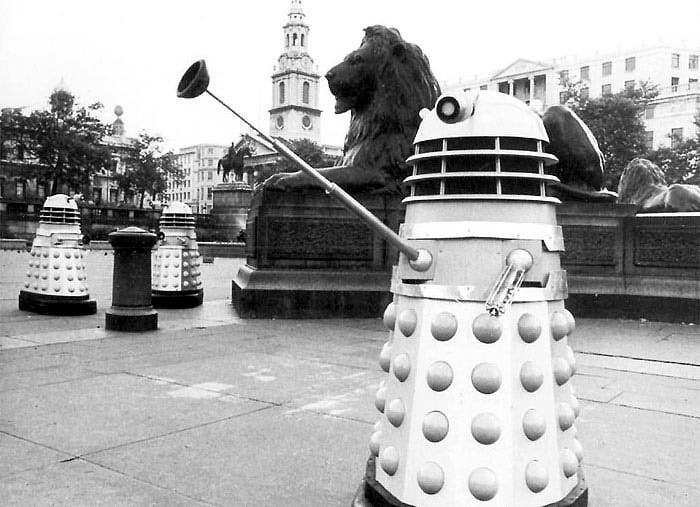
Daleks on Westminster Bridge
Given the Daleks’ anatomical disability, namely, their unfortunate endowment of a sucker and a mix-master like gun in lieu of hands, they naturally needed human help in their quest to drill to the earth’s centre. Having dominated the decimated human population, the Daleks robotized the intelligent males into drone like soldiers who responded to their orders. Almost everyone else was a slave in the Daleks’ mine in Bedfordshire. The few remaining “free” humans formed a resistance movement to fight the Daleks’ evil plan. The Doctor and his companions meet up with one such resistance group which was under the leadership of Dortmun, an incapacitated scientist confined to a wheel chair. One of these resistance members, David Campbell, was to become Susan’s fiancée, whilst another, Jenny, assisted Barbara in getting to Bedfordshire. Along the way Barbara has the glorious achievement of plowing down a group of Daleks whilst driving a truck.
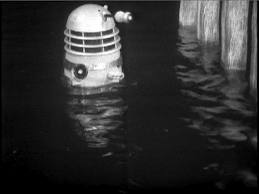
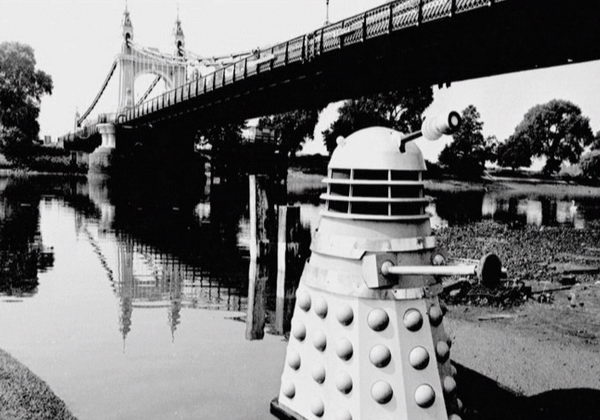
A submerged Dalek emerging from the Thames River
The Dalek shows no ill effects from its time in the polluted Thames
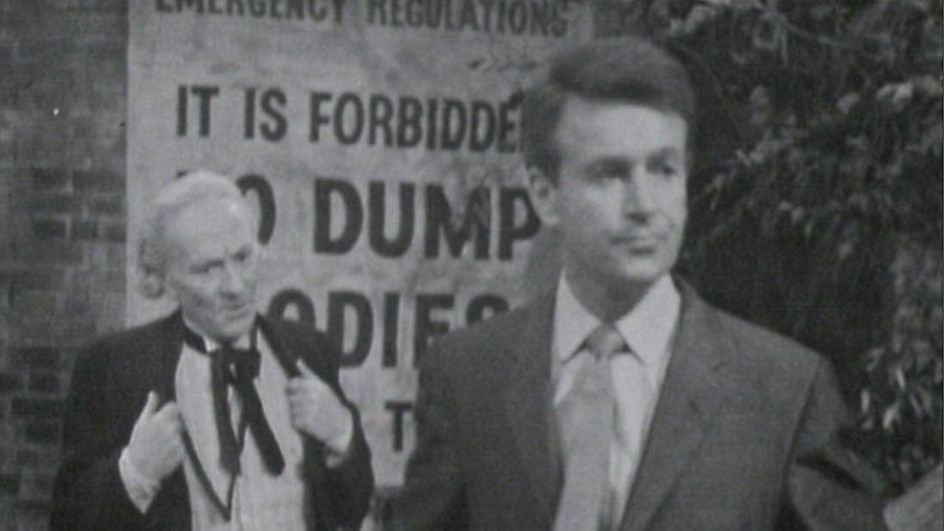
The Doctor and Ian in front of a sign forbidding the dumping of bodies in the river
In the course of the Doctor and his companions’ adventures, the Doctor is a captive in the Daleks’ spaceship and is almost robotized, Ian contends with a mutated creature called The Slyther and finds himself inside the bomb which will blow out the earth’s core, and Susan is almost eaten by alligators which now inhabit London’s sewers. Barbara and her companion Jenny are betrayed to the Daleks by two women from whom they seek refuge, and are then held captive with metal neck braces. After their ultimate victory over the Daleks, the Doctor, Barbara and Ian depart in the Tardis sans Susan. In the tear jerking conclusion, the Doctor locks his grand-daughter out of the ship and speaks to her through an intercom. As she is now a woman, she needs roots somewhere and David is the person who can give her those roots, “not a silly old duffer like me”, said the Doctor. Despite Susan’s protestations the Doctor leaves, but not before promising that one day he will be back. It is this oration which opens Who’s 20th anniversary special, The Five Doctors, which is the next occasion when the Doctor and Susan are seen together.
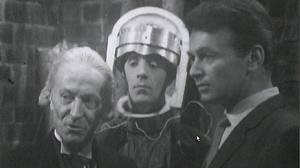
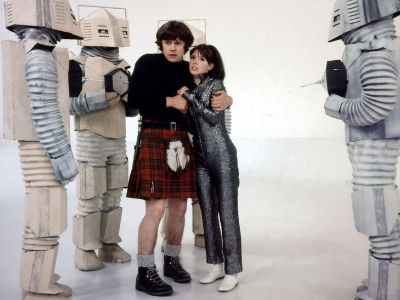
A Roboman with the Doctor and Ian
Slave labourers push a railway cart at the Bedfordshire mine
Akin to the first Dalek story, The Daleks, the writer, Terry Nation, drew upon Second World War imagery. Post Dalek invasion London has its genesis in the London Blitz. The Daleks are again a representation of the Nazis and are even seen to do Nazi salutes. They are the “masters of the Earth”. The Daleks make use of slave labour and communicate to the resistance by radio transmissions. Whilst most of the population is in grave fear of them, some self-interested individuals are prepared to co-operate with them for economic gain. Such is the case of the two women in the wood and the black market racketeer, Ashton.
A Dalek does a Nazi salute
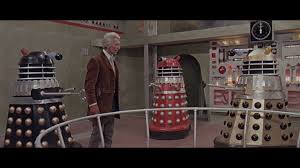
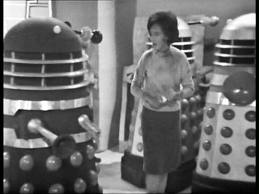
Daleks and Robomen at the Daleks’ spaceship
Barbara, as always, is fabulous and puts on a particularly good show when attempting to outwit the Dalek leadership by muddling history. As stated previously, she plows through Daleks, unscathed, in a truck and it is Barbara who realizes that the Robomen are given orders by a central command. Taking over that microphone, she and the Doctor order the Robomen to turn on the Daleks. Unfortunately she is oblivious to the sexism of the resistance men when she is asked whether she can cook. Her reply of “I can get by” results in her being assigned to cooking duties because the resistance “need cooks”. If this serial was produced five years later then perhaps she would have baulked at the gendered stereotype. Clearly these urban guerillas had underestimated the resourcefulness of Barbara.
Barbara tries to confuse the Daleks with muddled history
Barbara is caught by a Dalek’s sucker
The character of Jenny is particularly strong for a woman in the early 1960s. Dortmun assures Barbara that Jenny isn’t callous, although the years of battling the Daleks has certainly left her hardened. When Barbara asks why she is constantly running from the Daleks her reply is that “I’m not running, I’m surviving”. Her rather arrogant nature doesn’t make for a particularly endearing personality and one is left wondering if this is a reflection of an underlying belief by Terry Nation that powerful women cannot also be “nice”.
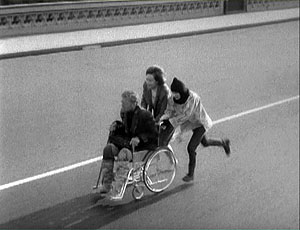
Barbara and Jenny run Dortmun to safety
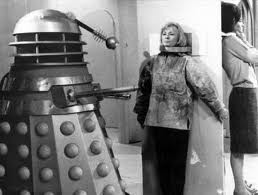
Jenny and Barbara are restrained by iron neck collars
Susan transforms from a girl to a woman in the course of this story as her relationship with David blossoms. She initially reject’s David’s proposal of marriage as her grandfather is old and now needs her. She didn’t want to have to make the choice between the stability that David offered, and the Doctor. The Doctor, from inside the Tardis, ultimately makes the decision for Susan which on the face of it appears harsh and unloving. David, however, reassures Susan that the Doctor knew that she could never leave him (David). That a relationship of such intensity could develop in the space of but a few days is indeed intriguing. It became a precedent, nonetheless, for romance linked companion departures in the future, such as the Fourth Doctor’s companion Leela, who remains on Gallifrey with her newly acquired love, Andred.
Susan talks to the Doctor through the Tardis’s PA system
Susan and David in a tender moment
Susan is distressed to leave her grandfather
The Dalek Invasion of Earth marked the end of companion stability and the beginning of an almost revolving door of companions for the First Doctor. It is in the next serial, The Rescue, that we are introduced to the Doctor’s “grand-daughter substitute”, orphan Vicki. A new era will begin.
The Doctor says farewell to Susan
The Dalek Invasion of Earth was first broadcast in the UK between November 21 and December 26, 1964
I’ve now finished watching the first season of Doctor Who and only have another 32 seasons to go. Watch out for reviews of “The Keys of Marinus”, “The Aztecs”, “The Sensorites” and “The Reign of Terror” over the next few days.
The Unearthly Child introduced Ian and Barbara as reluctant passengers of the Doctor’s spaceship who had been held against their will by the Doctor in an immoral, if not criminal, manner. The Doctor, however, saw no ethical issue with his actions and blamed the teachers for barging their way into his ship uninvited. The Doctor’s lack of empathy for the stranded passengers evidenced his narcissistic tendencies and refusal to acknowledge responsibility for any of his actions. On those few occasions when he apologized to Ian and Barbara it was inevitably shallow and consisted of platitudes such as “I’m sorry, I’m so terribly sorry”. The Doctor would soon revert, however, to his standard fare of blaming all but himself.
Ian and Barbara are reluctant passengers of the Tardis.
Relations between Ian and Barbara, and the Doctor, remained strained throughout the The Daleks. In the first episode, The Dead Planet, Barbara questioned if the Doctor would ever return them to earth and Ian, admitting to being scared, doubted it would ever happen. Barbara expressed frustration at having nothing to rely on and being unable to recognize or trust anything. She even pondered whether the Doctor deserved some form of retribution. The teachers were not the happy companions of later series, excited to experience a life of adventure travelling through time and space. They had no desire to travel with the Doctor and were keen to return to the security of 1963 London at the earliest possible convenience.
Ian and a Dalek – in colour!
When Ian forcefully told the Doctor that “we’re fellow travellers, whether you like it or not”, the Doctor retaliated with his standard defense that they had pushed their way into his ship. By way of an analogy, no Court of Law would acquiesce to householders permanently detaining trespassers to their property! The Doctor’s arrogant attitude continued unabated in The Dalekswhen he dismissed Ian’s inquiries by stating “I won’t be questioned by uninvited passengers”.
Ian’s legs are paralysed by a Dalek attack.
The Doctor’s ultimate act of treachery to his almost prisoner-like teacher companions was to remove the fluid link from the Tardis, and then claim that it required mercury to work again. This, of course, was one of the Doctor’s many lies and done solely with the intention of affording him the opportunity to explore the Dalek city on the premise that he might obtain mercury there. The Doctor did not admit to his lie until the second episode, The Survivors, during which time he contemplated departing with Susan and leaving Ian and Barbara alone in the Dalek city. Ian, the moral compass as always, argued that it was about time that the Doctor faced up to responsibility.
Barbara, the Doctor and Susan attempt to extricate Ian from inside the Dalek.
That morality was not a consideration for the Doctor was stated in as many words when he asserted that “this is no time for morals” when discussing the Thals’ pacifist objections to assisting the Tardis Crew retrieve the fluid link. Without the fluid link the ship and its crew would be stranded on Skaro. Clearly the Doctor considered his and Susan’s interests more highly than that of the collective Thal people.
The Doctor and his oldest foe.
Although successful in defeating the Daleks together, the Tardis Crew was still not a cohesive group of fellow travellers. It would take the third story of Doctor Who, The Edge of Destruction, to exhibit just how brittle relations between the alien Doctor and his grand-daughter, and their human passengers, really were.
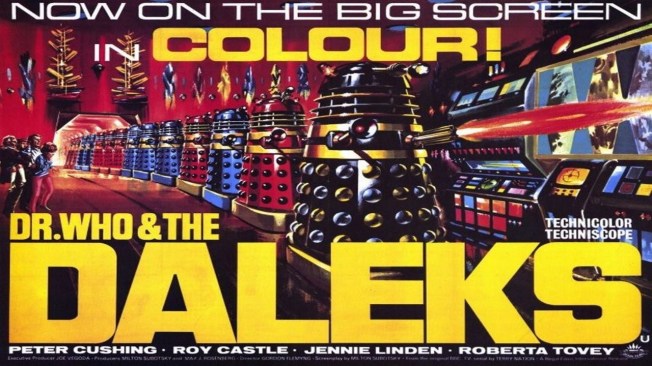
Within 18 months of the broadcasting of the BBC serial, The Daleks, Dalekmania had gripped the UK. The Daleks were now to be seen in all their colourful glory on the big screen in this somewhat sanitized adaptation starring Peter Cushing.
A brief step sideways in our chronological journey through 50 years of Doctor Who takes us to the big screen colour remake of The Daleks. Quite unexpectedly the second Doctor Who serial brought forth an almost instantaneous wave of Dalekmania. Sydney Newman, the Canadian born BBC Head of Drama, had famously been quoted as saying that Who was to have “no bug eyed monsters”. Newman subsequently admitted his error of judgement and acknowledged that it was the Daleks that propelled Who to great success.
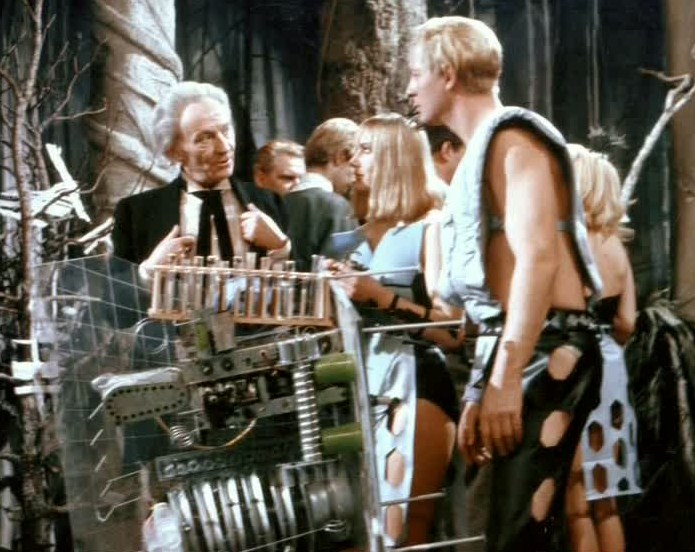
Dr. Who and the Daleks’ Susan, Barbara, Dr. Who and Ian.
Whilst the dialogue remained reasonably true to Terry Nation’s original script, the screen adaptation of The Dalekstook considerable liberties in reimaging the central characters of The Doctor, Susan, Barbara and Ian. The Doctor is not an alien, but rather an eccentric grandfather who builds a Tardis in the backyard of his suburban home. He is referred to throughout as “Dr.Who” rather than The Doctor. His grand-daughter, Susan, is much younger than the television portrayal and is perhaps 8 or 9 years old. Barbara is not a 30ish school teacher but rather Dr. Who’s eldest grand-daughter who is in her late teens. Her new boyfriend, Ian, is not the mature, intelligent and resourceful (single) teacher we see in Who, but rather a babbling klutz. Ian’s principal role is to provide comic relief and couldn’t be further from William Russell’s portrayal of Ian as the moral compass of Who.
Some mighty fine looking Daleks.
Characterization aside, Dr. Who and The Daleks is nonetheless a fun, if somewhat inane, romp and is undeniably beautifully realized in colour. The Daleks are spectacular in their colourful diversity and are of much more solid construction than their TV counterparts. Voiced by Who’sDavid Graham and Peter Hawkins, who unfortunately aren’t so credited, they thankfully sound totally authentic. The Thals also look spectacular, and somewhat camp, on screen with their blonde wigs, heavy bluish green eye shadow and yellow lipstick. Although lacking the darkness and depth of the original television serial Dr.Who and the Daleks is nonetheless worth a view for purely nostalgic purposes. Having now been released on Blu Ray it’s sure to look even more astounding.
The Terry Nation penned seven part serial, The Daleks, is undoubtedly a product of its times. Produced less than two decades after the cessation of the Second World War, and just prior to the emergence of the 1960’s peace movement, The Daleks not so subtly examines the politics of appeasement, pacifism and the effects of nuclear war.
“The Daleks” writer, Terry Nation.
The Daleks are a by product of a neutronic war between the then humanoid Daleks and their fellow inhabitants of the planet Skaro, the Thals. At the cessation of the war 500 years earlier the Dalek forefathers, mutated as a consequence of radiation, retreated into the Dalek underground city and protected themselves inside the machines we now know as the iconic Daleks. The Thals remained outside the city and also mutated, abandoning their warrior ideology and becoming pacifists.
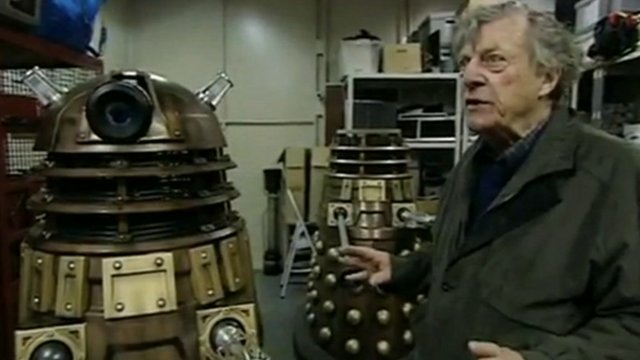
Ray Cusick, the designer of the iconic Daleks.
Whereas the Dalek mutation was horrific, the Thal mutation resulted in a fine looking race of blonde humanoids. Susan considered them magnificent looking people. The Thals protected themselves from further mutation with an anti-radiation drug and became farmers. They cultivated their land, relying on a great rain every two or three years to maintain their crops. At the time of the Doctor and his companions arrival on Skaro the Thals much needed rain was two years overdue. As a consequence they had left their plateau 12 months previously in search of better pastures and food.
The Doctor and the gorgeous Thals.
Unlike the Thals, the Daleks maintained, fostered and celebrated their warrior heritage. They knew that some Thals survived the neutronic war but assumed that they must be terribly mutated . As Ian quickly learned, the Daleks don’t act and feel like humans. They have “a dislike for the unlike”. They are arrogant and will make no concessions. As one Dalek stated “we don’t have to adapt to the environment. The environment will adapt to us”. That the writer, Terry Nation, chose to have these words coming from the story’s aggressors exhibits his obvious interest in the environment decades prior to society’s concern about Global Warming.
Barbara encounters a Dalek for the first time.
After obtaining some of the Thal’s anti-radiation drugs, the Daleks on which the drugs were administered become ill. It quickly became evident that the Daleks relied on radiation for their continued existence and they determined to release a massive dose of radiation the following day. In doing so it was hoped that the Thals would be destroyed and the Daleks would become Masters of Skaro. The Daleks considered it logical that both the Thals and the Tardis Crew would attack them.
Susan accepts delivery of anti-radiation drugs from a Thal.
The once warrior race of Thals, however, were now farmers and pacifists. Their society is a democracy where decisions can’t be made without the full approval of the people. They subscribe to the philosophy that “fear breeds hatred and war” and would return to the plateau from which they came if they were attacked by the Daleks. As one of the Thals stated “there can never be any question of the Thals fighting the Daleks”.
The Doctor and Susan are confronted by Daleks whilst held prisoner.
Ian and Barbara are intrigued by the Thal’s pacifism. Barbara wonders if it’s possible for pacifism to become a human instinct, whilst Ian posits that pacifism only works if everyone thinks the same way. Barbara ponders if pacifism is a belief that has become a reality because they’ve never had to test it. The Tardis Crew, however, seek the Thal’s fighting assistance to get into the Dalek city and retrieve the fluid link that the Daleks had previously confiscated from them. Ian is initially reticent to have the Thals sacrifice themselves for the sake of assisting the Doctor and his companions. The Doctor, however, considers this no time for morals and engages in a verbal dispute with Ian. Ian asks if the Thals are cowards or against fighting on principal.
Ian attempts to goad the Thals into fighting.
Attempting to goad the Thals into action and determine if there’s anything they will fight for, Ian grabs a Thal woman by the arm and threatens to take her to the Dalek city with him. A Thal male retaliates by punching Ian in the face. Reclining on the ground and rubbing his face, Ian’s mission has been accomplished as he has proved that the Thals will indeed fight for what is theirs. It doesn’t take long for the Thals to then agree to assist the Tardis Crew in their actions against the Daleks.
The Doctor and Dyoni.
Hasten to add, the Doctor, his companions and the Thals eventually defeat the Daleks in their own city. The moral of the story, therefore, is that pacifism is no answer to unadulterated aggression. Born in 1930, Terry Nation grew up during the Second World War at a time when in his own words “men were trying to kill me”. Nation was clearly contemptuous of the British policy of appeasement against German and Italian aggression in the 1930s, considering it cowardice. The pacifist Thals were therefore analogous to the pre World War II British and the Daleks to the German Nazis. The Doctor represents those who were skeptical of appeasement. Once the Thals rejected pacifism and fought they, like Britain, were successful in defeating the (Dalek) enemy.
Vivien Fleming
The first Doctor Who monsters and the Doctor’s oldest foes, the Daleks, were introduced to the public between 21 December 1963 and 1 February 1964. A British icon was born.
Welcome to TheDoctor Who Mind Robber. My challenge, should you care to join me, is to watch all the 800 televised episodes of Doctor Who from 1963 to 2013, in chronological order and in 50 weeks. That’s right, 50 years of Who in 50 weeks, or an average of roughly 2.3 episodes per day. If that isn’t enough, I’ll then blog about it! This blog is named for my favourite Who serial, The Mind Robber. Will this marathon so rob my mind? Only time will tell!
My principal interest in this blog will not be reviewing the episodes, per se, but rather examining the issues of politics, gender, religion and popular culture that arise from them. Special attention will be paid to character development, particularly in respect of the Doctor’s companions. There are a plethora of blogs and review sites that provide excellent standard reviews of Who and I hope not to repeat their content here. It’s my desire that that this blog, in focusing on social and cultural issues, will be a welcome addition to Whovian fandom.
A quick note on missing episodes and photos before we embark on our quest. At the time of writing there are 106 episodes missing from 1960’s Doctor Who. This is as a consequence of the BBC’s policy of junking or recycling tapes to save money and valuable storage space. Thanks to the efforts of around half a dozen original fans, the BBC now has the audio of all missing episodes. In the days prior to VCRs and the occasional repeat, the only way to experience Whoafter its initial airing was to read a novelization of the story, or if you were lucky, listen to the illegal tape that you made on your reel to reel tape recorder. It is from these fan made audio recordings that the BBC has retrieved the valuable audio component of these missing episodes.
Eager to experience these lost episodes, fans have made reconstructions of the episodes utilizing the BBC retrieved and remastered audio together with telesnaps and other photographs from the productions. Others have created complete animations of parts, or the whole, of missing episodes. The ingenuity of dedicated fans defies description. Many of these can be found on the internet and the BBC appears to have turned a blind eye to the obvious copyright infringements. After all, it was the BBC that lost the episodes to start with and have the fans to thank for saving the audio!
With the exception of the two serials that the BBC has made its own reconstructions of, Marco Polo and Galaxy 4, it’s my intention to complete my marathon by watching these fan made clips. I will also use the BBC produced ShadaDVD to watch that never completed or broadcast Tom Baker serial. All Doctor Who serials will be viewed from BBC produced and distributed DVDs and Blu Rays and are contained in my private collection. Rather than resorting to illegal downloading I encourage all fans to watch the splendor of Who legally.
In respect of photographs on this blogs most, if not all, would be the copyright of the BBC. No copyright infringement is intended and the photographs are displayed purely for illustrative purposes.
I hope you enjoy the journey and would appreciate your feedback.














 The Doctor Who Mind Robber