Monthly Archives: July 2013

The Smugglers

Standard

Image

It’s somewhat bizarre to “watch” a serial in which all four episodes have been lost but miraculously, all the violence is intact as tiny snippets of film. Such is the case with the opening story of Season 4, The Smugglers.  Always to the rescue in the event of missing episodes, Loose Cannon’s reconstruction is resplendent with John Cura’s famous telesnaps, authentic photos taken during production and snippets from an amateur film of the production.  Most startling, however, are five short clips courtesy of Australia’s Commonwealth Film Censorship Board.  Discovered in the National Archives of Australia in October 1996 by Doctor Who fans Damian Shanahan and Ellen Parry, the clips had been excised by the Film Censorship Board and retained as evidence of the edits.  At some point they had been transferred to the National Archives, presumably in accordance with government agency retention policies.

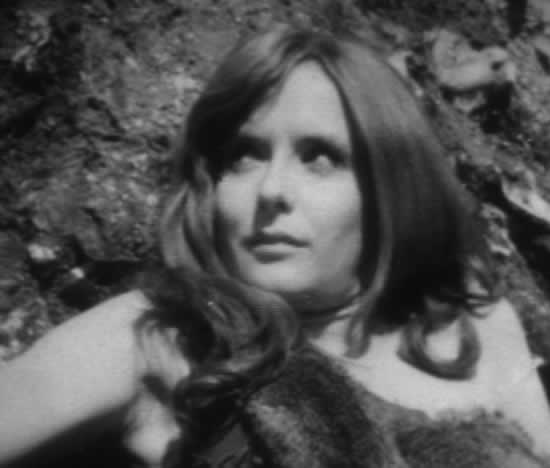
Elroy Josephs, who played the pirate Jamaica, was the first black person to have a speaking part in Doctor Who

Elroy Josephs, who played the pirate Jamaica, was the first black person to have a speaking part in Doctor Who

Always broadcast during children’s television times in Australia, Classic Series Doctor Who was subject to government classification prior to airing.  Segments deemed too terrifying or violent for children were routinely cut.  It was for this reason that The Daleks’ Master Plan was never broadcast in Australia.  Who’s most violent story to that date, the cuts required to The Dalek’s Master Plan were so extensive as to make it incomprehensible to the ordinary viewer.  Thanks to Shanahan and Perry’s research, together with the Censorship Board’s hardline policy of the 1960s, a number of clips from otherwise totally lost episodes and stories have now been returned to the BBC’s archives. Perhaps the most iconic of these clips is from 1968 Second Doctor serial, Fury from the Deep. A full 54 seconds of a clip survives in which Quill and Oak suffocate Mrs Harris by breathing deadly gas from their mouths.  Stayed tuned for my review of that Season 5 Serial 6 story to see the outstanding film clip.

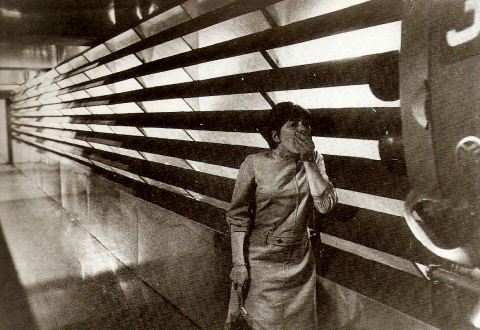
Once of the most iconic images from the Second Doctor's lost adventure Fury from the Deep.  Almost one minute of this clip survives thanks to the Australian Film Censorship Board

Once of the most iconic images from the Second Doctor’s lost adventure Fury from the Deep. Almost one minute of this clip survives thanks to the Australian Film Censorship Board

A listing of The Smugglers clips recovered from Australia can be accessed from this page of Loose Cannon’s website – http://www.recons.com/clips/clips-lc30.htm  Particularly valuable is Steve Phillips’ “The Doctor Who Clips List”.  Here you will find photographs and a short description of all recovered snippets – http://dwclips.steve-p.org/  An interview with Damian Shanahan is included amongst the special features of Lost in Time. Linked below for your viewing pleasure are The Smugglers clips, together with extracts from the amateur video.

The Smugglers – Missing clips and amateur film

The Smugglers was William Hartnell’s last historical story, and the first Doctor Who serial requiring the cast and crew to embark on a journey to the seaside for location shooting.  Filmed at Cornwell, the serial is sure to have looked superb. Without the visuals, however, it’s somewhat difficult to state much at all about the serial.  Whilst perfectly enjoyable, The Smugglers is by no means extraordinary.  The story of the Doctor and his new companions arriving on a late 17th Century Cornwell beach, and finding themselves immersed in the deadly games of piracy and smuggling, is profoundly simple.  The story could’ve been taken from any Boys’ Own Adventure book. Save for the Doctor, Polly and Ben arriving and departing in the Tardis, there is no science fiction in the story.  Nor is it based on a real, or even mythical, historical event.
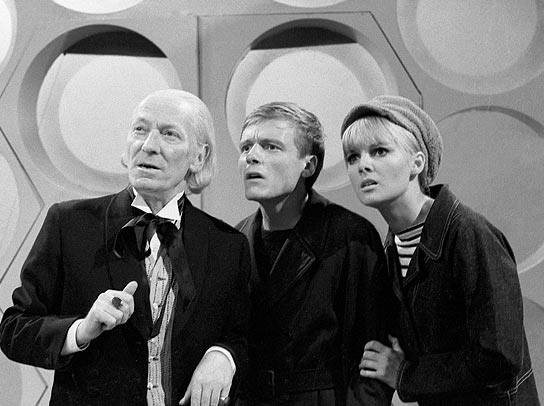
Ben and Polly arrive take their first trip in the Tardis

Ben and Polly take their first trip in the Tardis

As many clichés as possible were thrown into The Smugglers’ mix, such as an evil pirate captain with a hook for a hand; the drunken former pirate who becomes a drunken church warden; the local Squire who’s actually a small time crook; and the locals being insanely superstitious. For the first time ever a black actor has a speaking part, although Jamaica, the pirate crew member, is quickly dispatched by the evil Captain Pike for allowing prisoners to escape. The pirates are more interested in drinking the smugglers’ loot than retrieving it for their Captain, and most interestingly, the Doctor drinks some wine with Captain Pike.  It was only in The Gunfighters that the Doctor repeatedly vowed that he was a teetotaller.

The evil pirate, Captain Pike

The evil pirate, Captain Pike

Ben and Polly’s first trip in the Tardis provides from some comic interludes in the serial’s first part.  Unsurprisingly the new companions have difficulty accepting that the Tardis travels through time, although they are less puzzled by the Ship’s ability to transport them from London to Cornwell in a matter of minutes. Convinced that they are still in 1966, Ben and Polly immediately set off to find a train station.  Ben’s principal concern is returning to his boat in time.  This is despite him stating in The War Machines that he was on 6 months’ shore leave.  Perhaps the Crew had been put in a state of suspended animation for six months because in The Faceless Ones, Ben and Polly’s last story, they are returned to London on the same day that they left.  Needless to say, our new companions soon realize that it is not the 20th Century and quickly lose their sense of astonishment.  That is, of course, until Polly is repeatedly mistaken for a “lad” because she’s wearing trousers.  Even being locked up in a cell after being charged with the murder of the church warden, Ben and Polly are still decidedly calm.

Ben and Polly find appropriate clothing for 17th Century Cornwell.  Because she wears trousers Polly is mistaken for a "lad"

Ben and Polly find appropriate clothing for 17th Century Cornwell. Because she wears trousers Polly is mistaken for a “lad”

The Doctor, who is referred to as “Saw Bones” by the sailors, admits to his new companions that he is unable to control where and when the Tardis materializes. He displays a skill for tarot reading and a strong need to assist the local villagers.  When Ben seeks to quickly depart in the Tardis the Doctor advises Ben that he has a moral obligation to save the villagers from the rampaging pirates.  The Doctor’s ethics have changed considerably from his first adventures with Barbara, Ian and Susan.  In The Daleks he placed his Crew at risk to satisfy his desire to explore the Dalek city, and was just as quickly prepared to decamp from it without Ian and Barbara. No longer entirely egocentric, the Doctor is slowly developing into the universe saving character that we all know and love.

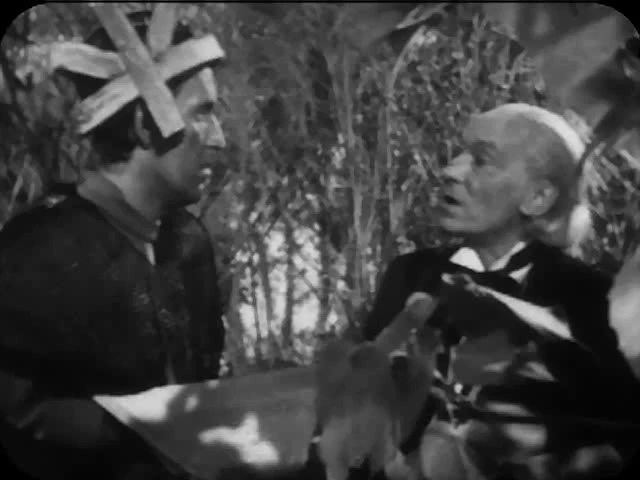
Captain Pike and Jamaica, just prior to the Jamaica's murder

Captain Pike and Jamaica, just prior to the Jamaica’s murder

Our next serial, The Tenth Planet, is Hartnell’s last journey in the Tardis as the Doctor. Join me for my next review in which the Cybermen make their premiere appearance and Doctor Who’s  first regeneration unfolds before our confused eyes.

Loose Cannon's VHS cover art for their The Savages Reconstructions. The Smugglers was originally aired in the UK between 10 September and 1 October 1966.

Loose Cannon’s VHS cover art for The Smugglers Reconstructions. The Smugglers was originally aired in the UK between 10 September and 1 October 1966.

Vivien Fleming

©Vivien Fleming, 2013.

50th Anniversary Special to be Simulcast

Standard

ImageThe UK’s The Sun newspaper has reported that Doctor Who’s 50th Anniversary Special on 23 November 2013 will be broadcast simultaneously throughout the world to avoid leaks. Set to air at 8.00 p.m. on BBC1 in the UK, it will be shown on ABC1 at 5.00 a.m. on 24 November in Queensland, and 6.00 a.m. in those eastern Australian States sensible enough to have Daylight Savings. I have yet to see any confirmation by the ABC, although The Sun reports that all global broadcasters have agreed. You can read the The Sun’s article at http://www.thesun.co.uk/sol/homepage/showbiz/tv/5034088/Dr-Who-special-aired-worldwide-at-exactly-same-time.html

Three seasons down, 30 to go!

Standard

Image

In terms of seasons, I’m now an eleventh of the way through my Doctor Who marathon – three seasons down and only 30 to go! William Hartnell has only two serials remaining as the Doctor, The Savages and The Tenth Planet, before Who’s first ever regeneration. I look forward to continuing my marathon with the Second Doctor, Patrick Troughton, even though every serial in Season 4 is incomplete.  Thank goodness for Loose Cannon’s superb reconstructions and the orphan episodes on Lost in Time. Please join me for Season 4, as my journey through Doctor Who continues.

Vivien Fleming

The War Machines

Standard

Image

The War Machines ushers in not only the end of Doctor Who’s third season,  but also the hasty, and unceremonious, exit of perhaps the most derided of all the Doctor’s companions, Dodo.  Having lost Steven only the previous week, when he decamped at the Doctor’s bidding to mediate a new world for the Savages and the Elders in The Savages, it looked for all of a minute that the Doctor might again be companion less. Although the Doctor’s ignorance seemingly lasted seven days until the next serial, The Smugglers, the audience well knew that Ben and Polly were new members of the Tardis Crew.  The cycle of companions continued, but more of that later.

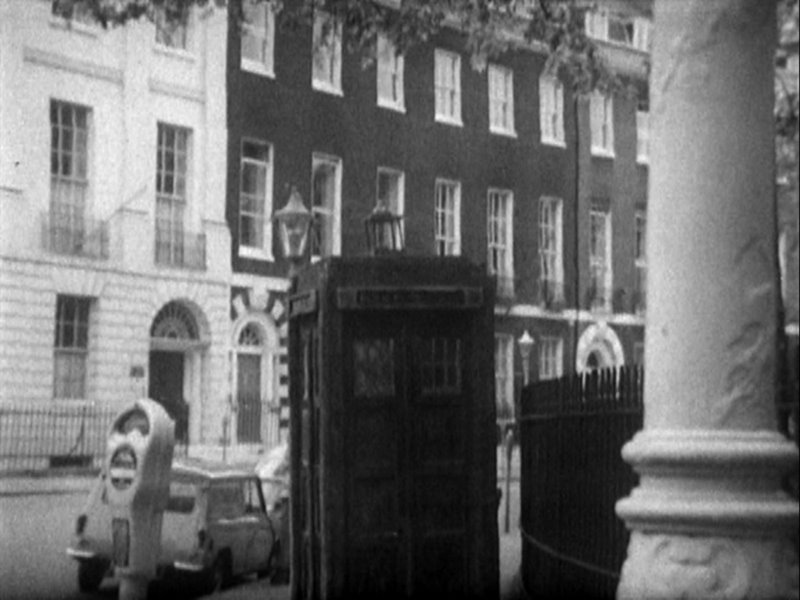
Dodo disembarks from the Tardis for the last time. The Doctor hangs an "Out of Order" sign on the Tardis lest it is mistaken for a real Police Box

Dodo disembarks from the Tardis for the last time. The Doctor hangs an “Out of Order” sign on the Tardis lest it is mistaken for a real Police Box

The last of the First Doctor’s serials which is 100 percent complete, The War Machines, plays upon the increasing fear of the mid 1960s that computers would usurp humans. This was an era almost ten years before the introduction of the first personal computers and 15 years before the release of IBM’s first PC and Microsoft’s MS-DOS computer operating system in 1981. Although personal computers had made inroads into the business markets by the late 1980s (Microsoft Windows was released in 1985) it was not until the mid 1990s that home PCs became more affordable and popular.  After borrowing friends’ unwieldy home-made computers to write my BA (Hons) thesis in mid 1980s, it was not until 1990 that I bought my first PC.  A clone of the IBM XT, it had a mammoth 128 KB of RAM and a 5¼ inch floppy drive!  An early adaptor of computer technology, the wonders of this piece of computer history came at an outrageous price of around $3,000.00.

An IBM XT.  My first computer was a clone of this machine

An IBM XT. My first computer was a clone of this machine

At the time of The War Machines’ transmission, it was unlikely that more than a handful of viewers would have ever personally seen a computer.  Computers were massive objects that frequently were the size of a room.  Perhaps seen in educational documentaries or on science fiction shows, computers were a great unknown. The playthings of mad scientists and eccentric geniuses, the distance between computers and the general public was such that they were greatly shrouded with mystique. I went through the whole of my schooling in the 1970s without ever seeing a computer, and entered the “real world” under a misapprehension, that was most probably quite commonly shared, that computers were only the domain of mathematical geniuses.

Anyone thinking of computers in the 1960s would probably envisage a machine such as this - The Whirlpool Computer which was designed for strategic air defense applications.  Photo courtesy of http://www.clavius.org/techcomp.html

Anyone thinking of computers in the 1960s would probably envisage a machine such as this – The Whirlpool Computer which was designed for strategic air defence applications. Photo courtesy of http://www.clavius.org/techcomp.html

Is it any wonder, therefore, that the ordinary Joe or Joy Bloggs might find a Doctor Who story set in present day London in 1966, about a computer intent on human domination, an altogether feasible possibility.  Although plainly science fiction, there was a kernel of fear and mistrust among many that this may one day become science fact.  Watching Classic Series  Doctor Who with an eye to history exhibits time and again that science fiction sometimes does become reality.  In Who’s first episode, An Unearthly Child, Susan predicts the UK’s conversion to decimal currency eight years prior to its eventual introduction in February 1971. “Spooky”, you might think, however The Time Machines did it again in mid 1966 when it foreshadowed the internet.

The War Machines foreshadowed the internet years before its introduction.  They even used funky computer graphics in the opening titles

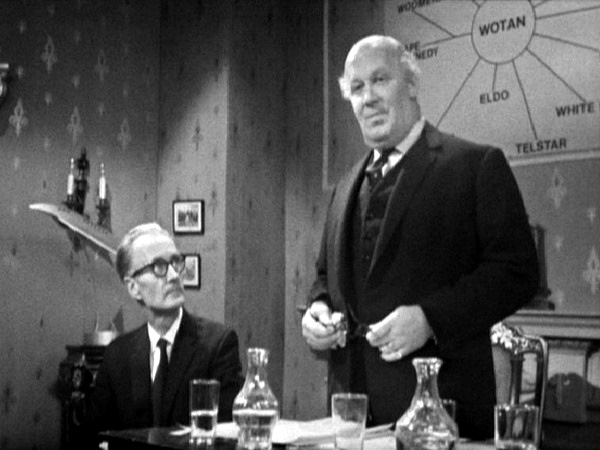
WOTAN,  an acronym for Will Operated Thought ANalogue, is the most advanced computer in the world, although not necessarily the largest.  It’s advanced technological capacities were a perfect companion for the building in which it was housed, the new Post Office Tower. Officially opened on the 15th July 1966 by the British Prime Minister, Harold Wilson, the Post Office Tower was the tallest building in London.  Towering 177 metres from the ground (581 feet), it held that title until 1980. “C Day”, or Computer Day was set for 16th July 1966, the day after the Post Office Tower’s official opening.  On that date all computers throughout the world were to be linked together under WOTAN’s (pronounced Votan) central control. The various sites to which WOTAN would be connected included the White House, Cape Kennedy, ELDO, TESTAR, RN, Woomera and EFTA.

Although not the world's largest computer, WOTAN in the most intelligent

Although not the world’s largest computer, WOTAN in the most intelligent

A media conference is held to outline WOTAN's roll out.  A graphic is displayed showing the computers which will be linked to WOTAN

A media conference is held to outline WOTAN’s roll out. A graphic is displayed showing the computers which will be linked to WOTAN

TELSTAR was the name of various telecommunications satellites which were launched in the early 1960s.  They provided the first transatlantic satellite television and telephone communications.  So heralded was the launch of the first TELSTAR in 1962 that an instrumental tune by the British band The Tornados became the first number one hit in the United States for a UK band.  Below, for your listening pleasure, is the Tornados with Telstar. ELDO was an acronym for the European Launcher Development Organisation (now the European Space Agency).  RN is presumably the British Royal Navy, EFTA is the European Free Trade Association (formed in 1960), and Woomera is a weapons testing range in South Australia.  Between 1946 and 1980 it was location for joint British and Australian weapons testing. The White House and Cape Kennedy require no explanation.

The Tornados – Telstar

The “C Day” linking of the world’s major computers foreshadowed the ARPANET, the first packet switching, in 1969. The Advanced Research Agencies Network (ARPANET) linked four university research centres together in the United States.  The World Wide Web as we know it now, did not reach fruition until the early 1990s. It could perhaps be rightly claimed that this serial of Doctor Who was the first television show to predict the emergence of the web.  Until I amended Wikipedia, a 1985 episode of Benson claimed to be the first such reference 🙂

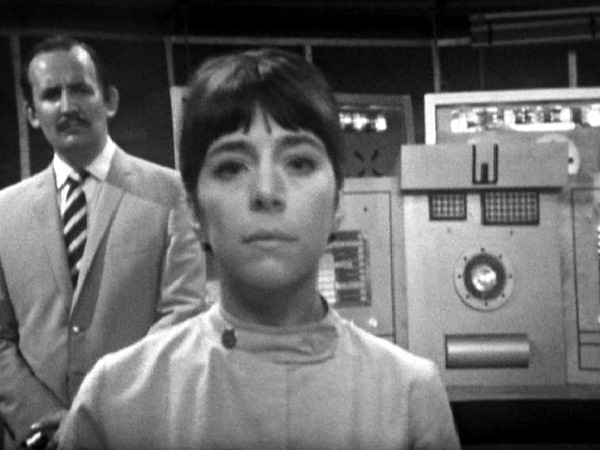
Professor Brett - the inventor of WOTAN.  The super-computer was to link all the leading computers in the world together

Professor Brett – the inventor of WOTAN. The super-computer was to link all the leading computers in the world together

Although the staff designated with WOTAN’s installation and roll-out were quick to dispel fears that the super-computer may eventually  become destructive, it does not take long for the malignant nature of WOTAN to become evident. WOTAN can speak and is receptive to voice commands, although ordinarily its answers are printed on a dot matrix type printer.  Computer monitors had clearly not been envisaged.  More intelligent than humans, WOTAN knows the answer to all questions, including inexplicably, what TARDIS is an acronym for. WOTAN, however, has a hidden agenda.  it believes that the world cannot possibly progress with humans at its helm and seeks to usurp them by mobile computer killing machines – the War Machines.

WOTAN has a secret agenda to usurp human control with its clumsy creations, the War Machines

WOTAN has a secret agenda to usurp human control with its clumsy creations, the War Machines

WOTAN uses mind control through the emission of sonic sounds and the humble telephone, to hypnotise humans into its sinister plan. Dodo is amongst its first victims and is instructed to co-opt the Doctor.  As luck would have it, his non-human form affords him protection from hypnosis, but not without him suffering physically nonetheless.   The Doctor’s magic ring again comes to the rescue as he is able to put Dodo to sleep, and snap her out of her hypnotic trance, merely by waving his hand before her face five times. Upon waking Dodo is dispatched to the country to recuperate and never again seen. Her subsequent decision to remain in London is communicated to the Doctor via a message from the companions-in-waiting, Ben and Polly.  A more pathetic companion departure had never been seen.

Dodo is hypnotised by WOTAN

Dodo is hypnotised by WOTAN

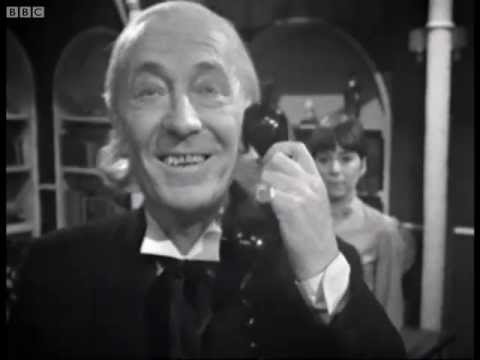
Hypnosis via the humble telephone is attempted on the Doctor.  The already submissive Dodo looks on

Hypnosis via the humble telephone is attempted on the Doctor. The already submissive Dodo looks on

WOTAN has its staff of hypnotised human slaves building a dozen War Machines in a disused warehouse in Covent Garden.  Professor Brett, the computer scientist who invented WOTAN, is quickly a victim of WOTAN’s hypnosis, and dispatched to the warehouse to oversee construction.  Polly, Brett’s secretary, also comes under WOTAN’s spell and is rescued by the Cockney sailor, Ben, who was sent on a mission by the Doctor to investigate. These War Machines were mobile computers but not in a form that we have today.  Extraordinarily large, they were more like wartime tanks than the laptops, net books and tablets that we know today.  Programmed by WOTAN, the War Machines are able to disable the firing mechanisms of Army guns and ammunition, and as such are seemingly unstoppable.  In an Army raid of the warehouse, the single operational War Machine is able to effect the deaths of many personnel.  On a rampage through the streets of Covent Garden, the War Machine is eventually outwitted by the Doctor’s cunning.  After the stupendous cliff hanger of episode three where the Doctor comes face to face with the War Machine and stares it down, he eventually stops the machine in its tracks by setting up an electromagnetic field around it.  An adept computer programmer, as he is of all manner of things scientific, the Doctor is able to reprogramme the War Machine. The machine is then sent on a mission to the Post Office Tower where it is able to reach the top floor, where WOTAN is housed, and destroy it. Commentators frequently joke about how the War Machine was able to fit in the lift, let alone press the floor buttons!

WOTAN's slave labour force construct War Machines

WOTAN’s slave labour force construct War Machines

Polly, Professor Brett's secretary, is hypnotised by WOTAN

Polly, Professor Brett’s secretary, is hypnotised by WOTAN

Save for the first episode of An Unearthly Child, in which you only see Coal Hill School and 76, Totter’s Lane,  and Planet of Giants, where the Tardis Crew are miniaturized in a suburban back yard and house, this is the first time Doctor Who has been set in modern day London. It affords the opportunity for many shots of 1966 London and naturally, the most innovative building of the day, the Post Office Tower. There are a number of very interesting special features on the DVD including Now and Then, a look at the locations used in the making of the story in which those used in 1966 are compared with the present day; Blue Peter, which includes a compilation of segments on the War Machines, and One Foot in the Past, in which the Politician and ex-Postmaster General Tony Benn investigates the history of the Post Office Tower. It’s all fascinating stuff.

The Doctor stops the War Machine by creating an electro magnetic field around it

The Doctor stops the War Machine by creating an electro magnetic field around it

The War Machines has shots a-plenty of London in 1966

The War Machines has shots a-plenty of London in 1966

Perhaps the most visually memorable part of The War Machines is when the Doctor enters the Inferno nightclub via a flight of stairs.  Resplendent in his cape, he enters the “hottest” night club in London, only to be told by one of the hipsters that his gear looked “fab”. It was not many episodes earlier that the Doctor had severely reprimanded Dodo for the use of the word “fab” and questioned if she could speak English properly.   Times were a-changing for Doctor Who and this was even more evident by the new companions.  Polly is a young London secretary who dresses in trendy clothes and is phenomenally forthright.  Ben is a Cockney merchant sailor who breaks the hitherto unwritten rule that all major cast members of Doctor Who must speak in “BBC English” or Received Pronunciation.  It was but a mere three months earlier that Dodo’s Manchurian accent lasted but 10 minutes. For the rest of Dodo’s tenure as a companion her accent changed from episode to episode and became increasingly more posh.  As groundbreaking as it was to have a companion without an RP accent, it took until the Seventh Doctor’s incarnation in 1987 for the Doctor to have his first regional accent.

Ben and Polly in "The Inferno", the hottest nightclub in London

Ben and Polly in “The Inferno”, the hottest nightclub in London

The Doctor, in that amazing cape, stares down the War Machine in the episode 3 cliff hanger

The Doctor, in that amazing cape, stares down the War Machine in the episode 3 cliff hanger

Join me for my next review where you’ll encounter the predecessor to 2011’s The Curse of the Black Spot, The Smugglers, in which every conceivable pirate cliché is presented before us.  It’s sure to be fun!

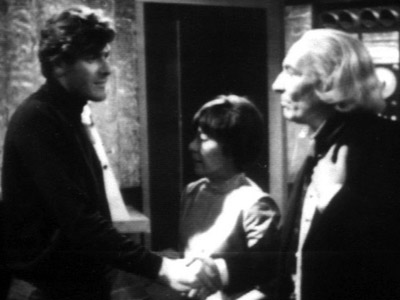
The Doctor is about to have two new companions.  Dodo and Ben meet the Doctor to pass on a message from the departing Dodo

The Doctor is about to have two new companions. Dodo and Ben meet the Doctor to pass on a message from the departing Dodo

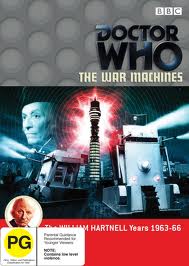
The War Machines was originally broadcast in the UK between 25th June and 16th July 1966

The War Machines was originally broadcast in the UK between 25th June and 16th July 1966

Vivien Fleming

©Vivien Fleming, 2013.

REFERENCE:

Lance Parkin & Lars Pearson, AHistory: An Unauthorised History of the Doctor Who Universe 3rd Edition. Des Monies, Mad Norwegian Press, 2012.

The Savages – Loose Cannon Reconstructions

Standard

The Savages - Loose Cannon VHS cover

All four episodes of The Savages are missing from the BBC Archives.  For the purposes of this marathon I viewed Loose Cannon’s reconstructions, the links for which are below.

Loose Cannon’s The Savages, Episode 1 Part 1

Loose Cannon’s The Savages, Episode 1 Part 2

Loose Cannon’s The Savages, Episode 2 Part 1

Loose Cannon’s The Savages, Episode 2 Part 2

Loose Cannon’s The Savages, Episode 3 Part 1

Loose Cannon’s The Savages, Episode 3 Part 2

Loose Cannon’s The Savages, Episode 4 Part 1

Loose Cannon’s The Savages, Episode 4 Part 2

The Savages

Standard

The Savages - Book

Watching The Savages was somewhat of a rare treat.  Not only was it a serial that I’d never before watched, but also one that I’d neither read nor heard spoken about.  I entered its viewing, therefore, with no preconceptions and an entirely open mind.  I’m very pleased that I did because I was thoroughly taken by this 1960’s tale of morality.  I enjoy looking for the political in serials, even if a message was not intentionally left.  The Savages, however, proudly flaunts its political design.  Whether it was intended to be a tale against South Africa’s apartheid regime, the association of eugenics with Nazi Germany, or a cutting condemnation of the British Class system, it matters not.  What is important in my mind is that The Savages is as equally as relevant today as it was in 1966.

The "Savage" inhabitants of the planet.  They are humans, just like the Elders, whoever they are considered barbarians

The “Savage” inhabitants of the planet. They are humans, just like the Elders, however they are considered barbarians by the Elders

The Doctor and his companions find themselves on an unnamed planet amongst a civilization which the Doctor considers highly advanced. Although the landscape is somewhat arid and populated by people leading an almost caveman like existence (the Savages), there is built on the planet a sparkling city.  Freedom is afforded to the city’s occupants sufficient to allow them as much leisure time as they so desire.  Their wants are always met, however they are unable to exit the city to the real world.  The city is entirely enclosed with no access to natural air, light, sun, rain or wind, however the occupants don’t consider themselves to suffer materially or physically as a consequence.  The occupants of both the city (the Elders) and the outside world (the Savages) are human and save for the vast differences in their qualities of life, are nonetheless identical physically and psychologically.

 Steven and Dodo are confronted by a Savage.  They run to the Tardis for cover


Steven and Dodo are confronted by a Savage. They run to the Tardis for cover

The Elders consider themselves superior in all ways to the Savages, who are treated as barbarians.  The Elders welcome the Doctor’s arrival and claim that they have been tracking the course of his spaceship for many eons. His arrival is considered a time of momentous historical importance. The Doctor is treated as a folk hero and a man of very high regard,  and is afforded the honorary office of High Elder. The Council of Elders, however, is nonetheless surprised that the Doctor is travelling with companions.  Dodo and Steven are welcomed and given gifts of a mirror inlaid with precious gemstones (for Dodo) and an ornamental dagger (for Steven).  The mirror plays an important role in the story at a later stage.

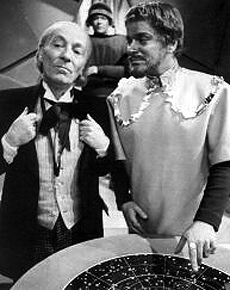
The Doctor and Jago, the Elder's leader

The Doctor and Jago, the Elder’s leader

The Elders are proud of their intellectual and scientific progress and extol its virtues to the Doctor.  Jano’s discussion of race perfection is chillingly reminiscent of eugenics:

“Doctor, do you realise that with our knowledge, we can make the brave man braver, the wise man wiser, the strong man stronger.  We can make the beautiful girl more beautiful still.  You will see the advantages of that in the perfection of our race”.

Nanina is a Savage whose life force the Elders use to make their own people more beautiful

Nanina is a Savage whose life force the Elders use to make their own people more beautiful

Whilst initially impressed by the Elders’ “vast scientific research” and their race of “great intelligence”, the Doctor soon became suspicious and had an uncomfortable feeling about this  place which otherwise evidenced a greatly advanced society.  On coming upon one of the Savages in the Elders’ facility the Doctor was quickly cognisant of what was occurring.  The Elders had “discovered a way of extracting life’s force from human beings, and absorbing it into themselves, leaving the victim, as you see, almost dead”.

The Elders escorting Nanina from their laboratory following a transference

The Elders escorting Nanina from their laboratory following a transference

Once aware of the horrors that were perpetrated against the Savages, the Doctor was quick to condemn the travesty.  In doing so, however, he found himself an unwilling participant in the Elders’ immoral “medical” procedure.  The Doctor’s powerful conversation with the Elder leader, Jano, is worthy of quoting verbatim.

JANO:  We do not understand you, Doctor. You have accepted our honours gladly, how can you condemn this great artistic and scientific civilisation because of a few wretched barbarians?

DOCTOR: So your rewards are only for the people that agree with you ?

JANO: No. No, of course not.  But if you are going to oppose us.

DOCTOR: Oppose you? Indeed I am going to oppose you, just in the same way that I oppose the Daleks or any other menace to common humanity.

JANO: I am sorry you take this attitude, Doctor.  It is most unscientific.  You are standing in the way of human progress.

DOCTOR: Human progress, sir?  How dare you call your treatment of these people progress!

JANO: They are hardly people, Doctor.  They are not like us.

DOCTOR: I fail to see the difference.

JANO: Do you not realise that all progress is based on exploitation.

DOCTOR: Exploitation indeed!  This, sir, is protracted murder!

JANO: We have achieved a very great deal merely by the sacrifice of a few savages.

DOCTOR: The sacrifice of even one soul is far too great!  You must put an end to this inhuman practice.

JANO: You leave me no choice.  Take him away, Captain.  And tell Senta that we have an emergency.  I shall be sending him special instructions.

The Doctor is placed on a gurney and strapped down.  Wheeled into the vaporization unit, the Doctor undergoes transference.  This procedure is considered by the Elders to be the most impressive ever undertaken because no person of such high intellect has previously been subjected to it. The Doctor is rendered unconscious and upon waking he is weak, groggy and disorientated.  He is unable to speak for the rest of the episode.

The Doctor is an unwilling donor in the Elders' life force extraction

The Doctor is an unwilling donor in the Elders’ life force extraction

Given the unique nature of the Doctor’s transference the Elder leader, Jano, volunteers to be the recipient of the Doctor’s life force. Unbeknownst to all, Jano receives more than he bargained for.  Perhaps because of the Doctor’s non-human DNA, Jano develops a conscience and the speech mannerisms of the Doctor. Rob Shearman argues in Running Through Corridors that this was a ploy by the Doctor Who production team to see if the Doctor could be performed by someone other than William Hartnell.  In my review of The Celestial Toymaker I noted that Hartnell was lucky to have escaped the chop during that production run.  Shearman goes on to state that Frederick Jaeger, the actor who played Jano, was unsuccessful in pulling it off.  Had he done so, and replaced Hartnell, then the series is unlikely to have lasted more than a short period of time.  It was the radical reworking of the title character in the form of Patrick Troughton, Shearman argues, that secured Doctor Who’s future.

Dodo in the tunnels of the Elders' city

Dodo in the tunnels of the Elders’ city

It is the emergence of Jano’s conscience that facilitates his treason against the Elders and support of the Doctor, his companions and the Savages in the destruction of the Elders’ scientific equipment.  The Doctor’s acquiescence to the wilful destruction evidences a distinct change to his previous “no interference” policy.  The Doctor is changing history and quite proudly doing so.  The devastation of the equipment is undertaken in a most luddite like manner and is perhaps a hint that this serial is just as much about the perils of technology, and its effect upon the working classes, as it is about issues pertaining to racism or eugenics. Given that the writer, Ian Sturt Black, died in 1997 we are unlikely to ever know for sure.

The Doctor and Exorse, one of the Elders. Note Exorse's less than flattering head gear

The Doctor and Exorse, one of the Elders. Note Exorse’s less than flattering head gear

It has been argued that The Savages is essentially the same story as The Ark. Both involve a society residing in an artificial environment in which one group oppresses the other.  There is no logical basis for this discrimination and in both serials the oppressed rise up and usurp their overlords.  Both end with the need for co-operation between the former enemies.  When reviewing The Ark I noted that there was no guarantee that the Monoids would accept the Guardians’ proposals for peace.  In The Savages, however, peace is assured by the intervention of an independent third party as mediator.  Much to Steven’s  dismay, the Doctor volunteered him to remain and facilitate the transformation to a fair and just society. Although initially hesitant, Steven quickly accepts the challenge and the Doctor and Dodo depart to the Tardis. Although Steven’s retreat  is only slightly less hasty than Vicki’s, at least he is not the victim of a quick romance and marriage.  As our next serial, The War Machines, will show, there are a lot worse companion exits to come.

The Doctor says farewell to Steven as the distressed Dodo looks on

The Doctor says farewell to Steven as the distressed Dodo looks on

For the record, The Savages is the first serial to not have its episodes individually titled. Henceforth the viewers are better able to know when a serial starts and finishes.  Unfortunately for diehard fans of the series it also means that there will no longer be any arguments on what the serial’s correct title is! A sign of the more innocent times of the 1960s can be seen in the Doctor’s unique calculating apparatus – a Reacting Vibrator.  Is it any wonder that it was never seen or heard of again. This serial is also unique in that there are absolutely no monsters.  The inhumanity of humans to their own kind is monstrous enough. The four episodes of The Savages are among the 106 episodes that are no longer held in the BBC archives.  This marathon was undertaken by viewing Loose Cannon’s excellent reconstructions.

The Doctor and his strangely named RV - Reacting Vibrator.  Is it any wonder that it was never seen or heard of again?

The Doctor and his strangely named RV – Reacting Vibrator. Is it any wonder that it was never seen or heard of again?

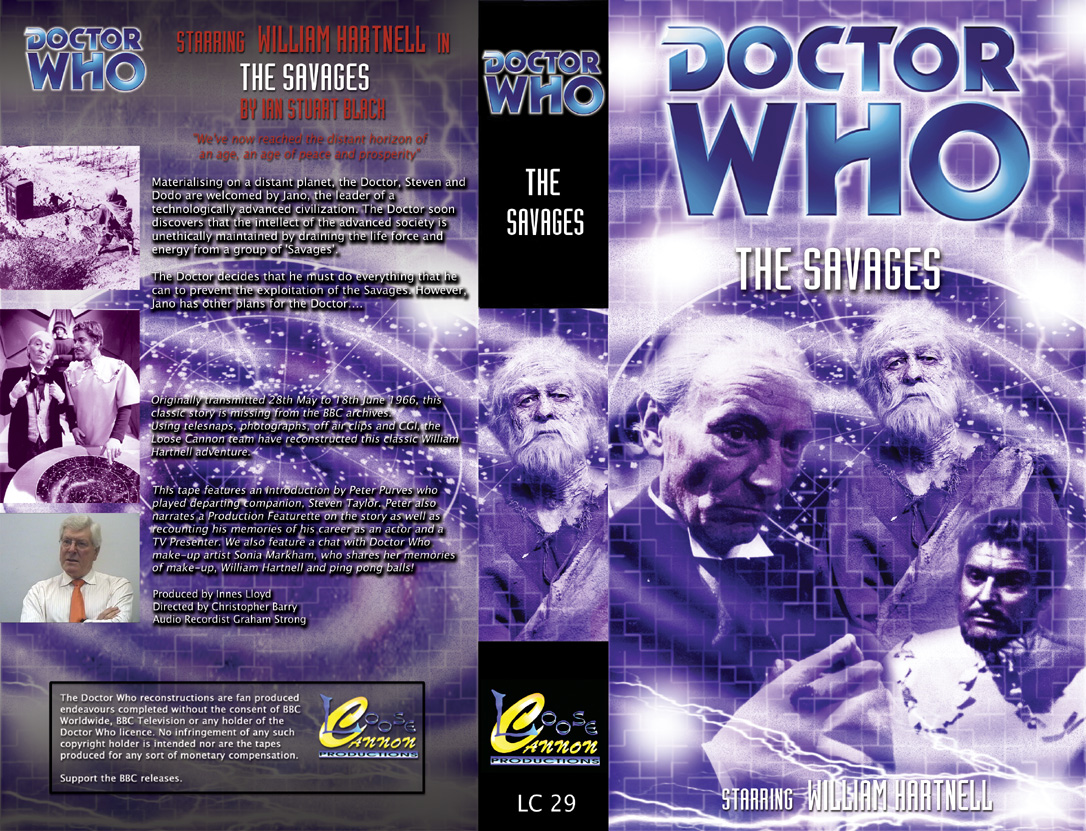
Loose Cannon's VHS Cover art for their The Savages reconstructions.  The Savages was originally broadcast in the UK between 28th May and 18th June 1966

Loose Cannon’s VHS Cover art for their The Savages reconstructions. The Savages was originally broadcast in the UK between 28th May and 18th June 1966

Vivien Fleming

©Vivien Fleming, 2013.

REFERENCE:

Robert Shearman and Toby Hadoke, Running Through Corridors.  Rob and Toby’s Marathon Watch of Doctor Who (Mad Norwegian Press, Des Moines, Iowa: 2011),

The Daleks’ 50th Birthday Party

Standard

Image

With all the hype surrounding Doctor Who’s 50th Anniversary  on 23rd November,  the 50th birthday of the Doctor’s oldest and most deadliest foe, the Daleks, looked like it may well have been forgotten.  Born on the screens of the United Kingdom’s 405 line black and white TV sets on 21st December 1963, the Daleks have appeared in over 30 Doctor Who serials, together with a number of cameos and flashbacks.  They have battled against 10 of the Doctor’s 11 incarnations and have been killed and resurrected more times than Rory Williams!

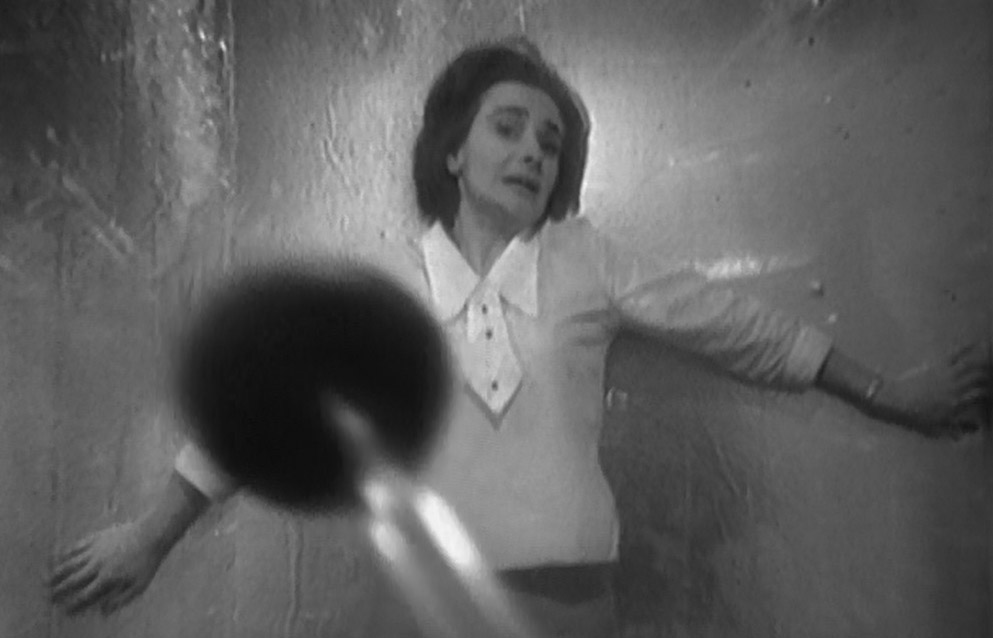
Barbara is pinned against the wall in fear during the Daleks' first appearance in Doctor Who on 21st December 1963

Barbara is pinned against the wall in fear during the Daleks’ first appearance in Doctor Who on 21st December 1963

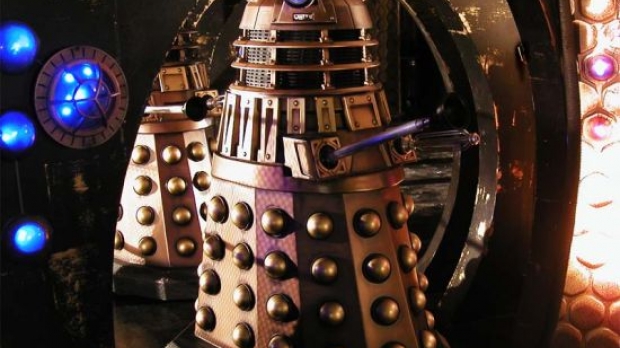
The BBC has today announced that the Daleks will appear in the Doctor Who 50th Anniversary special, together with the shape shifting Zygons who will make only their second appearance  – 38 years after their first. Details of the nature of the Daleks battle with the Tenth and Eleventh Doctors, together with John Hurt, a hitherto unknown incarnation, have yet to be revealed.  Let’s hope it’s as memorable as the closing shot of 1963’s The Dead Planet where companion Barbara Wright is pinned in fear against wall.  Barbara’s screams indicated the presence of a terrifying foe, although for the next seven days the audience could only but imagine what the strange rubber object on the end of a metal rod was. The Daleks were born and there was no looking back.  Without the Dalekmania which followed their first story, it’s unlikely that Doctor Who would have celebrated its first birthday, let alone its 50th. Long live the Daleks and may we look forward to another 50 years of terror!

The BBC today released this photograph of the Daleks from the 50th Anniversary special which is to be aired on 23rd November 2013

The BBC today released this photograph of the Daleks from the 50th Anniversary special which is to be aired on 23rd November 2013

Vivien Fleming

©Vivien Fleming, 2013.

The Gunfighters

Standard

Image

Recently released to celebrate the 50th anniversary of Doctor WhoCelebrate Regenerate is a fan produced chronicle of every broadcast episode of Who.  Available as a free PDF download from http://celebrateregenerate.weebly.com/ this mighty tome features a page long article on every serial.  The authors of The Gunfighters article, Mike Greaves and Andrew Boland, succinctly summarize received fan wisdom on this Western adventure. Dreadful, terrible, boring, and badly made are some of the words and phrases used by Greaves and Boland to describe the average fan’s dismissal of this tale.  So convinced were they that the viewing experience would be tortuous and entirely unenjoyable that once viewed, they questioned whether  they’d watched the right serial.  Were there two 1960s Doctor Who Westerns, they wondered.   There was indeed only one and clearly there was something peculiar going on. Greaves and Boland had actually thoroughly enjoyed The Gunfighters.

Edited by Lewis Christian, Celebrate Regenerate is a fan produced chronicle of every Doctor Who episode

Edited by Lewis Christian, Celebrate Regenerate is a fan produced chronicle of every Doctor Who episode

Phil Sandifer in his book Tardis Eruditorum Volume 1: William Hartnell examines this received wisdom in depth and identifies three distinct stages of fan criticism.  The first he describes as 1980s fandom; the second as the Great Re-evaluation of the 1990s; and the third, the Reconstructionist era beginning in 2002. The first era occurred in a time when there was neither video releases of Doctor Who nor the internet.  Fan opinion was derived from memories of the programmes when originally broadcast and a limited number of books, the most notable of which was Peter Haining’s 1983 Doctor Who: A Celebration. This coffee table book was almost seen as the Bible of Who and its critical analysis of episodes taken as Gospel.   Haining’s review of The Gunfighters was scathingly negative and it is most probably from this source that received fan wisdom grew.

The Doctor and his companions visit Tombstone, Arizona

The Doctor and his companions visit Tombstone, Arizona

The Great Re-evaluation that followed the release of stories on VHS cassette was not so much a detailed reappraisal of stories, but rather discussions to produce a general consensus on the relative merits of each story.  It was not until all existing stories had been released on VHS, and Loose Cannon had completed their reconstructions, that what Sandifer describes as the democratization of fan criticism began.  The ordinary Who fan was now in a position to access the stories for themselves and with the re-launch of Who in 2005, new fans had little concern for what the Classic Series critics of old said. With the pervasiveness of the internet and instant access to television programming everyone had become a media critic.

Steven and Dodo enjoy dressing up as Cowboys and Cowgirls

Steven and Dodo enjoy dressing up as Cowboys and Cowgirls

It is from this new position of fan criticism that The Gunfighters has been reappraised.  That the story is unique cannot be denied.  It is the only Doctor Who story with a sung narration, in the form of The Ballad of the Last Chance Saloon. Sung by Lynda Baron, the Ballad is heard at times of climatic tension throughout the serial.  The lyrics change to reflect the action and it’s also sung by Steven and Doc Holliday’s girlfriend, Kate, in the saloon.  It’s the latter renditions that are posted below for your viewing pleasure.

The Ballad of the Last Chance Saloon

Written by Donald Cotton, the author of The Myth Makers, the serial has a similar comedy format to Cotton’s previous Who outing.  Again it mirrors the events in Troy when episode four descends into tragedy. The Gunfighters  is set in 1881 America and follows the film The Gunfight at the OK Corral  as one of its primary sources.  Doctor Who would not return to the American Wild West until the Eleventh Doctor’s 2012 adventure A Town Called Mercy. Having broken a tooth eating one of the Cyril’s lollies in The Celestial Toyroom, the Doctor uses his unexpected arrival in the American mid-west to procure the services of the local dentist, Doc Holliday. He is immediately mistaken for Holliday by the town’s residents and hunted down by the Clanton family. Throw into the mix the Earp brothers, Virgil and Warren, and add Johnny Ringo (who historically wasn’t involved in these Tombstone, Arizona events), and you have a ripping good yarn.

The Doctor has a tooth extracted by Doc Holliday

The Doctor has a tooth extracted by Doc Holliday

William Hartnell absolutely shines in The Gunfighters, undoubtedly because it was a comedy and the genre in which he most enjoyed to act. The Doctor is given some fabulous lines and rarely does he stumble on them.  Except, of course, when he refers to Steven as a “she”!  Peter Purves does a superb job, as always, and Jackie Lane, as Dodo, is at last afforded the opportunity to act.  Her scene with Doc Holliday when she threatens him with a gun is just fabulous.  The set work was superb even if the stair railings did wobble when Ike Clanton fell to his death. The Doctor Who production team must have recently found the services of an animal wrangler.  Less than two months earlier they’d had an elephant in the studio for The Ark and this time a horse.  I wonder what the cleaners thought at the end of the day’s filming!

The Doctor in Doc Holliday's dentist chair.  Beside the Doctor is Kate, Doc's girlfriend

The Doctor in Doc Holliday’s dentist chair. Beside the Doctor is Kate, Holliday’s girlfriend

There are a couple of interesting facts to note in this serial.  The original working title was The Gunslingers, and as anyone who has viewed the Series 7 episode, A Town Called Mercy, would be aware,  there’s a character by that very same name. The Gunfighters  also stared the Thunderbirds voice artists, David Graham (Brains) and Shane Rimmer (Alan Tracey). Graham played the unfortunate barman, Charlie, and Rimmer the character of Seth Harper.  Lynda Baron, the off camera singer of The Ballad of the Last Chance Saloon appeared in the Series 6 story Closing Time as Val.

The working title of The Gunfighters was The Gunslingers.  That name was not forgotten and the character, The Gunslinger, appeared in 2012's A Town Called Mercy

The working title of The Gunfighters was The Gunslingers. That name was not forgotten and the character, The Gunslinger, appeared in 2012’s A Town Called Mercy

Guess which two Thunderbirds voice artists appeared in The Gunfighters

Guess which two Thunderbirds voice artists appeared in The Gunfighters

The Gunfighters was originally broadcast in the UK between 30 April and 21 May 1966

The Gunfighters was originally broadcast in the UK between 30 April and 21 May 1966

The Gunfighters DVD was released with the Fifth Doctor adventure The Awakening in the Earth Story Box Set

The Gunfighters DVD was released with the Fifth Doctor adventure The Awakening in the Earth Story Box Set

Vivien Fleming

©Vivien Fleming, 2013.

REFERENCES:

Lewis Christian (ed), Celebrate, Regeneratehttp://celebrateregenerate.weebly.com/, 2013.

Phil Sandifer, Tardis Eruditorum Volume 1: William Hartnell. Self published, 2011.

The Celestial Toymaker – Loose Cannon Reconstructions

Standard

Image

Episode 4 of The Celestial Toymaker is available on the Lost in Time DVD.  For the purposes of this marathon I viewed Loose Cannon’s reconstructions of episodes 1, 2 and 3, and the BBC produced DVD for episode 4.

Loose Cannon’s The Celestial Toymaker, Episode 1 Part 1

Loose Cannon’s The Celestial Toymaker, Episode 1 Part 2

Loose Cannon’s The Celestial Toymaker, Episode 2 Part 1

Loose Cannon’s The Celestial Toymaker, Episode 2 Part 2

Loose Cannon’s The Celestial Toymaker, Episode 3 Part 1

Loose Cannon’s The Celestial Toymaker, Episode 3 Part 2

Episode 4 of The Celestial Toymaker is included in the Lost in Time triple DVD set. The Celestial Toymaker was originally broadcast in the UK between 2nd April and 23rd April 1966

Episode 4 of The Celestial Toymaker is included in the Lost in Time triple DVD set. The Celestial Toymaker was originally broadcast in the UK between 2nd April and 23rd April 1966