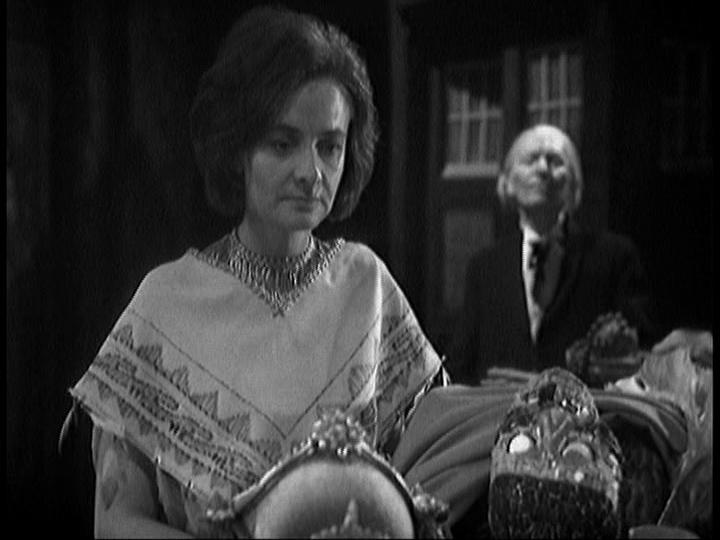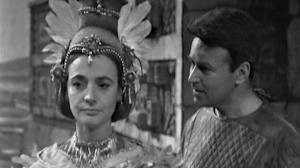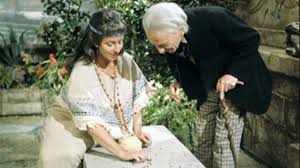
Category Archives: Companions

The Romans

Standard

Image

The Romans is the first of only two Doctor Who stories set in ancient Italy.  It would take a further 43 years, until 2008’s The Fires of Pompeii, for the Doctor to again visit the region.  Perhaps in a nod to the First Doctor’s inability to navigate the Tardis, the Tenth Doctor and Donna landed in what they had initially thought was Rome, but soon discovered was Pompeii.  The Tenth Doctor referred to his earlier adventures in Rome by stating that his role in the Great Fire of Rome was almost “nothing”.
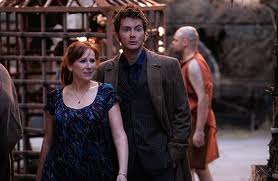
The Tenth Doctor and companion Donna in "The Fires of Pompeii"

The Tenth Doctor and companion Donna in “The Fires of Pompeii”

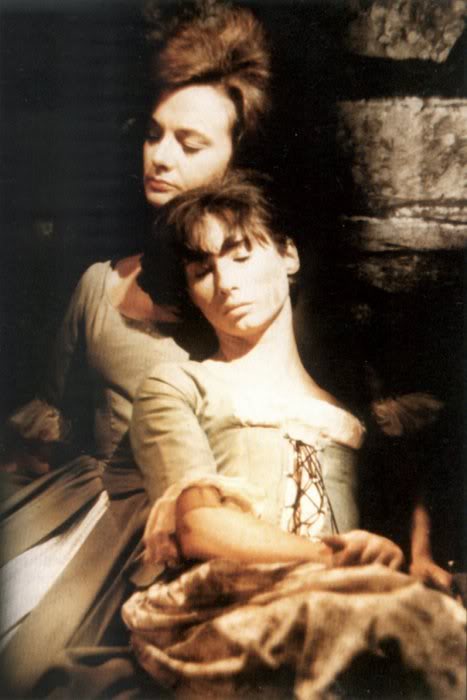
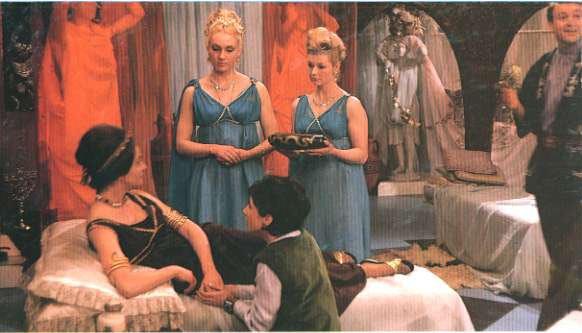
The Romans is perhaps the only Doctor Who story to have ever been conceived as a farce.  Unapologetically in the English tradition of ribald comedies, such as Carry On movies, The Romans does not lack the  “slap and tickle” school boy humour of the genre.  Barbara is chased around by Caesar Nero for most of episode 3, in a slapstick game of sexual catch in which she is an unwilling participant.  Seen as a threat by Nero’s wife,  Barbara is the victim of yet another attempted poisoning.  Unlike the first poisoning conspiracy in The Aztecs, it is not Barbara who thwarts the attempt on her life but Vicki, albeit unknowing of the intended victim.
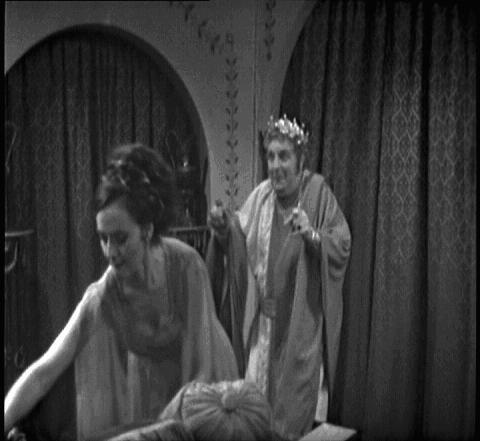
Nero plays a game of "slap and tickle" with a reluctant Barbara

Nero plays a game of “slap and tickle” with a reluctant Barbara

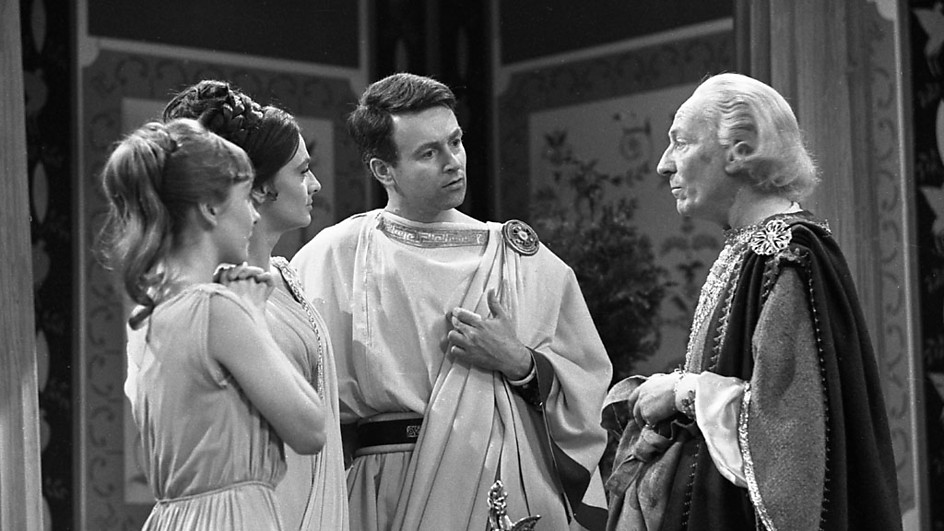
The story begins with the Doctor and his companions living it up in a Roman country villa.  For the first time since the show’s commencement, the Tardis Crew are holidaying and have been leading a leisurely existence for the last month.  Although never stated, but clearly implied, Ian and Barbara are very much a couple.  Together they play harmless practical jokes and Barbara restyles Ian’s hair. Ian would be happy to continue this lifestyle indefinitely, however the young Vicki is easily bored.  She complains to Barbara that she is not getting the life of adventure that the Doctor had promised.   Vicki shows no ill effects from the psychological trauma suffered at the hands of Bennett/Koquillion in her first serial.  Given that the term Post Traumatic Stress Disorder was not coined until the 1970s, it’s perhaps not surprising that the writer, Dennis Spooner, was not conversant at the time with psychological trauma and its effects.
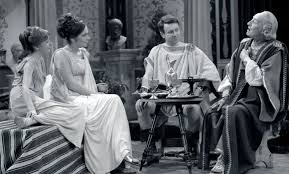
The Tardis Crew living it up in a country villa

The Tardis Crew living it up in a country villa

The irascible Doctor decides to visit Rome and is begged by Vicki to be allowed to accompany him. Although accepting Vicki’s request, the Doctor refuses to allow Ian and Barbara to join him.  He doesn’t need people to fuss over him and suggests instead that they make their own way there.  Little does the Doctor know that his fellow companions will eventually make it to Rome, but not by their own free will.  Even at the story’s conclusion the Doctor is blindly unaware of his two companions’ adventures.
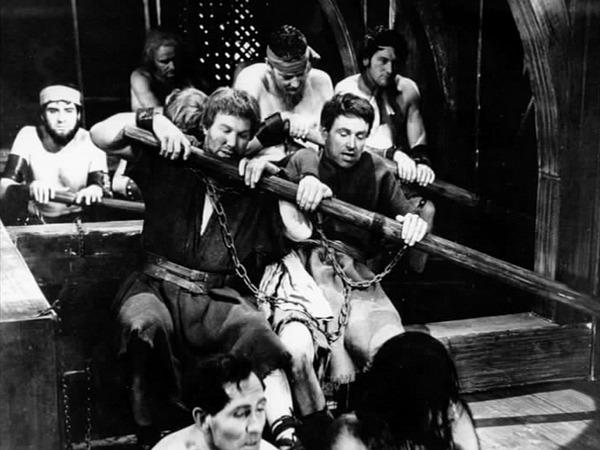
Ian as a galley slave

Ian as a galley slave

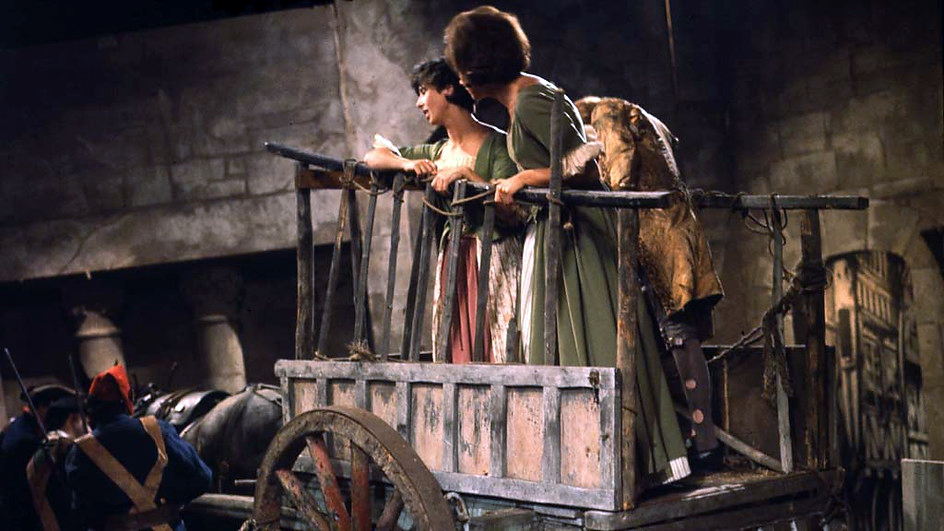
The farce continues as the Doctor is mistaken for the famous Corinthian lyre player, Maximus Pettullian. Initially unable to remember his assumed name, the Doctor and Vicki are taken to Nero’s palace where the real, but now decidedly dead, Maximus was due to play a recital. Being bereft of all lyre playing skills does not prevent the Doctor from performing at a feast for Nero in a hysterical example of what today might be described as “Air Lyre”.  Meanwhile, the Doctor and Vicki continuously, but ever so slightly, miss running into Barbara and Ian, who are unaware that their fellow Tardis crew members are also in Nero’s palace. After being captured in the villa and taken as slaves, Barbara is sold to Nero’s household as a servant and Ian finds himself as a galley slave in a boat.  After again being knocked unconscious, this time by a beam,  Ian escapes upon the boat’s wreck.  Making his way to Rome to save Barbara, Ian eventually finds her in Nero’s household.
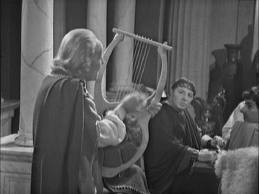
The Doctor and his non-existent lyre playing skills

The Doctor and his non-existent lyre playing skills

Almost every conceivable cliché of Roman life is played in this story.  When shopping in a market for fabric Barbara reminds Vicki that “when in Rome, do as the Romans do”. Ian quotes Latin texts whilst lounging around the villa eating grapes, is trained as a gladiator, and almost ends up as a lion’s meal.  The Doctor gets the corniest lines when, in reference to playing lyre amongst the lions, he states that his performance is bound to be a “roaring success” and “something to get your teeth into”. Slave traders abound, and the “good guy” in Nero’s household, Tavius, is a closet Christian. Rome burns whilst Nero plays the lyre, but not before the Doctor inadvertently gives him the idea that a fire is a good way of circumventing objections to Nero’s rebuilding plans.  Even the episode naming is clichéd, with the second entitled All Roads Lead to Rome.
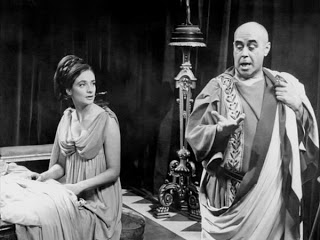
Barbara and the "guy guy" of Nero's household, Tavius

Barbara and the “guy guy” of Nero’s household, Tavius
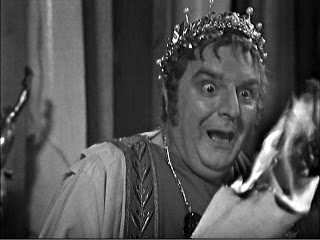
Nero conceives of the idea to burn Rome

Nero conceives of the idea to burn Rome

Relations between Vicki and Barbara have softened following the killing of Sandy in the The Rescue.  Vicki goes as far as asking Barbara to make her a dress while the pair are shopping in a Roman market.  Dressmaking is a skill frequently assumed of Barbara.  The Doctor continues to be decidedly amoral and exhibits how much he relishes a good fight. Upon being confronted by a would-be assassin, the Doctor smashes a pot plant over his head and then wraps a blanket around him.  He then throws wine over the assassin’s face, hits him over the head with a jar and very athletically dodges a swinging sword.  Just as Vicki picks up an object to hit the assailant, he jumps out of an open window.  Frustrated by Vicki’s intervention the Doctor regales the girl with tales of his fighting prowess.
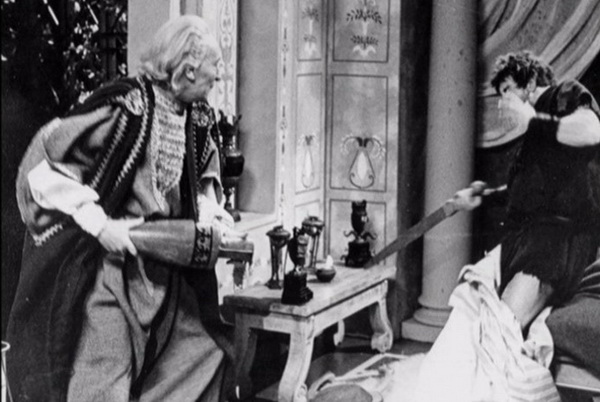
The Doctor displays his finely tuned fighting skills whilst in battle with a would-be assassin

The Doctor displays his finely tuned fighting skills whilst in battle with a would-be assassin

DOCTOR: Young lady, why did you have to come in and interrupt? Just as I’d got him all softened up and ready for the old one, two.

VICKI: You’re all right then?

DOCTOR: All right? Of course, I’m all right, my child.  You know, I am so constantly outwitting the opposition, I tend to forget the delights and satisfaction of the arts, the gentle art of fisticuffs.

VICKI: I realize you’re a many of many talents, Doctor, but I didn’t know fighting was one of them.

DOCTOR: My dear, I am one of the best.  Do you know it was I that used to teach the Mountain Mauler of Montana!

VICKI: The what?

DOCTOR: Do you remember?  Have you never heard?  No, of course, no, no, of course you haven’t, have you?
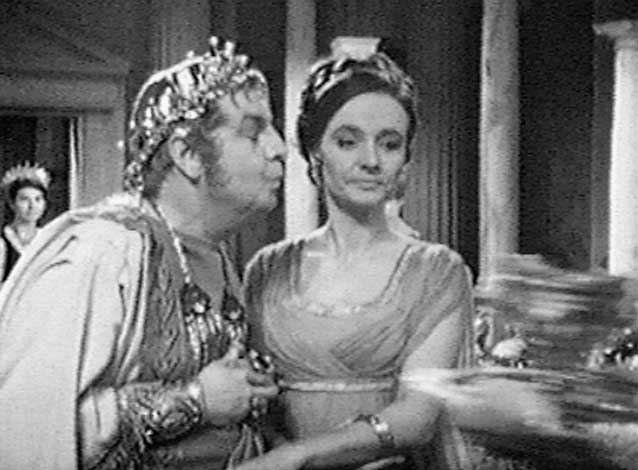
Barbara continually resisted Nero's advances, notwithstanding the gift of a gold bracelet.  The bracelet will be of significance in the next story, "The Web Planet"

Barbara continually resisted Nero’s advances, notwithstanding the gift of a gold bracelet. The bracelet will be of significance in the next story, “The Web Planet”

The Doctor, who in later serials such as Galaxy 4 is keen to advise all that neither him nor his crew kill, clearly has no such inhibitions when it comes to fighting. Will the Doctor entertain us with his combat skills in the next serial, The Web Planet? Stay tuned for the next review where perhaps this question will be answered.
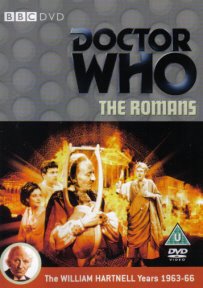
The Romans was originally broadcast in the UK between 16th January and 6th February 1965
The Romans was originally broadcast in the UK between 16th January and 6th February 1965

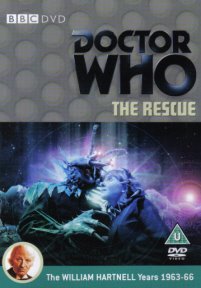
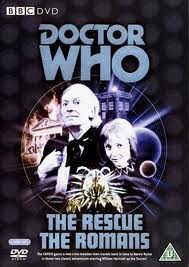
"The Romans" DVD was released in a Box Set with "The Rescue" entitled (unsurprisingly) "The Rescue The Romans"

“The Romans” DVD was released in a Box Set with “The Rescue” entitled (unsurprisingly) “The Rescue The Romans”

Vivien Fleming

©Vivien Fleming, 2013.
The Rescue

Standard

Image

Perhaps more than any other, The Rescue is a serial that is more profoundly disturbing on the second viewing than on the first. Should you wish to watch this story without forewarning of its contents, then beware.  Spoilers are contained within.

Taken at face value, The Rescue is a somewhat innocuous story.  One of the few two part serials in classic Who, The Rescue was originally broadcast between the Dalekmania inducing Invasion of Earth, and the Carry On style slapstick comedy of The Romans. The Doctor’s grand-daughter, Susan, had left Doctor Who at the conclusion of The Dalek Invasion of Earth to commence a new life with the urban guerrilla, David Campbell. The purpose of this story was to introduce the new companion, Vicki, an orphan survivor of a spaceship crash on the planet Dido.

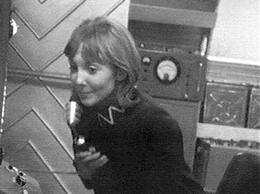
Vicki radios the Dido bound rescue craft

Vicki radios the Dido bound rescue craft

Only two crew members of the ship remain at the serial’s commencement, Vicki and Bennett, an apparently disabled man in his 30s or 40s who was played by Australian actor, Ray Barrett.  The other crew members who had survived the crash, it was believed, had perished in an explosion when they had attended a “meet and greet” with the residents of the planet, Dido. It was in this explosion that Bennett is said to have sustained an injury to his legs that left him all but bedridden.  Vicki was the only crew member who didn’t attend the function as she was suffering from a fever at the time.

Vicki and Bennett are the sole survivors of a spaceship crash on the planet Dido

Vicki and Bennett are the sole survivors of a spaceship crash on the planet Dido

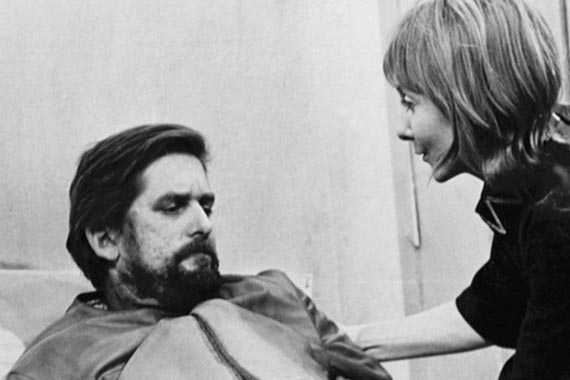
Barbara, Bennett and Vicki

Barbara, Bennett and Vicki

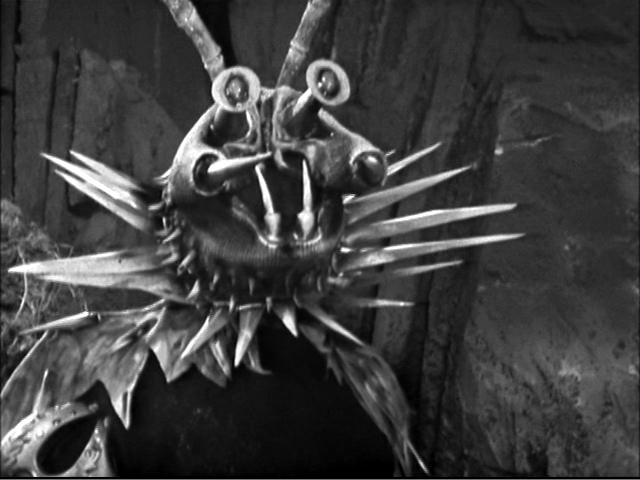
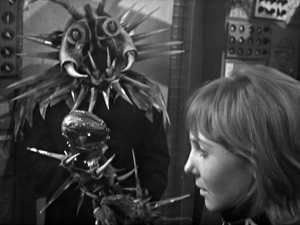
As the only able bodied survivor, Vicki takes on the role of caring for Bennett, who remains in his cabin most of the time.  Menacing the survivors is a grotesque monster called Koquillion. Although humanoid in body form, Koquillion’s head and hands are a jumble of large and pointed spikes. Vicki, however, is only ever alone when sees the monster. Bennett has not witnessed the beast in the presence of Vicki, however appears more than knowledgeable about its threat.  He is quick to remind Vicki to watch out for Koquillion.  He’ll be around somewhere, advises Bennett, and he will kill both of them if he learns about the rescue mission which is due to shortly arrive.

Koquillion menaces Vicki

Koquillion menaces Vicki

Koquillion plays a sinister game of mind control and psychological abuse on Vicki.  He arrives at the ship intermittently and tells her that she is not to wander within 50 yards of the vessel.  Koquillion claims that the local people are warlike and that he alone can save Vicki and Bennett from his own people.  “I am your only protection!” exclaims Koquillion,  “You should be grateful”.  This psychological warfare has left Vicki confused and contradictory.  One moment she is scared that Koquillion could keep her on Dido forever, yet when Barbara looks at her in a concerned manner she immediately snaps “You’re sorry for me, aren’t you?  I’m perfectly all right, you know.  I don’t care if nobody ever comes.  I’m fine.  I’m perfectly fine”.  Clearly Vicki is anything but fine.

Ian, Barbara and Koquillion

Ian, Barbara and Koquillion

Ordinarily left with no company other than the abrupt and irascible Bennett, Vicki takes solace in her friendship with a Didonian, a reptilian like native of the planet.  Whilst collecting water in jerry-cans her legless companion, whom Vicki has named Sandy, approaches.  Fearful that it is about to pounce on Vicki, Barbara shoots it, not withstanding Vicki’s protestations.   It subsequently takes the Doctor’s intervention to heal the rift that necessarily emerges between Vicki and Barbara.

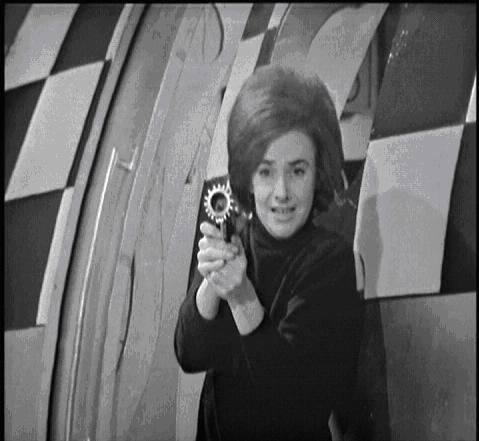
Barbara shows that even the inexperienced can shoot to kill

Barbara shows that even the inexperienced can shoot to kill

Vicki has been living on tenterhooks, waiting always for the unexpected arrival of Koquillion.  His psychological control of her is immense, notwithstanding that there has been no apparent physical violence. Vicki’s predicament is not dissimilar to that of a victim of domestic violence, particularly someone subject to verbal abuse and controlling behaviour.  The perpetrator may appear the perfect partner to outsiders as he or she is cautious to ensure that there are no witnesses to their behaviour.  The effect of this psychological violence is therefore all that much greater on the victim, who can unfortunately underplay the effects on them for the shame of revelation, or fear of not being believed.

Koquillion and Vicki

Koquillion and Vicki

It is only near the story’s end that the Doctor reveals that Koquillion and Bennett are one of the same.  Bennett has been leaving the ship through a hidden escape hatch in the floor of his cabin, donning the Koquillion gear, and terrorising Vicki.  It is this fact that makes The Rescue all that more unsettling.  Bennett had killed a crew member on the spaceship and had been arrested.  Prior to his crime being radioed to Earth, the ship crashed.  To conceal his crime he reasoned that he must kill all of the crew members, save for Vicki who was unaware of his crime. It was Bennett who arranged the explosion using the ship’s armaments, which killed the crew (including Vicki’s father) and the people of Dido who were attending the “meet and greet”. “You destroyed a whole planet to save your own skin”, said the Doctor, “You’re insane”.  The masquerade as Koquillion was to scare Vicki into believing that the Didonians were a terrible people.  She could therefore be assured to support his story that the blast that had killed the crew was caused by the Dido people.  Bennett met his end, however, at the hands of two of the Didonians who unbeknownst to him, had survived the blast.

The wrecked spaceship in which Vicki's father was killed

The wrecked spaceship in which Vicki’s father was killed

The Doctor, meanwhile, is suffering from the psychological effects of Susan’s departure.  For the first time ever he sleeps during the materialization of the Tardis.  In fact, it is during this serial that the word “materialize” is used for the first time to indicate the landing of the Tardis.  We also learn that the Tardis can travel through solid matter in flight.  Barbara wonders whether they will see a new side to the Doctor, to which Ian responds by saying he’s not getting any younger.  He then gesticulates in a manner so as to suggest that the Doctor is going senile. The Doctor also admits for the first time that he never obtained a medical degree, and even compliments Ian’s intelligence.

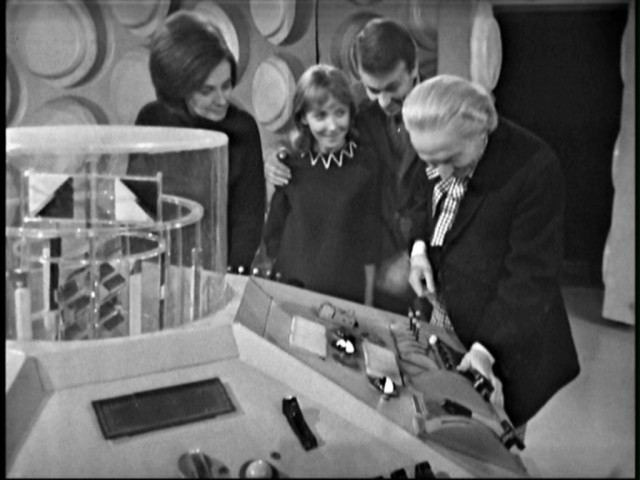
Barbara, Vicki, Ian and the Doctor safely in the Tardis at "The Rescue's" end

Barbara, Vicki, Ian and the Doctor safely in the Tardis at “The Rescue’s” end

The Doctor comforts Vicki upon telling her that Bennett murdered her father and offers to take her with them.  Ian and Barbara had simultaneously, but separately from the Doctor, also come to the conclusion that Vicki should depart Dido in the Tardis.  Promising her an abundance of adventure, Vicki accepts the Doctor’s invitation to travel in the “old box” which is bigger on the inside.  What scars, if any, she bears from her ordeal remain to be seen.  The orphaned girl from 2493 begins her exploits in time and space.

"The Rescue" was originally broadcast in the UK between 2nd and 9th January 1965

“The Rescue” was originally broadcast in the UK between 2nd and 9th January 1965

"The Rescue" DVD was released in a Box Set with "The Romans" entitled (unsurprisingly) "The Rescue The Romans"

“The Rescue” DVD was released in a Box Set with “The Romans” entitled (unsurprisingly) “The Rescue The Romans”

Vivien Fleming

©Vivien Fleming, 2013.
The Dalek Invasion of Earth

Standard

Image

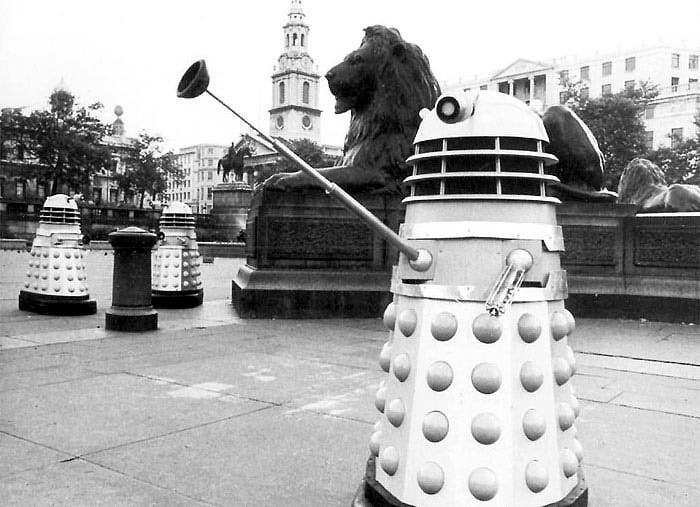
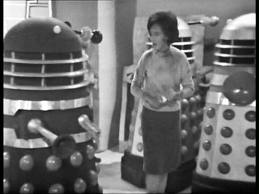
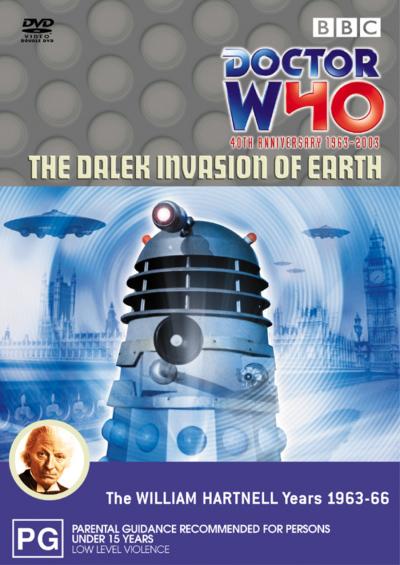
With iconic imagery of London that would remain unmatched until the classic emergence of the Cybermen from St. Paul’s Cathedral in 1968’s The Invasion, The Dalek Invasion of Earth was a ground breaking serial in Doctor Who’s history.  The story was the subject of a number of significant firsts and lasts, including the earliest shots of the English capital’s tourist hotspots which are so celebrated that at least one has been reenacted for the forthcoming docudrama to celebrate Who’s 50th anniversary, An Adventure in Space and Time. The story was also the first to see the departure of a companion, Susan, and the first on screen kiss, between Susan and her fiancé, David.  The Daleks made their only appearance with parabolic discs on their backs and the serial was also the second, and last, to be made into a feature film.

In the best tradition of Doctor Who, The Dalek Invasion of Earth involved the wild and improbable premise that Daleks invaded earth on or about 2164.  Six months prior to arriving in their now stereotypical looking flying saucers, the Daleks had sent meteors bearing the plague to the earth which had decimated the continents of Africa, South America and Asia. Countries were destroyed and the world became fragmented into small, independent communities. Although considering themselves “masters of Earth”, the Daleks interest in earth was not the domination of its human population, but rather to use it as a spacecraft.  Drilling to the core of the earth in Bedfordshire, the Daleks planned to remove its magnetic core, de-gravitize it, and then replace the core with a power system of their own making.  The Daleks then intended to steer the earth throughout the universe.  One would have thought it easier for the Daleks just to make more of their flying saucers, but alas, a rollicking good yarn that would not have been!

Producer of Doctor Who, Verity Lambert, pictured with a parabolic disc Dalek. These Daleks were only ever seen in "The Dalek Invasion of Earth".

Producer of Doctor Who, Verity Lambert, pictured with a parabolic disc Dalek. These Daleks were only ever seen in “The Dalek Invasion of Earth”.

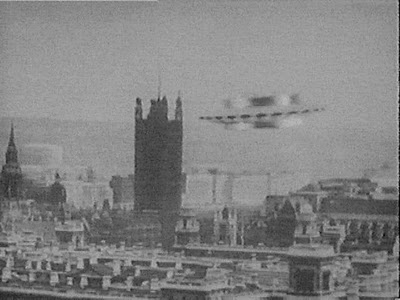
One of the Daleks' less than realistic flying saucers

One of the Daleks’ less than realistic flying saucers

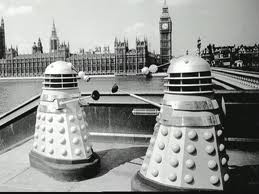
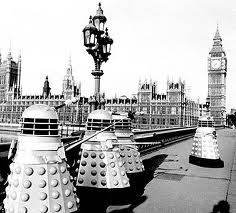
Dalekjs on Westminster Bridge

Daleks on Westminster Bridge

Given the Daleks’ anatomical disability, namely, their unfortunate endowment of a sucker and a mix-master like gun in lieu of hands, they naturally needed human help in their quest to drill to the earth’s centre.  Having dominated the decimated human population, the Daleks robotized the intelligent males into drone like soldiers who responded to their orders.  Almost everyone else was a slave in the Daleks’ mine in Bedfordshire. The few remaining “free” humans formed a resistance movement to fight the Daleks’ evil plan.  The Doctor and his companions meet up with one such resistance group which was under the leadership of Dortmun, an incapacitated scientist confined to a wheel chair.  One of these resistance members, David Campbell, was to become Susan’s fiancée, whilst another, Jenny, assisted Barbara in getting to Bedfordshire.  Along the way Barbara has the glorious achievement of plowing down a group of Daleks whilst driving a truck.

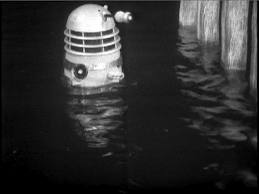
A submerged Dalek emerging from the Thames River

A submerged Dalek emerging from the Thames River

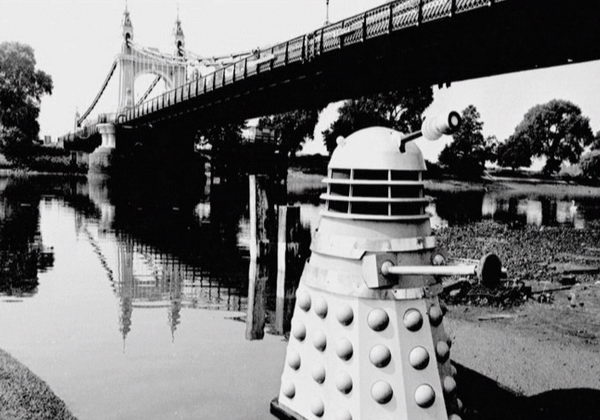
The Dalek shows no ill effects from its time in the polluted Thames

The Dalek shows no ill effects from its time in the polluted Thames

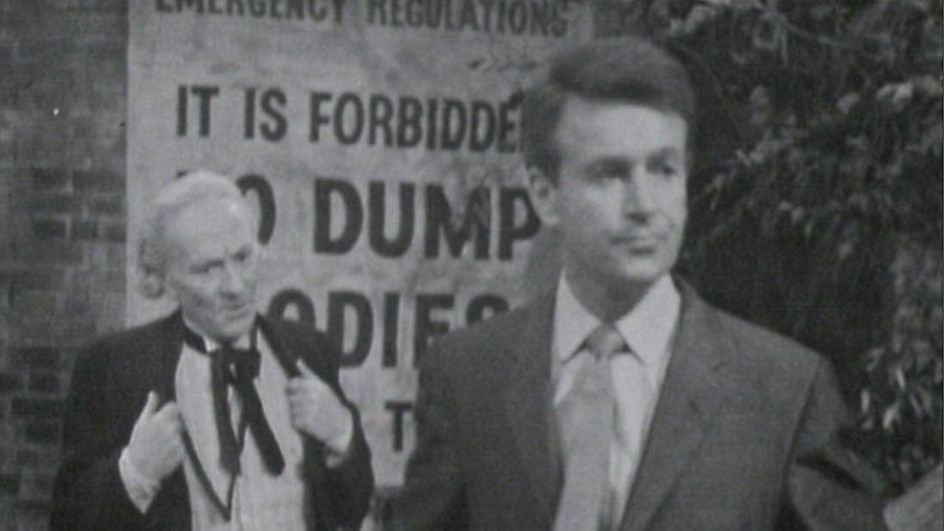
The Doctor and Ian in front of a sign forbidding the dumping of bodies in the river

The Doctor and Ian in front of a sign forbidding the dumping of bodies in the river

In the course of the Doctor and his companions’ adventures, the Doctor is a captive in the Daleks’ spaceship and is almost robotized, Ian contends with a mutated creature called The Slyther and finds himself inside the bomb which will blow out the earth’s core, and Susan is almost eaten by alligators which now inhabit London’s sewers. Barbara and her companion Jenny are betrayed to the Daleks by two women from whom they seek refuge, and are then held captive with metal neck braces.  After their ultimate victory over the Daleks, the Doctor, Barbara and Ian depart in the Tardis sans Susan. In the tear jerking conclusion, the Doctor locks his grand-daughter out of the ship and speaks to her through an intercom.  As she is now a woman, she needs roots somewhere and David is the person who can give her those roots, “not a silly old duffer like me”, said the Doctor.  Despite Susan’s protestations the Doctor leaves, but not before promising that one day he will be back.  It is this oration which opens Who’s 20th anniversary special, The Five Doctors, which is the next occasion when the Doctor and Susan are seen together.

A Roboman with the Doctor and Ian

A Roboman with the Doctor and Ian

Slave labourers push a railway cart at the Bedfordshire mine

Slave labourers push a railway cart at the Bedfordshire mine

Akin to the first Dalek story, The Daleks, the writer, Terry Nation, drew upon Second World War imagery.  Post Dalek invasion London has its genesis in the London Blitz. The Daleks are again a representation of the Nazis and are even seen to do Nazi salutes. They are the “masters of the Earth”.  The Daleks make use of slave labour and communicate to the resistance by radio transmissions. Whilst most of the population is in grave fear of them, some self-interested individuals are prepared to co-operate with them for economic gain.  Such is the case of the two women in the wood and the black market racketeer, Ashton.

A Dalek does a Nazi salute

A Dalek does a Nazi salute

Daleks and Robomen at the Daleks' spaceship

Daleks and Robomen at the Daleks’ spaceship

Barbara, as always, is fabulous and puts on a particularly good show when attempting to outwit the Dalek leadership by muddling history.  As stated previously, she plows through Daleks, unscathed, in a truck and it is Barbara who realizes that the Robomen are given orders by a central command.  Taking over that microphone, she and the Doctor order the Robomen to turn on the Daleks.  Unfortunately she is oblivious to the sexism of the resistance men when she is asked whether she can cook.  Her reply of “I can get by” results in her being assigned to cooking duties because the resistance “need cooks”.  If this serial was produced five years later then perhaps she would have baulked at the gendered stereotype.  Clearly these urban guerillas had underestimated the resourcefulness of Barbara.

Barbara tries to confuse the Daleks with muddled history

Barbara tries to confuse the Daleks with muddled history

Barbara is caught by a Dalek's sucker

Barbara is caught by a Dalek’s sucker

The character of Jenny is particularly strong for a woman in the early 1960s.  Dortmun assures Barbara that Jenny isn’t callous, although the years of battling the Daleks has certainly left her hardened.  When Barbara asks why she is constantly running from the Daleks her reply is that “I’m not running, I’m surviving”.  Her rather arrogant nature doesn’t make for a particularly endearing personality and one is left wondering if this is a reflection of an underlying belief by Terry Nation that powerful women cannot also be “nice”.

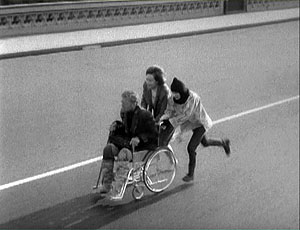
Barbara and Jenny run Dortmun to safety

Barbara and Jenny run Dortmun to safety

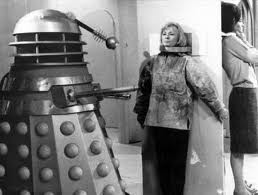
Jenny and Barbara are restrained by iron neck collars

Jenny and Barbara are restrained by iron neck collars

Susan transforms from a girl to a woman in the course of this story as her relationship with David blossoms. She initially reject’s David’s proposal of marriage as her grandfather is old and now needs her.  She didn’t want to have to make the choice between the stability that David offered, and the Doctor.  The Doctor, from inside the Tardis, ultimately makes the decision for Susan which on the face of it appears harsh and unloving.  David, however, reassures Susan that the Doctor knew that she could never leave him (David). That a relationship of such intensity could develop in the space of but a few days is indeed intriguing.  It became a precedent, nonetheless, for romance linked companion departures in the future, such as the Fourth Doctor’s companion Leela, who remains on Gallifrey with her newly acquired love, Andred.

Susan talks to the Doctor through the Tardis's PA system

Susan talks to the Doctor through the Tardis’s PA system

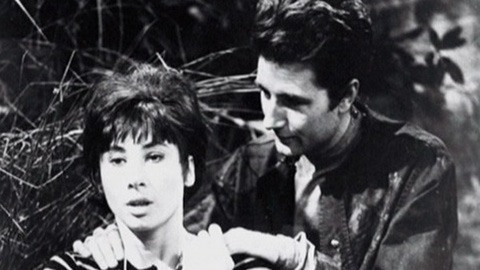
Susan and David in a tender moment

Susan and David in a tender moment

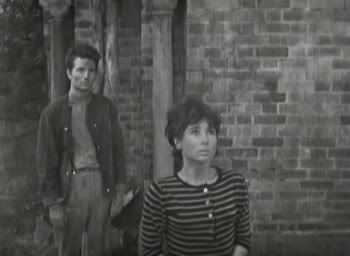
Susan is distressed to leave her grandfather

Susan is distressed to leave her grandfather

The Dalek Invasion of Earth marked the end of companion stability and the beginning of an almost revolving door of companions for the First Doctor. It is in the next serial, The Rescue, that we are introduced to the Doctor’s “grand-daughter substitute”, orphan Vicki. A new era will begin.

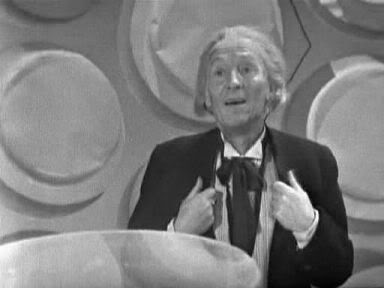
The Doctor says farewell to Susan

The Doctor says farewell to Susan

The Dalek Invasion of Earth was first broadcast in the UK between November 21 and December 26, 1964

The Dalek Invasion of Earth was first broadcast in the UK between November 21 and December 26, 1964

Vivien Fleming

©Vivien Fleming, 2013.
Planet of Giants

Standard

Image

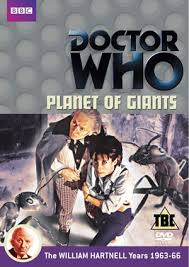
The opening serial of the second season of Doctor Who, Planet of Giants saw the return of the Tardis Crew after a break from the television screens of a mere six weeks. The penultimate serial to feature all the original cast members, Planet of Giants, albeit in a somewhat divergent form and with a different writer, was originally intended as the premiere serial of the first series.  Rather unsurprisingly given its infancy, the ninth Who story was the first since the premiere episode, An Unearthly Child, to be set in modern day England.  That being said, the action is all studio based and not a glimpse of London can be spied. Although modern day London was featured prominently in the season three finale, The War Machines, viewers didn’t have to wait that long to see the recognizable landmarks of England’s capital.  Set in the twenty second century the next serial, The Dalek Invasion of Earth, would undoubtedly have satiated the tastes of all those viewers seeking earth-bound points of reference. That story, however, is for my next review.

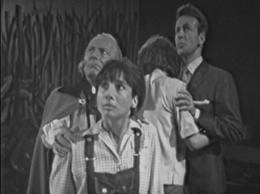
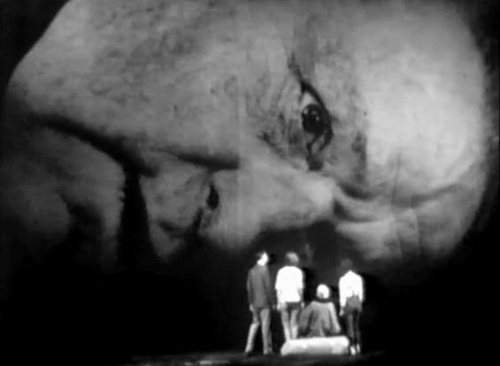
The frightened Tardis Crew are smaller than painted blades of grass

The frightened Tardis Crew are smaller than painted blades of grass

Planet of Giants was an ambitious story, beautifully realized on what was undoubtedly a budget almost as minute as the Doctor and his companions were in the serial.  Originally filmed as four episodes, but cut to three to quicken the pace of episodes three and four, Planet of Giants saw the Tardis Crew reduced to not much more than the size of ants.  As the Tardis was materializing in a suburban London backyard, presumably to return Barbara and Ian home, the doors flung open. For reasons unable to be later explained by the Doctor, the ship and its occupants were shrunk. The Tardis Crew, however, were unaware of their diminutive size until they stumbled upon a series of strange and perplexing objects whilst exploring outside. After splitting into two groups, Ian, with Susan, initially presumed that they had landed in the middle of some form of trade fair.  An exhibition, of sorts, in which huge copies of various objects were on display. Ants were the size of dinosaurs and matchboxes like houses. It was Susan, though, who quickly realized that it was the Tardis Crew that had been shrunk.  Perhaps it was her alien antecedents that permitted her to see that which Ian couldn’t.

Susan, Ian and the matchbox

Susan, Ian and the matchbox

Soon the Doctor and his companions were confronted by the hazards that naturally confront ant sized people.  Ian, who had climbed into a near empty match box, was picked up and carried away but a short distance. He was bounced around the matchbox brutally, slamming uncontrollable from side to side. To the others, this otherwise short stroll across a nicely manicured lawn to be reunited with Ian was a treacherously long haul. The Doctor, who was now much more concerned about the well-being of his companions, was insistent on locating “Chesterton”.  Eventually they are reunited.

A profoundly dead insect of mammoth proportions is examined by Barbara and the Doctor

A profoundly dead insect of mammoth proportions is examined by Barbara and the Doctor

In the interim, the viewers were witnesses to a conversation about a new insecticide, DN6, between Farrow, a “Ministry” man and Forrester, a conniving business person whose income and life style is dependent upon the approval, production and marketing of DN6.  Developed by the scientist Smithers in his back yard laboratory, DN6 has the capacity to kill more than just insects and remains effective indefinitely.  Farrow had learned of the potentially fatal consequences of DN6 whilst preparing a report for the government, however the insecticide’s inventor, Smithers, seemed blindly unaware of its hazards.  Unprepared to risk losing approval for DN6, Forrester shoots Farrow dead. He soon after reveals the murder to Smithers, thereby implicating him as an accessory after the fact.

The deceased Mr Farrow as seen by the Doctor and his companions.  This looks like something out of a Hitchcock movie

The deceased Mr Farrow as seen by the Doctor and his companions. This looks like something out of a Hitchcock movie

The Doctor and his companions are confronted by Farrow’s body on the lawn but are soon separated again when Ian and Barbara seek shelter in a brief case.  The brief case is picked up and carried inside the house.  Barbara considered the ride in the suitcase not dissimilar to that of a roller coaster and sustained a bad bruise to her knee from an unsecured paper clip. The Doctor and Susan must now rescue the teachers and in doing so encounter adventures galore.  Whilst outside a domestic cat was a menacing beast, inside a common sink and drain is sufficient to make out heroes contemplate imminent death by drowning. Lighting a match is akin to ramming a stockade, whilst lifting a telephone receiver is almost as laborious as lifting a London bus an inch off the ground.

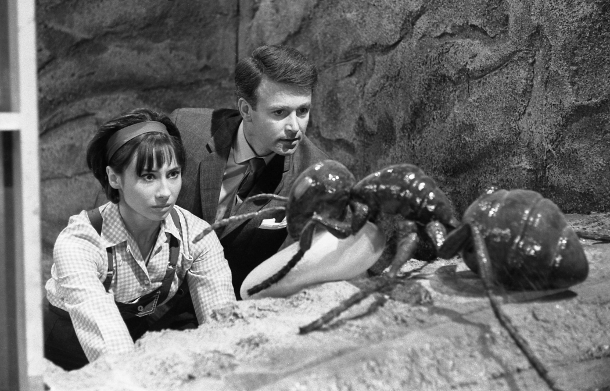
Ian and Susan are confronted by a giant ant

Ian and Susan are confronted by a giant ant

Perhaps what I admire most about this story is its strong environmental message. Concern for the long term effects of pesticides is something I would have thought was rarely discussed in the early 1960s. It’s certainly Doctor Who’s first venture into enviro-politics, an area of much concern in a number of Third Doctor serials including Inferno and The Green Death (yes, the one with the giant maggots!).  Not only is the Doctor concerned about the effect of the insecticide on his companions – he advises them not to eat or drink anything – but also other insects.  When Barbara questions what would kill insects in an ordinary garden, and then posits that killing “bees, and worms, and things” is wrong, the Doctor concurs and states that “Quite so.  Both are vital to the growth of things”.

The Doctor and Susan contemplate death by drowning

The Doctor and Susan contemplate death by drowning

Barbara, who absolutely shines in this story, subsequently becomes gravely ill after touching a grain of wheat which had been sprayed by insecticide.  Ian, who is with her at the time, does not notice and upon realizing her error, Barbara hides her actions from him. This is in spite of the fact that Barbara had asked to borrow Ian’s hanky and was aggressively attempting to clean the poison off her hands.  The usually observant and intelligent Ian was clearly away with the fairies on this occasion. Once Barbara becomes so ill that she collapses, and can no longer deny that she touched the insecticide, the Doctor determines that they must return to the Tardis as soon as possible.  When the ship’s crew is returned to their normal sizes the pesticide will only be 1/70th as potent on Barbara, the Doctor asserts. Naturally the Doctor was entirely correct and at the serial’s end the grain of wheat which was taken into the Tardis with much physical exertion, had resumed its normal proportions. Barely could it be seen.

Barbara is terrified to run into a giant fly

Barbara is terrified to run into a giant fly

A thoroughly enjoyable romp, with an honourable message and momentous adventure,  the Planet of Giants was a memorable start to Doctor Who’s second season. 

Planet of Giants was originally broadcast in the UK between 31st October and 14th November 1964

Planet of Giants was originally broadcast in the UK between 31st October and 14th November 1964

Vivien Fleming

©Vivien Fleming, 2013.

The Reign of Terror

Standard

Image

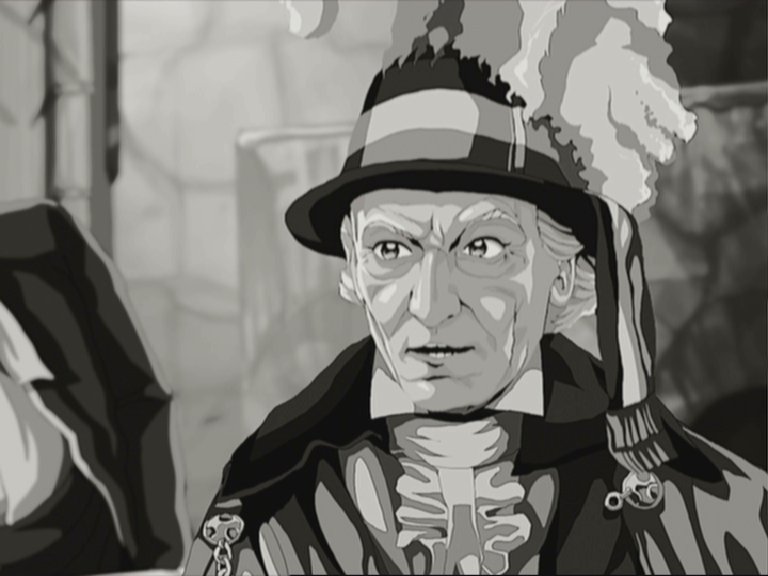
Released for the first time on DVD in 2013, The Reign of Terror is an eagerly awaited addition to the collections of Doctor Who fans.  With episodes 4 and 5 junked by the BBC, the missing episodes were animated.  For the first time, probably since its original transmission, viewers are able to see this great historical epic on the French Revolution.

The Doctor in animated form

The Doctor in animated form

The last story of Season 1, The Reign of Terror was also the first Doctor Who serial to include some location filming, albeit in the form of a very persuasive double of The Doctor walking down a row of poplar trees. It was also the last filming of First Doctor stories at the old and cramped Lime Grove studios where the Director, Henric Hirsch, collapsed in the third episode. Unable to complete direction of that episode, Hirsch was not credited as Director.

The Doctor with the work-party leader whom he subsequently knocks unconscious with a shovel

The Doctor with the work-party leader whom he subsequently knocks unconscious with a shovel

Attempting to return Barbara and Ian to present day London, the Tardis, not surprisingly, gets the time and location wrong.  Instead it lands 170 years earlier and 100 kilometres away in Paris during the height of the French Revolution.   Not that any of the Crew initially realize the error!  That the ship should dock in the Doctor’s favourite period of Earth history, The French Revolution, is quite fortuitous, for him at least.  Whilst the teachers are again unable to return home, the Doctor is afforded the opportunity to dress in fine clothing and impersonate a District Commissioner.  The Reign of Terror allows the Doctor the occasion to again take the show’s lead and save his fellow companions.  Ian, Barbara and Susan are arrested by soldiers and are awaiting execution by guillotine.  The Doctor was lucky to escape capture by being conveniently knocked unconscious just prior to the soldier’s arrival.  His miraculous escape from a burning farmhouse, with the help of a young peasant boy, afforded him an element of surprise as he was assumed dead.

The Doctor, resplendent in the costume of a District Commissioner

The Doctor, resplendent in the costume of a District Commissioner

Whilst the Doctor is more willing to take risks to save the Tardis Crew in this serial, his ethics still remain dodgy.  He not only forges documents enabling him to impersonate a senior government official, but also grievously assaults the leader of a work-party after he has been mistakenly conscripted into it. Although this incident is played somewhat as a farce, it certainly exhibits a dimension of the Doctor which fans of today’s episodes would be unfamiliar with. Hitherto, knocking people out had been Ian’s domain.  The Doctor also takes a blow at another bloke whilst endeavouring to free Susan from prison.

Barbara and Susan in prison

Barbara and Susan in prison

The companions in The Reign of Terror begin to take on a more secondary role, in line with the Doctor’s increasingly pivotal role. Susan spends much of the serial moaning (quite justifiably) or ill, and displays a profound fear of rats. Ian and Barbara are given a little more to play with, and are particularly amusing when they take on the roles of landlord and barmaid of a pub. Barbara gets a love interest, of sorts, and William Russell’s two weeks leave during the serial is well disguised by the insertion of pre-recorded segments.

Ian looks from his prison cell as Barbara and Susan are taken to the guillotine

Ian looks from his prison cell as Barbara and Susan are taken to the guillotine

Whilst lore has it that historical dramas were the least popular of the early Doctor Who escapades they certainly showcased the BBC’s great skill at historical dramas. Costuming was divine. The animation of the two missing episodes was particularly well done, even if my children questioned why it was presented in black and white.  Once I explained the need for authenticity so as not to stand out from four extant black and white episodes, they were happy to accept what appeared to them to be very bizarre animation.

An animated Doctor

An animated Doctor

Barbara animated

Barbara animated

The Reign of Terror was originally broadcast in the UK between 8th August and 12th September 1964

The Reign of Terror was originally broadcast in the UK between 8th August and 12th September 1964

Vivien Fleming

©Vivien Fleming, 2013.

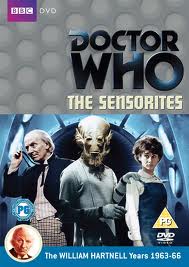
The Sensorites

Standard
The Sensorites

The Sensorites

Comedian, actor, and author of Moths Ate My Doctor Who Scarf, Toby Hadoke, investigates the writer of The Sensorites, Peter R. Newman, in an informative documentary in the Special Features of the Doctor Who The Sensorites DVD release.  Why am I telling you this, you may ask? Because of Hadoke’s humorous manner of introducing The Sensorites.  It says much about how The Sensorites has been viewed by the Doctor Who fan community. Here’s how Hadoke leads into the documentary.

Toby Hadoke - Stand-up comedian, actor and author of "Moths Ate My Doctor Who Scarf".

Toby Hadoke – Stand-up comedian, actor and author of “Moths Ate My Doctor Who Scarf”.

HADOKE:  The Sensorites.  Poor, unloved, The Sensorites.  Nestling, lost somewhere, down the back of the fans’ collective sofa.  There it lies at number 7 in the first heady year of Doctor Who.  It didn’t even have the decency to be wiped so we could all mourn its loss, and imagine how brilliant it must have been.  It’s not a story anyone really talks about.  We certainly don’t know that much about it …

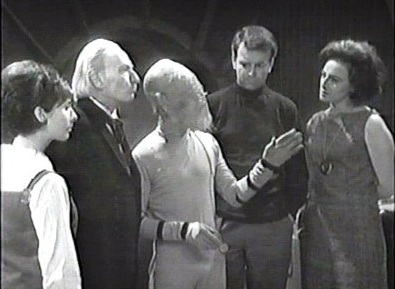
The Tardis Crew and a Sensorite

The Tardis Crew and a Sensorite

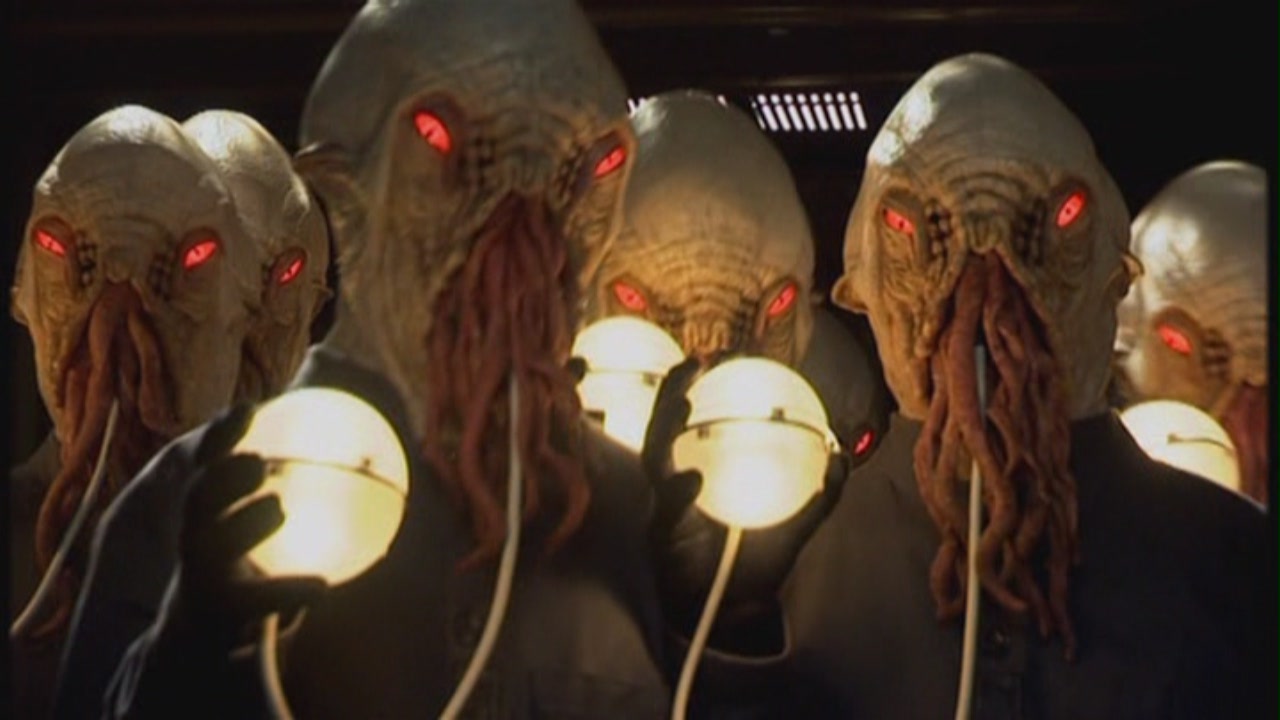
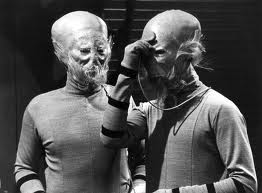
Yes, the much derided The Sensorites. In the development of Doctor Who, however, The Sensorites is not without merit.  If it were not for The Sensorites there’s a distinct possibility that one of the New Series’ favourite creatures, the Ood, may never have made their way to The Impossible Planet in 2006.  Like the Ood, the peculiar looking Sensorites have a humanoid bodily appearance but with rather unusual heads. They share telepathy with the Ood and a tube that hangs from their body.  In the Sensorites case there isn’t an external brain at the cord’s end, but rather a stethoscope type device which, when put to the forehead, permits their telepathic communication.  Devoid of the Ood’s face tentacles, the Sensorites instead have a fine head of hair growing onwards and upwards from their chins.  It’s perhaps because of the quantity of hair on the lower part of their heads that they have none left for their bald heads!  Like the Ood, the Sensorites appear genderless and nameless.  According to 2008’s Planet of the Ood, their home planet, the Ood-Sphere, is close by to the Sensorites’ home, the Sense-Sphere.

The near neighbours of the Sensorites, the Ood.

The near neighbours of the Sensorites, the Ood.

Tat Wood and Lawrence Miles in their well regarded series of books, About Time, describe The Sensorites as “quite possibly the most important Doctor Who story of all”.  Why? Because “the Doctor saves a planet not simply to get his Ship back but because it’s the right thing to do”. Yes, the Doctor that we know and love is beginning to develop.  For once he’s the instigator of action, rather than Ian, and beginning to be less egocentric. The Doctor, quite inexplicably though, still threatens to put Ian and Barbara off the ship at the next planet because Ian reiterates the Doctor’s own admission that he can’t control the TARDIS.  There’s still some way to go for the Doctor, although he’s beginning to take the well worn path that we all know.

A Sensorite using telepathy.

A Sensorite using telepathy.

In The Sensorites Susan exhibits a strong telepathic tendency in her ability to communicate with the planet’s locals. She is a little more reminiscent of the Susan we see in An Unearthly Child and also quarrels with her grandfather for the first time.   “Growing up” is how the forever teacher Barbara describes her behavior to the Doctor.

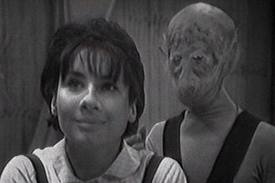
Susan and a Sensorite

Susan and a Sensorite

The change that is taking place in the Tardis Crew is mentioned in the first episode, Strangers in Space.  It also provides a convenient potted summary of the crew’s adventures in the previous 6 months since Doctor Who was first broadcast.

IAN: There’s one thing about it, Doctor.  We’re certainly different from when we started out with you.

SUSAN: That’s funny.  Grandfather and I were talking about that just before you came in.  How you’ve both changed.

BARBARA: Well we’ve all changed.

SUSAN: Have I?

BARBARA: Yes.

DOCTOR: Yes, it all started out as a mild curiosity in a junkyard, and not it’s turned out to be quite a, quite a great spirit of adventure, don’t you think?

IAN: Yes.  We’ve had some pretty rough times and even that doesn’t stop us.  It’s a wonderful thing, this ship of yours, Doctor.  Taken us back to pre-historic times, the Daleks.

SUSAN: Marco Polo, Marinus.

BARBARA: And the Aztecs.

The Sensorites was originally broadcast on BBC1 between 20th June and 1st August 1964.

The Sensorites was originally broadcast on BBC1 between 20th June and 1st August 1964.

Vivien Fleming

©Vivien Fleming, 2013.

Reference

Tat Wood & Lawrence Miles, “About Time. The Unauthorized Guide to Doctor Who. 1963-1966 Seasons 1 to 3”. Mad Norweigan Press, Illinois, 2009.

The Aztecs

Standard

Image

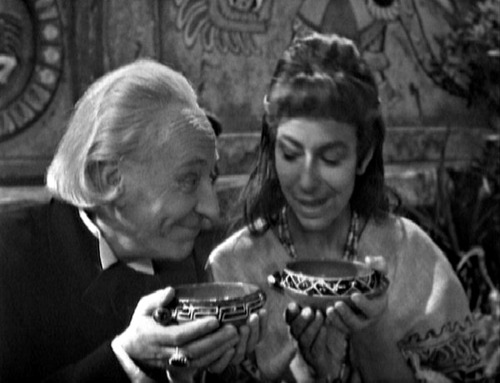
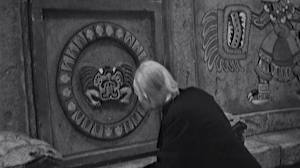
There’s probably very little that needs to be said about The Aztecs, a serial that is widely lauded by fans and critics alike as an outstanding  milestone in the history of Doctor Who.  It is in The Aztecs that the parameters of what New Series fans might describe as the “Wibbly Wobbly Timey Wimey … Stuff” are fleshed out.  Rules are enunciated that will forever limit the Doctor and his companions’ ability to alter the course of historical events.  As the Doctor states categorically to Barbara, “You can’t rewrite history.  Not one line!: It’s also the serial where Barbara is mistaken for the reincarnation of the Aztec high priest, Yetaxa, and the Doctor accidently becomes engaged by sharing a cup of cocoa!

Barbara unconditionally shines in The Aztecs.  When the serial commences Barbara exhibits her superb knowledge of history, finely tuned by years of secondary school teaching, when she tells Susan, almost down to the year, the age of some Aztec masks.  That Susan didn’t already know this is somewhat surprising, particularly given her knowledge of the French Revolution in An Unearthly Child.  Perhaps her historical knowledge is limited to her grandfather’s pet interests, for it’s in The Reign of Terror that Susan tells us that the French Revolution is the Doctor’s favourite historical period.

Yetaxa in all her finery.

Yetaxa in all her finery.

Having already displayed a keen interest in bangles during The Keys of Marinus, Barbara locates and puts on a snake bracelet.  After being detained by the Aztec leaders, Barbara is quickly identified as the reincarnation of the high priest, Yetaxa.  Susan asks why the Aztecs should think Barbara the reincarnation when Yetaxa was a man.  Displaying again her broad knowledge, Barbara responds by advising that form doesn’t matter.  It’s the wearing of the bracelet that’s all important.  Barbara immediately falls into the role of a god and is resplendent in fine clothing and head gear.  Her demeanor, deportment and speech is that of a being with infinite authority.  When confronted with a forthcoming human sacrifice Barbara grasps the opportunity to save the Aztecs from their eventual demise.  Mindful of the link between the Aztecs’ cultural practices and the destruction of their society, Barbara resolves to end the practice of human sacrifice, which she considers barbaric.  She refuses to sit back and watch at the ceremony in which Ian, who has been conscripted as a warrior, must hold down the sacrificial victim.  Despite the Doctor’s advice that history must never be rewritten Barbara remains resolved.  The dialogue between the Doctor and Barbara is extraordinarily powerful and worth providing here verbatim.

The Doctor explains a few facts to Barbara about time travel.

The Doctor explains a few facts to Barbara about time travel.

DOCTOR: There’s to be a human sacrifice today at the Rain Ceremony

BARBARA: Oh, no.

DOCTOR: And you must not interfere, do you understand?

BARBARA: I can’t just sit by and watch.

DOCTOR.: No , Barbara!  Ian agrees with me.  He’s got to escort the victim to the altar.

BARBARA: He has to what?

DOCTOR: Yes, they’ve made him a warrior, and he’s promised me not to interfere with the sacrifice.

BARBARA: Well, they’ve made me a goddess, and I forbid it.

DOCTOR: Barbara, no!

BARBARA:  There will be no sacrifice this afternoon, Doctor.  Or ever again.  The reincarnation of Yetaxa will prove to the people that you don’t need to sacrifice a human being in order to make it rain.

DOCTOR: Barbara, no.

BARBARA: It’s no good, Doctor, my mind’s made up.  This is the beginning of the end of the Sun God.

DOCTOR: What are you talking about?

BARBARA: Don’t you see?  If I could start the destruction of everything that’s evil here, then everything that is good would survive when Cortes lands.

DOCTOR:  But you can’t rewrite history!  Not one line!

SUSAN: Barbara, the high priests are coming.

DOCTOR:  Barbara, one last appeal.  What you are trying to do is utterly impossible.  I know, believe me, I know.

BARBARA: Not Barbara, Yetaxa.

The Doctor is pleased to have found a source of poison

The Doctor is pleased to have found a source of poison

Barbara’s command not to sacrifice the victim does not save his life, however.  Considering it an honour to be sacrificed, the intended victim is shamed and jumps to his death.  The Doctor, naturally, quickly seizes the opportunity to chide Barbara for her actions.  He explains that human sacrifice is their tradition and religion.  The intended victim wanted to be offered.  A distressed Barbara tells the Doctor that “she just didn’t think”, to which the Doctor promptly apologizes for being so harsh.  The Doctor advises her that what happens next is up to her.  Already suspected of being a false god by some, Barbara faces a challenge.

Barbara and Ian

Barbara and Ian

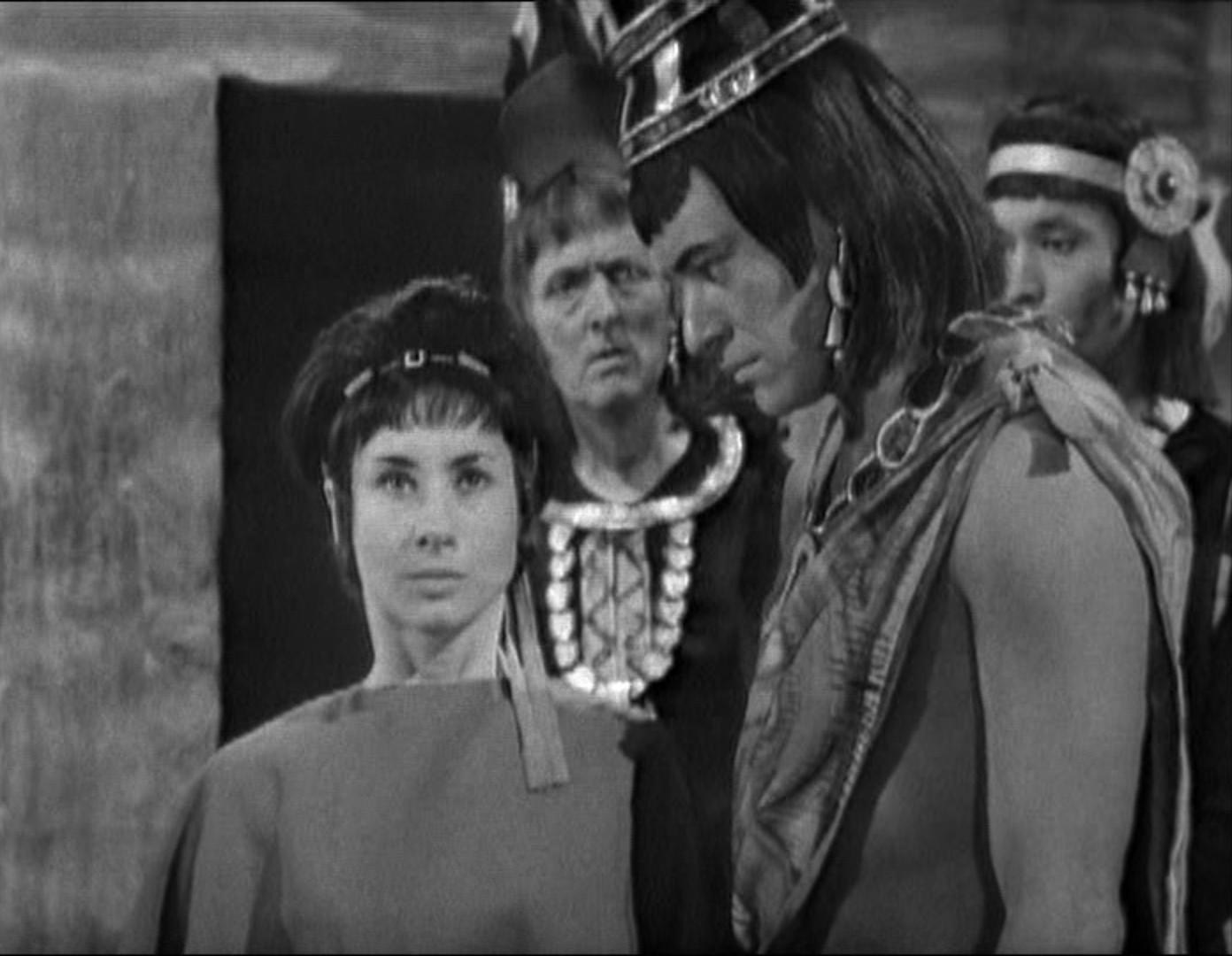
Barbara continued the façade of being the Yetaxa and amongst her other actions, put a knife to Tlotoxl’s throat in  a successful endeavour to save Ian’s life.  Engaged in a ritualistic fight to the death with Ian, Ixta (the combatant) had the upper hand after the Doctor had, by Ixta’s deception, given him a mild poison.  Ixta had scratched Ian on the wrist with this poison during the fight, thereby rendering him groggy and increasingly incapable of fighting.  When goaded by the participants to save her servant Ian, presumably by supernatural means, Barbara responded by threatening to kill Tlotoxl if Ian died.  Commanding Ixta to put down his club, the combatant obeyed and the fight was over.  Ixta didn’t claim victory.  In response to Autloc’s subsequent comment that the people had been awaiting a miracle from the Yetaxa, Barbara pragmatically stated “Why should I use divine powers when human ability will suffice?”

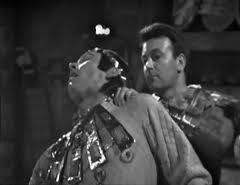
Barbara holds a knife to Tlotoxl's throat.

Barbara holds a knife to Tlotoxl’s throat.

After outwitting a plan to have her consume poison, thereby proving her human identity, Barbara eventually admits that she is not the Yetaxa.  When the Tardis Crew is eventually able to escape back into the cave and reach the safety of the Tardis, Barbara laments the failure of her mission to civilize the Aztecs.  Again, it is worth quoting the Doctor and Barbara’s conversation verbatim.

BARBARA: We failed.

DOCTOR: Yes, we did.  We had to.

BARBARA: What’s the point of travelling through time and space if we can’t change anything? Nothing. Tlotoxl had to win.

DOCTOR: Yes.

BARBARA: And the one man I had respect for, I deceived.  Poor Autloc.  I gave him false hope and in the end he lost his faith.

DOCTOR: He found another faith, a better, and that’s the good you’ve done.  You failed to save a civilization, but at least you helped one man.

Tlotoxl - Evil dudes don't come much better than this!

Tlotoxl – Evil dudes don’t come much better than this!

The Doctor’s character softens to a small degree in The Aztecs.  For the first time we see a love interest in the form of the intelligent and resourceful Cameca.  Although clearly taken by Cameca, he is not prepared to take her with him.  This relationship affords several opportunities for comic relief, not least of which is when the Doctor accidently accepts Cameca’s proposal of marriage.  He was not aware that sharing a cup of cocoa was an act of betrothal.  Similarly, when the Doctor advises Ian that he has a fiancée, the expression on Ian’s face is priceless.  Clearly the tension between Ian and the Doctor is beginning to mellow.

The Doctor and his love interest, Cameca.

The Doctor and his love interest, Cameca.

That shared cup of cocoa!

That shared cup of cocoa!

Ian learns that the Doctor has a fiancee.

Ian learns that the Doctor has a fiancee.

This mellowing of tension is also shown in the Doctor’s relations with Barbara, and particularly her eventual acknowledgement that the Doctor was correct in respect of not rewriting history.  Although chiding Barbara harshly, she soon admits her own indiscretion and readily forgives him.  The Doctor shows ingenuity in making the wheel, a device not yet discovered by the Aztecs.  This allowed the Doctor and his companions to lift the door separating them from the Tardis.

The Doctor and that not so heavy stone

The Doctor and that not so heavy stone

Susan’s character development in The Aztecs is particularly interesting and in some respects proto-feminist.  Susan was sent to a seminary type institution upon suspicions of Barbara’s divinity being raised.  Yetaxa’s “handmaiden” was tutored in the skills required of a young Aztec woman.  She displayed a quick aptitude to learn however, like Barbara, she was not prepared to accept the status quo in all respects.  Upon being told to keep her eyes downcast when she meets her future husband, Susan asked how she would know who he is.  In response she was advised that she will be told who she’ll marry.  Susan was outraged and stated that she would live her life the way she wanted and chose whomever she wished to marry.

Susan, the Yetaxa's handmaiden.

Susan, the Yetaxa’s handmaiden.

Later, it had been decided that Susan would marry the “Perfect Victim”, the person intended for the next sacrifice three days later during an eclipse.  Such a person is afforded anything they wish for in the days prior to their sacrifice.  Susan responded to this news with rage and stated that it’s barbaric and that they were all monsters.  For her insubordination she was to be punished.  That the male writer, John Lucarroti, should attribute Susan with such a strong will against this undeniably sexist practice is quite extraordinary.  This serial was aired in 1964, prior to the large scale emergence of second-wave feminism.  Perhaps Lucarroti had read Betty Friedan’s seminal work, The Feminine Mystique, which was first published in 1963.

Ian defeats Ixta with finger power

Ian defeats Ixta with finger power

Ian almost succumbs to Ixta.

Ian almost succumbs to Ixta.

Ian remains the hero and “man of action” in this serial.  He becomes a warrior, defeats Ixta in a trial battle through the mere use of finger pressure to the neck, and eventually propels Ixta to his death is a most heroic and ingenious manner.  He moves a large boulder blocking a tunnel with little discomfort, although it’s admitted in the special features that the boulder was made from a very light material.  He also knocks out a number of people.  A force to be reckoned with, Ian is also becoming more tolerant of the Doctor and can have the occasional light moment with him.  The Tardis Crew is not yet a totally cohesive group, however the hostility of early serials is beginning to diminish.

Ian the warrior

Ian the warrior

The Aztecs was originally broadcast in the UK between 23 May and 13 June 1964

The Aztecs was originally broadcast in the UK between 23 May and 13 June 1964

Vivien Fleming

©Vivien Fleming, 2013.
The Keys of Marinus

Standard

Image

Much ridiculed by fans, but less so than The Sensorites, the Keys of Marinus is one of two little regarded stories in Doctor Who’s first season.     Written by the Daleks’ author, Terry Nation, it was hoped that the Voord, the principal baddies in the serial, would become the “next big thing”.  Alas, this was not to be and unlike the Daleks whose iconic status sees them still appearing in Who 50 years later, the poor Voord have never again been spied.  Although their heads were pretty cool, the wetsuit clad bodies and swimming flippers do not a great monster make!

You can't help but love the Voord, the "next big thing" that were never seen again on Doctor Who.

You can’t help but love the Voord, the “next big thing” that were never seen again on Doctor Who.

Not dissimilar to season 16’s The Key to Time, this serial involves a quest by the Doctor and his companions to locate the four hidden micro-keys for the Conscience of Marinus, a machine with the power to not only judge good and evil, but also permeate the minds of citizens, eradicating all evil thoughts and intentions, and replacing them instead with only good and honourable deeds.

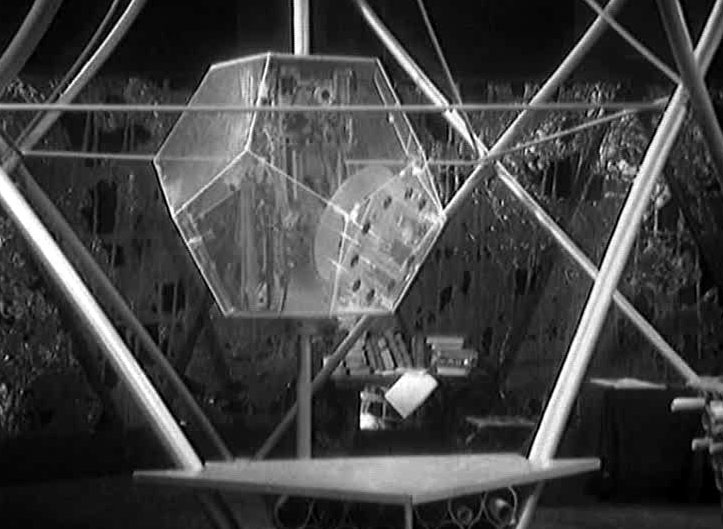
The Conscience of Marinus

The Conscience of Marinus

Whereas the Fourth Doctor, Tom Baker, and Romana I’s quest for keys extended to six serials (five of four episodes and the last of six), the Keys of Marinus must be found in six episodes only.  Episodes 1 and 6 are set in the Tower, the home of Arbitan, the keeper of the Conscience of Marinus, whereas the remaining episodes (2-5) are each set in a different city or area of the planet Marinus.  The logistics of this, naturally, meant the construction of five different sets, something which invariably would have been a huge budgetary headache for the production team. The ravine over which the party, minus the Doctor, cross in episode 4, The Snows of Terror, looks suspiciously like the set used in The Ordeal, which is part 6 of The Daleks.   The trusty BBC could be assured of not wasting a good set!

Sabetha, with the assistance of Susan, crosses that ravine.

Sabetha, with the assistance of Susan, crosses that ravine.

For all the criticism directed at the Keys of Marinus, which are too numerous to elucidate here, the story is not without its virtues.  The Doctor, who is absent from episodes three and four because William Hartnell was on holidays, begins to protect his reluctant companions more so than in previous stories.  In episode 5 particularly, Sentence of Death, the Doctor acts as Ian’s advocate at a trial in the city of Millennius.  Ian has been framed for murder and the legal system operating in the city is the opposite of that which we know in the United Kingdom and its former colonies.  Rather than there being a presumption of innocence, in Millennius one is guilty unless innocence can be proved beyond reasonable doubt.  Any person, irrespective of legal training, can appear as advocate (the equivalent to a solicitor, barrister or attorney) for the accused.  The Doctor shines in his spirited defense of Ian.  A salutary moral is obviously told in respect of the rule of law.

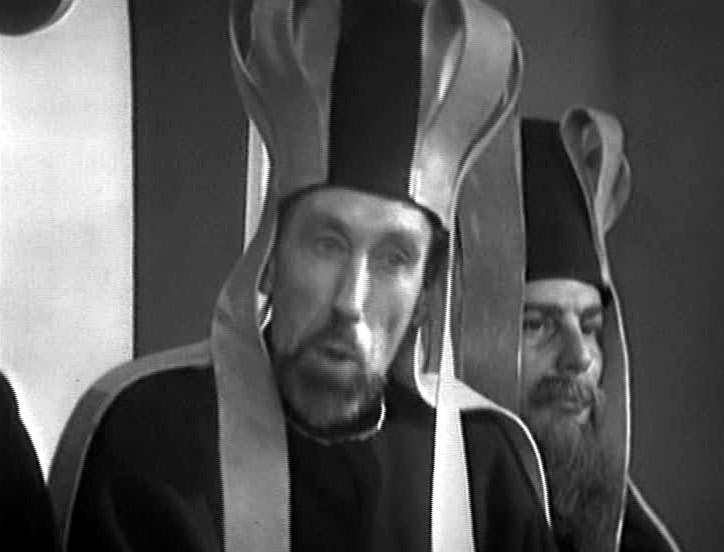
The senior judge in the city of Millennius.  All three were possessed of the most outrageous head gear.

The senior judge in the city of Millennius. All three were possessed of the most outrageous head gear.

That humans should not be ruled by machines, and that individual conscience is essential to human society, is an overarching theme of the story.  The Conscience of Marinus’ destruction at the story’s end is shown as a worthy result.

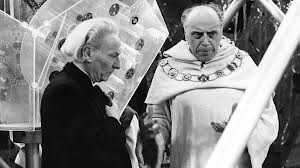
The Doctor with Arbitan, the keep of the Conscience of Marinus

The Doctor with Arbitan, the keep of the Conscience of Marinus

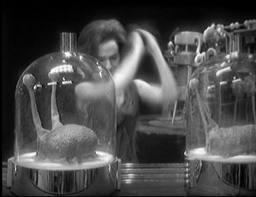
Ian remains the hero of the show which is all the more evident in that the Doctor’s absence in episodes three and four is barely noticed.  Susan screams too much, particularly in part 3, The Screaming Jungle, and Barbara is initially prepared to accept the decadent wealth of the city in part 2’s The Velvet Web.  Whilst Ian is the pragmatist and wonders what price you must pay for having all that you desire, he is soon won over.  It is Barbara, who after a night’s rest, can see through the charade and realizes that the beauty she had previously seen, and the other members of the Tardis Crew still see, is but an optical illusion.  Beautiful clothes are but rags and fine drinking ware is tin.  Barbara also has the tremendous scene where she smashes the Brains of Morphoton, horrid brains in bell jars that look not dissimilar to snails’ heads. It is in the next serial, The Aztecs, that Barbara will really shine. Striking throughout is the character of Sabetha, played by Katherine Schofield.  At the end I was left rather wishing that she’d joined the Tardis Crew and not gone off to start a new life with her boyfriend, the gorgeous Altos.

Barbara smashes the Brains of Morphoton

Barbara smashes the Brains of Morphoton

The Keys of Marinus was originally broadcast in the UK between 11th April and 16th May 1964

The Keys of Marinus was originally broadcast in the UK between 11th April and 16th May 1964

Vivien Fleming

©Vivien Fleming, 2013.
Marco Polo

Standard
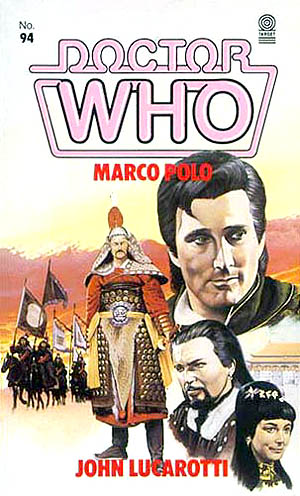
The novelization of Marco Polo.

The novelization of Marco Polo.

Undoubtedly the most sought after of the lost Doctor Who serials, Marco Polo has an almost mythical status.  An historical story, this seven part serial was the fourth to be broadcast and is set in 1289 Cathay (China).  Landing in the Himalayas, the Tardis Crew are picked up by the explorer Marco Polo as his caravan is making its way along  the Silk Road to meet Emperor Kublai Khan. Seeking to win the favour of Khan, Polo seizes the Tardis with the intention of giving the strange “flying caravan” to him.

The BBC made a 30 minute reconstruction of Marco Polo and it was released with The Edge of Destruction as part of the 3 disc The Beginnings box set.  Utilizing photographs from the production, the reconstruction provides a nice teaser of what clearly was an extraordinary serial.  Surprisingly, many colour photos have been preserved, a few of which I share for your viewing pleasure.

Ping ChoMarco Polo 2marco_polo_in_colourMarco Polo

The 30 minute BBC reconstruction of "Marco Polo" can be found in the 3 Disc box set "The Beginning".

The 30 minute BBC reconstruction of “Marco Polo” can be found in the 3 Disc box set “The Beginning”.

Vivien Fleming

©Vivien Fleming, 2013.

The Edge of Destruction

Standard

The necessity to produce a two part story without any budget for guest actors, or sets other than the pre-existing Tardis,  precipitated the watershed serial, The Edge of Destruction. The third story of Doctor Who, it followed An Unearthly Child and The Daleks and was envisaged as an inexpensive means of producing the last two of thirteen episodes initially authorized by the BBC for production.

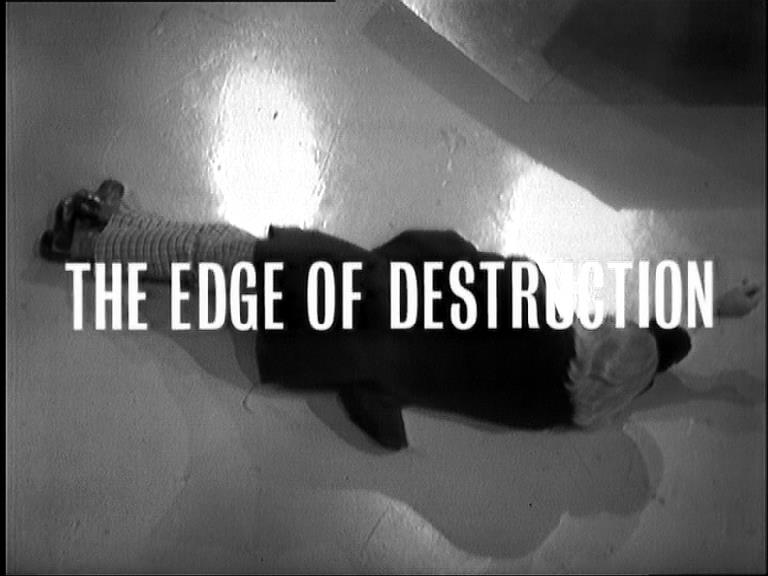
The Edge of Destruction Title Card

The Edge of Destruction Title Card

In a style very much similar to a psychological thriller, The Edge of Destruction focused principally on the interactions between the hitherto discordant Tardis occupants.  After leaving Skaro following the Tardis Crew’s defeat of the Daleks, the ship experiences a frightful bang whilst in flight. The Doctor is laying on the floor, Ian slumped in a chair, and Susan sprawled over the console.  All are unconscious, save for Barbara.  When each awake it is evident that all is not well. The memories of the occupants have been erased and Ian still thinks that he’s at Coal Hill School.

The story begins with all but Barbara unconscious.

The story begins with all but Barbara unconscious.

After patching up the Doctor’s cut head with an almost magical bandage, Susan collapses when she touches the console.  Ian hauls Susan over his shoulder and takes her to the bedroom where he pulls an S shaped recliner down from the wall. Placing Susan on the bed, Ian briefly leaves the room and returns with a wet handkerchief.  Brandishing a pair of scissors, Susan sits up and asks Ian who he is.  She attempts to stab him, but being unsuccessful stabs at the reclining bed numerous times prior to collapsing again. This quite horrifying scene was the cause of many complaints to the BBC and the show’s pioneering producer, Verity Lambert, subsequently admitted that its inclusion was an error of judgement.

Susan threatens Ian with a pair of scissors.

Susan threatens Ian with a pair of scissors.

Barbara wonders whether anything has entered the ship, perhaps another intelligence, thereby producing the crew’s illogical behavior.  An impatient Doctor dismisses Barbara’s concerns and labels them “absurb theories”.  Although Ian had removed the scissors from Susan, she subsequently sneaks out of the sleeping bay and retrieves them, returning to the bed and feigning sleep.  When Barbara checks on Susan she again menaces her with them.

Barbara and the fabulous food machine.

Barbara and the fabulous food machine.

The Doctor, meanwhile, has become increasingly paranoid and accuses Ian and Barbara of having tampered with the ship’s controls.  In response to Ian’s question of why ever they would do that, the Doctor states “Blackmail, that’s why.  You tried to force me to return you to England”. The subsequent exchange between Barbara and the Doctor exhibits so profoundly the distrust and fear amongst the ship’s crew.  It’s worth quoting a section verbatim.

BARBARA: How dare you! Do you realise, you stupid old man, that you’d have died in the Cave of Skulls if Ian hadn’t made fire for you? 
DOCTOR: Oh, I 
BARBARA: And what about what we went through against the Daleks? Not just for us, but for you and Susan too. And all because you tricked us into going down to the city. 
DOCTOR: But I, I 
BARBARA: Accuse us? You ought to go down on your hands and knees and thank us. But gratitude’s the last thing you’ll ever have, or any sort of common sense either. 

Immediately it becomes evident that there is a force, other than the passengers, at work and the Doctor, in an apparent 180 degrees turn , admits that they need more time to think.  Bearing a tray with cups, he  offers all members of the party a cup of tea.  Ian is astounded by the Doctor’s bipolar type behavior and states “I wish I could understand you, Doctor.  One moment you’re abusing us, and the next, you’re playing the perfect butler”.

The Doctor and Ian.

The Doctor and Ian.

The cliff hanger to the first episode sees the Doctor at the console with a person’s hands around his throat.  We learn in the next episode that these are Ian’s hands.  After being pushed away by the Doctor, Ian collapses on the floor.  The Doctor is furious and alleges that  Ian is play-acting.  Again he accuses Barbara and Ian of a plot to control the Tardis.  Despites Barbara’s protestations of innocence the Doctor states “I told you I’d treat you as enemies”.  Barbara asks the Doctor what he thinks she and Ian have done to him.  Have they hypnotised or drugged him?  Accusing the teachers of trying to poison Susan’s mind against him, the Doctor threatens to put Ian and Barbara off the ship.

The Doctor with Susan.

The Doctor with Susan.

The Doctor is soon to admit that the drink he gave them the prior evening was a sleeping drug.  The perfect butler he certainly wasn’t! For reasons best known to himself, the Doctor has an epiphany  and realizes that the problem lies with all crew members. Advising that they are on the brink of destruction, the Doctor says that total destruction is imminent.  Ten minutes is all he believes they had left. Why the crew would believe him, particularly as the Doctor is again forced to confess to lying to Ian, is a moot point.

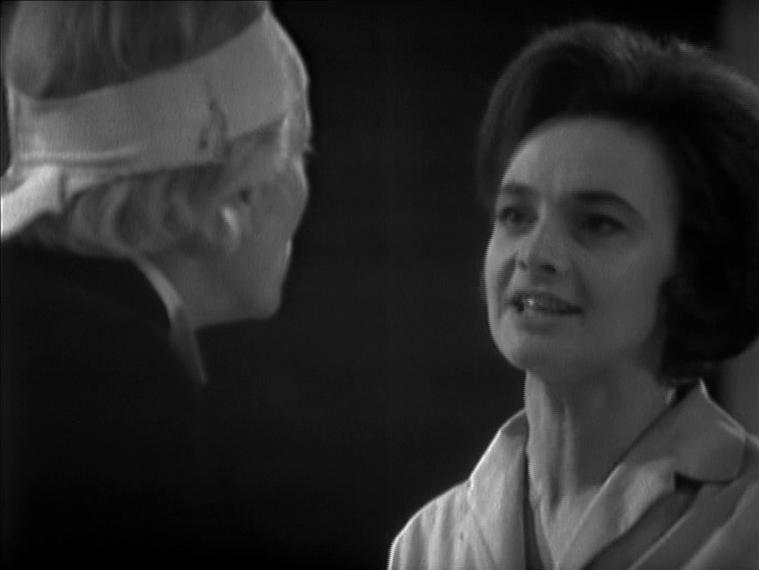
Barbara and the Doctor.

Barbara and the Doctor.

After an educational diatribe on the formation of solar systems, the Doctor admits to having underestimated Barbara.  It was the spring in the Fast Return, which was permanently switched on, which had been the fault all along.  Barbara, not being happy to accept half hearted apologies, sulks and asks the Doctor why he cares what she thinks and feels.  “As we learn about each other, so we learn about ourselves”, the Doctor responds.  Admitting that he’d accused Ian and Barbara unjustly, the Doctor complimented Barbara on her determination to prove him wrong.

It was the Fast Return all along!

It was the Fast Return all along.  It’s a shame that the BBC couldn’t afford any professional lettering!

The episodes ends with the Tardis having landed in a snow covered land. Offering Barbara “wearing apparel” from the ship’s “extensive wardrobe” the Doctor gives Barbara his arm and states “we must look after you, you know.  You’re very valuable”.

The Edge of Destruction was originally broadcast on BBC ONE between 8th and 15th February 1964.

The Edge of Destruction was originally broadcast on BBC ONE between 8th and 15th February 1964.

Vivien Fleming

©Vivien Fleming, 2013.
Transcript courtesy of http://www.chakoteya.net/doctorwho/1-3.htm