The Perth Mint has today announced the release of the Doctor Who50th Anniversary 2013 1 oz Gold Proof Coin. With a limited edition of only 250 coins, these 99.9% Pure Gold coins are issued by the New Zealand Mint and legal tender for Niue, a South Pacific Island nation. Retailing at $2,995.00 it’s highly unlikely that any of these $200.00 coins will find their way into circulation in Niue. The officially licensed product comes with a numbered Certificate of Authenticity and a prestigious wood display case. The reverse of the coin features an engraved relief of the TARDIS. Details are available from the Perth Mint website.
The Perth Mint has also announced the 18 October 2013 release of a rare coin collection featuring eleven 1/2 oz silver proof coins – one for each of the Doctor’s current eleven regenerations. No further details on this release are currently available.
A limited mintage of 10,000 1 oz Silver Proof Coins released earlier this year has sold out., Featuring the same TARDIS design as the gold coin, the coin is also legal tender in Niue and has a face value of $2.00. It retailed for $115.00.
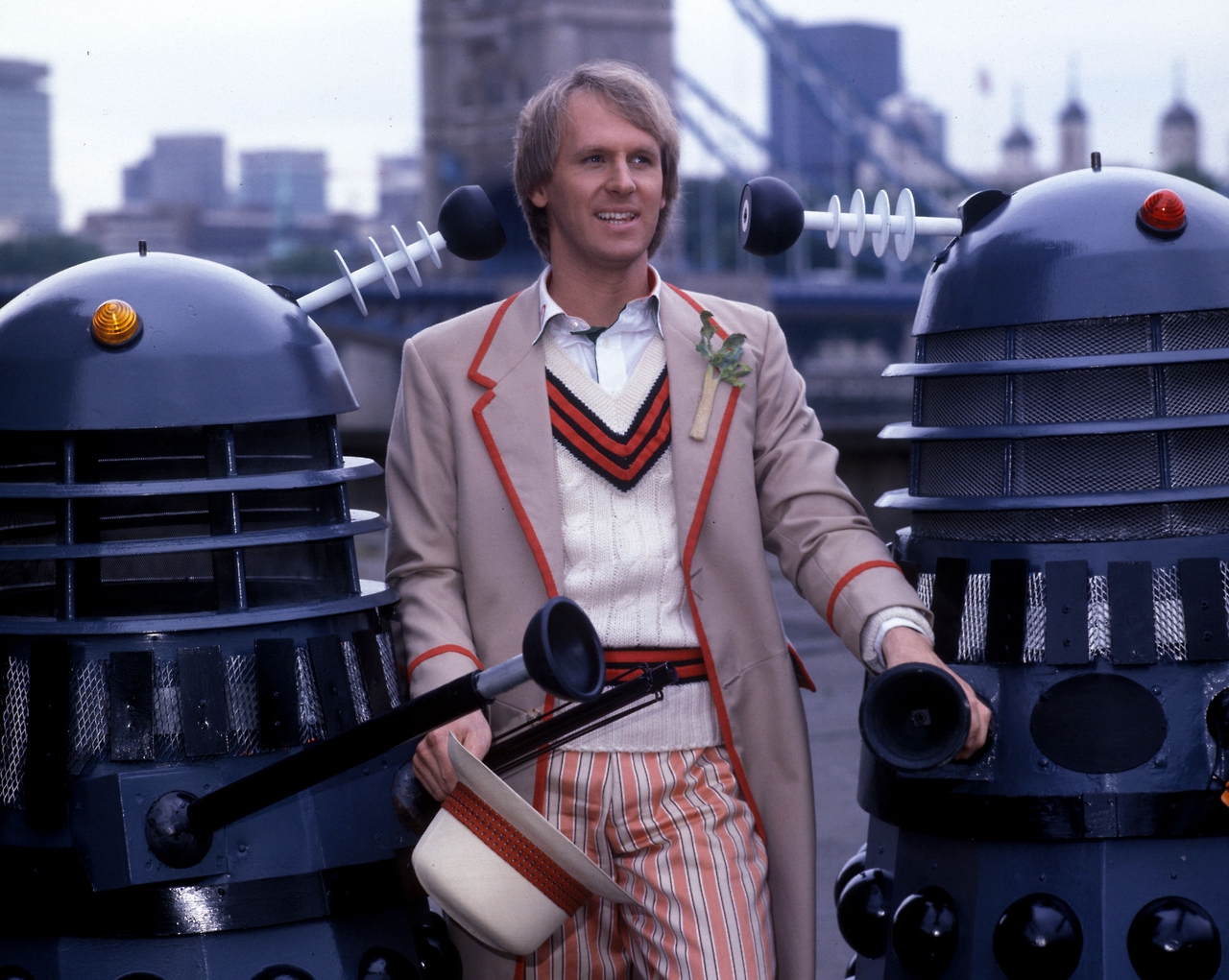
Speculation is rife on the nature of Peter Davison’s involvement in Doctor Who’s50th Anniversary celebrations. Digital Spy has reported Davison to have said “I’m making an appearance somewhere over that period of time but I can’t reveal in what. I can’t reveal anything specific about it. I’m not allowed to. It is a big year for the show and we’re all doing our bit for it. Trust me.”
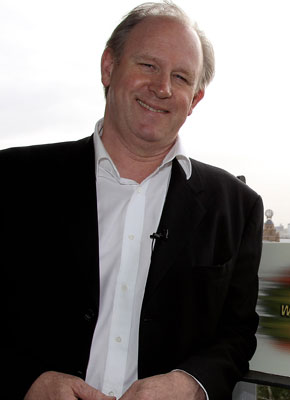
A recent photo of Peter Davison
Davison, who played the Fifth Doctor from 1981 to 1984, could be alluding to anything from a convention appearance, of which he has four scheduled for November 2013, to a role in the 50th Anniversary special, The Day of the Doctor.
BBC promotional poster for the Doctor Who 50th Anniversary Special, The Day of the Doctor
In March 2013 TV Rage reported that Davison had denied being involved in the 50th Anniversary Special. Speaking at the Mysticon convention in the US Davison said “I don’t think it will involve the older Doctors, certainly in their present form, because of course we’re meant to look exactly as we did when we left the TARDIS and none of us really do. Some of us are not here any more and others of us have weathered less well than others. I don’t know where I’d put myself in that category. I’m not going to make that decision.”
Davison, along with Colin Baker, Sylvester McCoy and Paul McGann, was in Australia for the Lords of TimeConventions in April 2013. It was at that time that the location shooting for The Day of the Doctorwas being undertaken in the UK. Appearing on the Australian television morning show, the Sixth, Seventh and Eighth Doctors denied any official involvement in the official 50th Anniversary television special.
Three Doctors on Channel 9 Australia Morning Show
Perhaps the involvement that Davison is alluding to is audio rather than television. It has previously been confirmed that Tom Baker, Peter Davison, Colin Baker, Sylvester McCoy and Paul McGann will be appearing in the special 50th Anniversary Big Finish audio production, The Light at the End.Joining the five Doctors will also be Louise Jameson (Leela), Sarah Sutton (Nyssa), Nicola Bryant (Peri), Sophie Aldred (Ace), India Fisher (Charley Pollard), Geoffrey Beevers (The Master). The Light at the Endis due for release in November.
Big Finish 50th Anniversary Official Audio Aventure.
As to what Davison’s true involvement in the 50th Anniversary celebrations is remains to be seen. With only a little more than two months left until 23 November we don’t have long to wait for the answer.
You can’t deny that Doctor Whofans have a sense of humour. Following the announcement on Monday that a painting found languishing in a Norwegian attic was a canvas by the Dutch artist Vincent Van Gogh, Doctor Whofanshave identified the mysterious blue building in the top left hand corner as the TARDIS. Van Gogh is a favourite of Whovians following the Series Five episode, Vincent and the Doctor (2010).
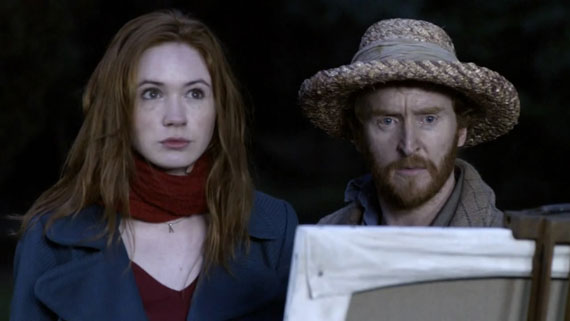
Tony Curran appeared as Vincent Van Gogh in the 2010 episode Vincent and the Doctor. He is pictured here with Amy.
Andy Macdonald of the CBC New Community Blog posted an article on the TARDIS revelation yesterday. Macdonald’s article can be found here.
You can read about the discovery of the lost masterpiece, Sunset at Montmajour, here.
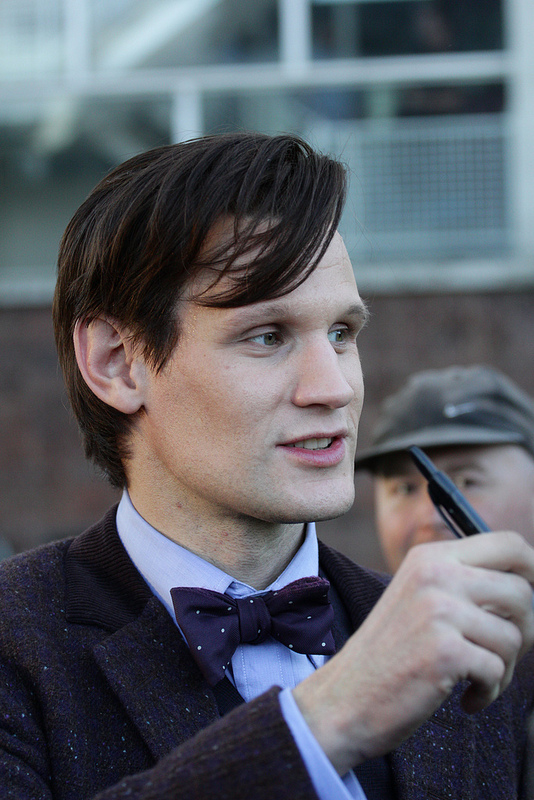
Filming has commenced for the 2013 Doctor Who Christmas Special and on 10 September the crew was spotted in Cardiff. Matt Smith, who is currently bearing a skin-head type hairdo following his filming of How to Catch a Monsterin Detroit earlier this year, donned a floppy hair wig for the occasion. The Christmas Special will be Smith’s last appearance in DoctorWhoand will see him regenerate into the Twelfth Doctor, Peter Capaldi.
Matt Smith in How to Catch a Monster
You can find two pages of photographs on flickr here. No copyright breach is intended.
Unfortunately the link to BBC Entertainment News has already been deleted. Was the statement released too early by accident or was it incorrect? Only time will tell.
BBC.co.uk’s Entertainment News have revealed the BBC’s plan to celebrate Doctor Who’s 50th Anniversary in November: *Update 23:00pm- BBC removed the page very quickly just after I published this article, clearly they released information far too early as BBC Ones Official Twitter account this evening, said that they will be revealing the plans at midnight – oops*
BBC confirms #DoctorWho 50th to culminate in progs across BBC TV & Radio. Exclusive Day Of The Doctor promo pic here http://t.co/60lscuzbnJ
The BBC has announced a raft of programmes to mark the 50th anniversary of the first episode of Doctor Who. A 75-minute special called The Day Of The Doctor will star the soon-to-leave Matt Smith and David Tennant. Smith said: “Hope you all enjoy. There’s lots more coming your way.”
Other highlights include a BBC Two lecture by Professor Brian Cox on the science behind…
Almost universally condemned as one of the worst Doctor Who serials ever, The Dominators was the serial Patrick Troughton personally requested be screened at the convention he was attending at the time of his death. Perhaps Troughton could see something of merit in The Dominators that fans and critics were unable to discern. But then again, in 1987 there weren’t many extant Second Doctor serials available. There aren’t many more accessible today. That’s probably reason enough to at least try to detect something favourable about the serial. Thankfully the good contributors to Celebrate Regenerate have come to our rescue and said this about The Dominators:
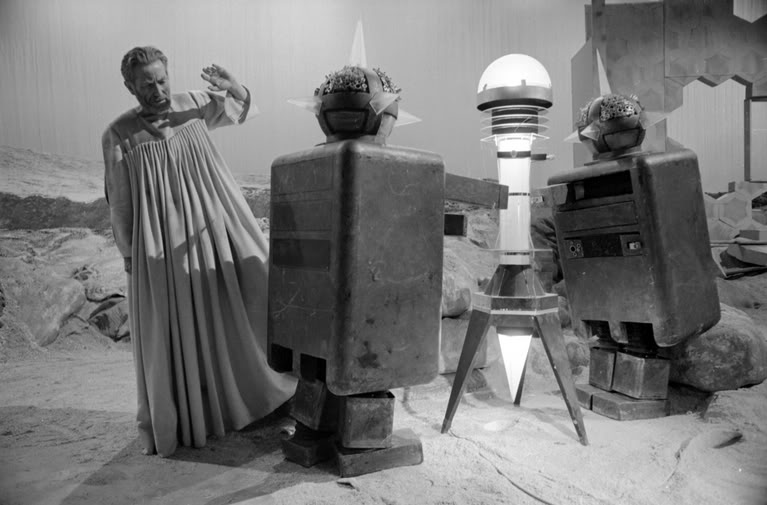
The Quarks were less than convincing as monsters
I think I knew The Dominators was the weakest of the bunch. But I still loved it: it was funny. It’s the only Doctor Who story I know of that’s based on a clash of household furnishings. Guys wearing sofas invade a world of people dressed in curtains. The natives immediately surrender to them despite the fact that they’re incompetent (those other ten galaxies must have really been pushovers). And then there are the Quarks. Small, slow, waddling, penguin-esque with squeaky voices and very low-capacity batteries. But at the end of the day , I love the Dominators …
Edited by Lewis Christian, Celebrate Regenerate is a fan produced chronicle of every Doctor Whoepisode
Save for its slowness and distinct lack of plot, the principal criticism directed at The Dominators is the writers’ reactionary premise that pacifism is abhorrent and pacifists gullible and unintelligent. In their third and final outing as writers for Doctor Who Mervyn Haisman and Henry Lincoln took a direct swipe at the growing anti-war movement. The Dulcians are pacifists and presented as unquestioning morons. Although they have two hearts they are physically weak and not use to manual labour. When forced to labour as slaves to the aggressors, the Dominators, they are next to useless and are seen to struggle under the burden of moving heavy rocks. The Dulcians’ education system appears to prioritize rote learning over intellectual enquiry and they accept any statements as fact until they are otherwise proved false. It isn’t too hard to envisage what Haisman and Lincoln’s perception of anti-war protestors were.
The Dulcians are not use to physical labour
The Dominators was not Doctor Who’s first anti-pacifist adventure. That dishonour goes to Terry Nation’s The Daleks in which the gorgeous Thals are pilloried for their being unprepared to fight . In my review of The DaleksI examined Nation’s contempt for the 1930’s British policy of Appeasement. Unlike the Thals, Haisman and Lincoln do not afford the Dulcians any redemption. They are portrayed in an unfavourable light throughout the whole of the serial. Given that Doctor Who has generally taken a more liberal view on political issues this contempt for pacifism is all the more extraordinary.
The aliens with perhaps the most inept name ever, the Dominators
More than 40 years later such distain for pacifism was again evidenced in Toby Whitehouse’s Series Six story, The God Complex (2011). This time, however, a reactionary political message was veiled in humour. When the Eleventh Doctor asks Gibbis, a native of Tivoli, how he arrived at the “hotel” his response was enlightening – “I was at work. I’m in town planning. We’re lining all the highways with trees so invading forces can march in the shade. It’s nice for them”. Tivoli is the most conquered planet in the galaxy and its residents have resigned themselves to being constantly overrun. Accordingly they welcome invading armies and their national anthem reflects the ease with which they accept domination – “Glory to <Insert Name Here>”.
Another pacifist portrayed in an unfavourable light was Gibbis in The God Complex (2011)
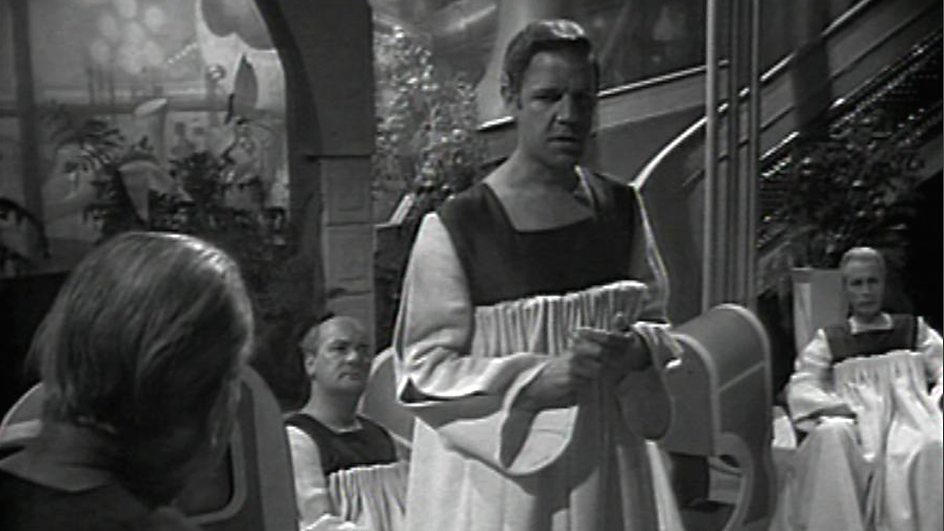
What I also found disturbing about The Dominators was the patriarchal nature of the Dulcians’ society. Only men, and old ones at that, are members of their governing council. Certainly there are numerous other Doctor Who serials which are guilty of not positively representing women, however The Dominators totally disenfranchises them. I would hope that this says more about the writers’ views than those espoused by the producers of Doctor Who. That being said, the decision to give the Quarks childish female voices is bizarre, to say the least. Hitherto all monsters, without exception, have had masculine voices even if their bodies are not specifically gendered. The one and only time that a woman is used to voice a monster, the voices are clumsy and laughable. It left me wondering if this was some form of bad joke in which women, in general, were being ridiculed.
Only men are members of the Dulcian ruling elite
Unfortunately the Quarks proved to be appalling monsters. Small in stature, school children were encased within them for the filming. They shuffled around, always looking as though they were about to tumble over, and had arms that were even more impractical than the Daleks’. They were easily defeated, at one stage by a conveniently light boulder pushed from a hill top by Cully, the only resident of Dulkis to rebel from their pacifism. Created by Haisman and Lincoln specifically for their marketing potential, the Quarks were almost the subject of legal proceedings between the writers and the BBC. Relations between the writers and Doctor Who deteriorated further when the serial was cut from six episodes to five and substantially rewritten. Haisman and Lincoln sought to have their names removed from the credits and accordingly a pseudonym, “Norman Asby”, which was taken from the first names of the writers’ father-in-laws, was adopted.
The marketing rights to the Quarks almost resulted in legal proceedings between the writers and the BBC
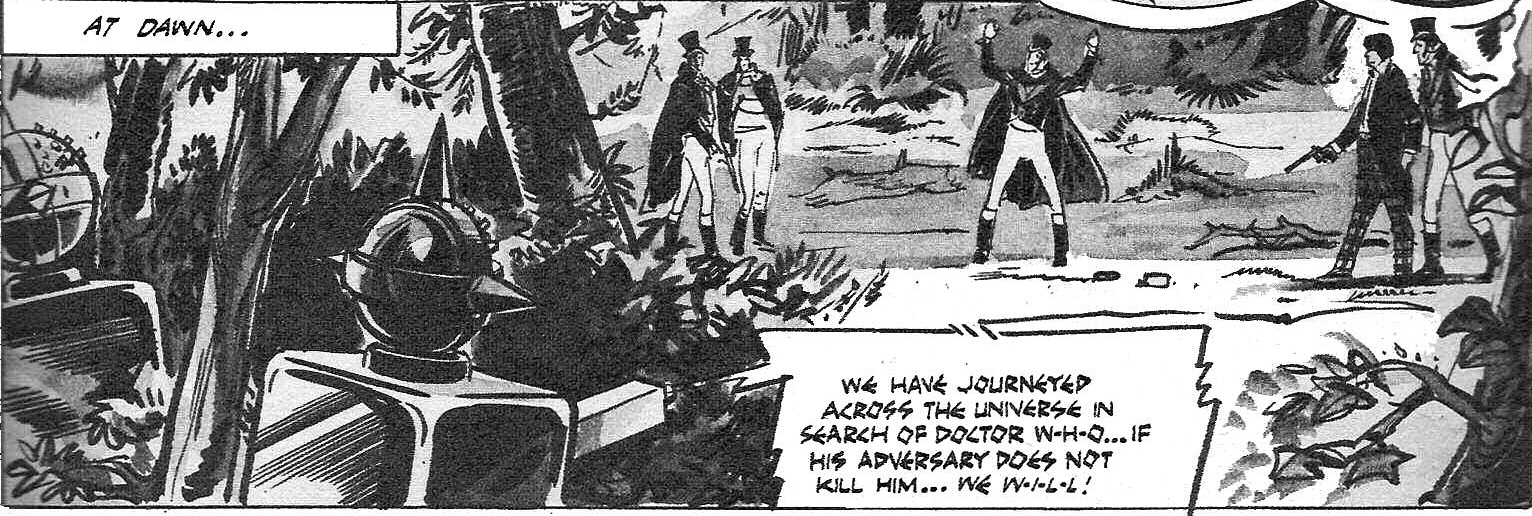
Although the Quarks were never again seen on TV they were encountered in comics
The Doctor’s ethics in The Dominators are also questionable. He is responsible for the deaths of the two Dominators after he places their atomic seed-device, intended to destroy the planet, onto the aggressor’s own space craft. This is plainly an example of lazy writing as it was the easy option for disposing of the bomb quickly. Surely the Doctor could have diffused it rather than acting as judge, jury and executioner.
The Doctor and Jamie hold hands again
Despite its many failing I surprised myself by actually enjoying The Dominators. Perhaps I was just relieved at watching the first complete serial since The Tomb of the Cybermen or maybe, just maybe, I could see in the story the good that Patrick Troughton evidently saw. I really don’t know, however I am sure that our next story, The Mind Robber, lives up to its reputation as Troughton’s favourite serial. Please join me for my next review as we enter the land of fiction.
The Dominatorswas originally broadcast in the UK between 10 August and 7 September 1968
I was recently browsing YouTube and came upon this fabulous compilation of colourized clips from William Hartnell’s tenure as the First Doctor. Here’s what the producer, who is known only by the alias of “It’s far from being all over”, says about his work:
“My Tribute to the man that started it all, William Hartnell.
I always felt many of his adventures deserved to be seen in colour, so I set to work. It’s taken about three months and I’ve colourised something in the region of 2,125 frames – one by one, frame by frame.
Some clips work better than others – as I reached the end I found myself dropping shots I didn’t like and recreating new ones! It’s been a labour of love and I hope you enjoy seeing some classic 60’s Doctor Who – in Colour!
Big thanks to ‘Pelham Cort aka @johnxgin3’ for his colour references and support throughout – I’ll do some Troughton soon! “
Hooray! Having completed Season Five of Doctor WhoI’m now two-thirds of my way through Patrick Troughton’s tenure as the Second Doctor. Soon the long three seasons of missing episodes will be but a distant memory as I dive into the largely intact Season Six. Please join me as I continue my journey through 50 years of Doctor Who.
The Fifth Season of Doctor Whoconcluded with The Wheel in Space. Episodes 3 and 6 are held in the BBC Archives and have been released on the Triple DVD set, Lost in Time.For the purposes of this marathon I viewed Loose Cannon’s excellent reconstructions of episodes 1, 2, 4 and 5, links for which appear below.
Loose Cannon’s The Wheel in Space, Episode 1 Part 1
Loose Cannon’s The Wheel in Space, Episode 1 Part 2
Loose Cannon’s The Wheel in Space, Episode 1 Part 3
Loose Cannon’s The Wheel in Space, Episode 2 Part 1
Loose Cannon’s The Wheel in Space, Episode 2 Part 2
Loose Cannon’s The Wheel in Space, Episode 4 Part 1
Loose Cannon’s The Wheel in Space, Episode 4 Part 2
Loose Cannon’s The Wheel in Space, Episode 5 Part 1
Loose Cannon’s The Wheel in Space, Episode 5 Part 2
The Wheel in Space was originally broadcast in the UK between 27 April and 1 June 1968. Episodes 3 and 6 of The Wheel in Space are held in the BBC Archives and have been released on the triple DVD set, Lost in Time.
The Wheel in Spacemarks the end of Doctor Who’s Fifth Season and the almost constant run of missing episodes which have plagued marathon viewers since the beginning of Season Three. Season Six is complete, save for the penultimate serial The Space Pirates, and two episodes of the eight part serial The Invasion. Thanks to the brilliant work of Cosgrove Hall. the two missing episodes of The Invasion have been animated and the complete serial is available for viewing on DVD.
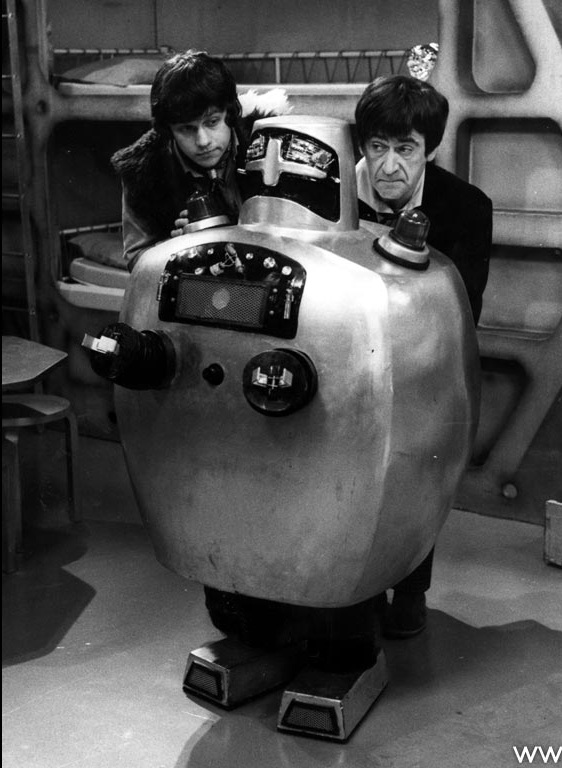
Jamie and the Doctor with the Servo-Robot which subsequently rendered the Doctor unconscious
The Cybermen made their fourth appearance in 18 months in The Wheel in Space. With the temporary retirement of the Daleks in the last serial of Season Four, the Cybermen had assumed the mantle of the Doctor’s number one enemy. Whereas the Daleks were previously guaranteed to appear in two serials per season, Terry Nation’s attempts to sell his creations to the US saw the Cybermen snatch their title as favourite recurring monsters. Their appearance in The Wheel in Space, however, was a great deal more subtle than in previous adventures. Not seen until the cliff hanger of episode two, their screen time was nearly as limited as their speech. The somewhat verbose sing-song voices of The Tenth Planet Cybermen were replaced by almost mute monsters with more human voices. Now possessing three silver fingers, the Cybermen’s principal terror derived from them silently emerging unexpectedly from anywhere on the Wheel.
The companion-in-waiting, Zoe, with two Cybermen
The hints of humanity that the first generation Cybermen possessed were long gone, with the cyber creatures now described by the Doctor thus: “Their entire bodies are mechanical and their brains have been treated neuro-surgically to remove all human emotions, all sense of pain. They’re ruthless, inhuman killers!”. These Cybermen, the Doctor said, need to colonize and have the treasures of earth.
The emotionless Cybermen provide a brilliant juxtaposition to the Doctor’s newest companion, Zoe Heriot. 15 year old Zoe is an astrophysicist and astrometricist first class and employed as the Wheel’s parapsychology librarian. Her perfect recall of scientific facts and ability to undertake mental calculations faster than a hand-held calculator are the consequence of her being brainwashed by the City’s educational institution. The processes by which she was educated are not revealed, although one can only guess that they were somewhat similar to those encountered by the First Doctor’s companion, Vicky. Coming from 2493, Vicky outlined to a stunned Barbara in The Rescue how her schooling comprised of being hooked up to a machine for only an hour a week. Zoe, however, comes from a much earlier time, perhaps the early 21st Century, so it’s possible that the education system was not the same. Wood and Miles in About Time argue that the character of Zoe would never work in a current day series “largely because most of her functions could be served by an idiot with a laptop”. With the digital age not even dreamed of in 1968, Zoe was one of the brainwashed bureaucrats that many feared would envelop us in the future.
Tat Wood & Lawrence Miles, About Time 2
An unfortunate consequence of Zoe’s education is she is entirely logic driven and completely unable to cope in unexpected circumstances. She is described as being without emotion twice in one day by her co-workers on the Wheel. Rob Shearman in Running Through Corridors described her as “a robot wanting to be a human being”. Shearman’s analysis of Zoe on page 266 is so well written as to warrant me quoting it in full.
The Doctor’s latest companion, Zoe Heriot
Someone else enslaved to logic is Zoe Heriot. She’s a much darker character than I’d ever realised. Whitaker’s script rather brilliantly only hints that she comes from a pitiless totalitarian regime, where young children are taken and brainwashed so that they can come out the other end supergeniuses – capable of holding a huge amount of information, but not the wherewithal to respond to it emotionally. She’s just another Cyberman.
Rob Shearman brilliantly analyses Zoe in Running Through Corridors
Zoe’s brainwashing was quickly detected by the Doctor who responded to her with perhaps one of his most memorable comments, “Logic, my dear Zoe, merely enables one to be wrong with authority”. During the course of the serial the limitations she faces because of her reliance on logic become painfully clear. Jamie and Zoe’s conversation in the Wheel Operations room during episode five evidences her growing disillusionment, and foreshadows her ultimate decision to stow away in the Tardis.
JAMIE: Oh, there is something you don’t know, then.
ZOE: There’s too much I don’t know. I was trained to believe logic and calculation would provide me with all the answers. Well, I’m just beginning to realise there are questions which I can’t answer.
JAMIE: You’re just not trained for an emergency like this.
ZOE: Well, that’s the whole point. What good am I? I’ve been created for some false kind of existence where only known kinds of emergencies are catered for. Well, what good is that to me now?
JAMIE: Hey, we’re not done yet, you know.
ZOE: And if we survive? What then, Jamie? Suppose we do get ourselves out of this mess. What have I got left? A blind reliance on facts and logic?
The Crew in the Control Room of the Wheel
When Zoe is found in the TARDIS’s magic chest at the story’s end Jamie’s immediate reaction is to say that it’s impossible for her to go with them. This of itself is quite extraordinary given that he voiced no such concerns when Victoria hitched a ride after her father’s death in The Evil of the Daleks. Perhaps Jamie was secretly hoping that the Doctor would pop back and pick up Victoria from Brittanicus Base? The less polite might argue that Jamie wanted the Doctor all to himself! The Doctor responded to Zoe’s request to stay by saying that it wasn’t impossible but “something that we have to decide”. It appears that the TARDIS is a democracy and that the Doctor is not the sole decision maker. This is in stark contrast to the First Doctor’s tenure where the Ship was clearly his own, to do with as he pleased. Kidnapping is something that the Second Doctor would never acquiesce to.
Jamie is initially reticent to accept Zoe as a member of the TARDIS Crew
To help Zoe decide if she wanted to accept the challenges of life in the TARDIS, the Doctor projected his thought patterns onto a monitor and the reprise from episode two of The Evil of the Daleks was seen. In the break between Seasons Six and Seven the BBC aired the first ever Doctor Who repeat, The Evil of the Daleks, and this was scripted into both episode six of The Wheel in Space and episode one of Season Six, The Dominators. This was the first and only time that a repeat was scripted into a serial. The viewers had to wait for Zoe’s decision on whether to stay with the Doctor and Jamie.
The Evil of the Daleks was the first Doctor Who serial ever repeated and the first and only repeat to be scripted into a serial
Another first for The Wheel in Space was the use of the Doctor’s pseudonym, John Smith. When Gemma Corwyn, the Second-in-Command of the Wheel and a particularly strong and well developed female character, asked Jamie what the Doctor’s name was he was stumped. “The Doctor” was the only name by which Jamie knew this mysterious man with whom he’d lived and travelled for the past two years. Glancing over at some medical equipment manufactured by John Smith & Associates Jamie replied, “Er. John Smith”. Later, when the Doctor recovered from his Servo-Robot induced unconsciousness and Corwyn introduced him to Zoe, Jamie had to nudge the Doctor into recognizing that his name was John.
The piece of medical equipment which inspired (the now literate) Jamie to give the Doctor the alias “John Smith”
The Doctor would go onto use the alias John Smith dozens of time thereafter. It could be argued that Jamie’s naming of the Doctor was a mere coincidence and that he was already known by that alias. In the Series Five episode, The Vampires of Venice, the Doctor produced a library card with the First Doctor’s image on it and the address 76 Totter’s Lane. This may well be another example of retroactive continuity as previously discussed in my review of The Abominable Snowmen. Interestingly enough, on one occasion when the Doctor didn’t use the alias of John Smith (Tooth and Claw) he adopted the name James McCrimmon instead. What a lovely nod to Jamie that was.
The Eleventh Doctor shows his library card bearing the name and photo of Dr John Smith in The Vampires of Venice (2010)
The Tenth Doctor identifies himself as James McCrimmon in Tooth and Claw(2006)
It is important to be mindful, however, of the voluminous amounts of criticism that have been directed at The Wheel in Space. Frequently dismissed for being the last of an almost continuous stream of “Base under Siege” stories in Season Five, The Wheel is somewhat slow and features a great deal less of the Doctor then generally seen. Patrick Troughton was on holidays during episode two when the Doctor is conveniently unconscious for the whole episode. When he does appear not a great deal happens. This general disaffection with the story is perhaps best summed up by Cornell, Day and Topping in The Discontinuity Guide (1994) when they describe the serial like this:
Dull, lifeless and so derivative of other base-under-siege stories that it isn’t really a story in its own right. Despite the detailed Wheel setting, the galloping lack of scientific credibility is annoying, and the Cybermen are so bland and ordinary that they could have been any other monster. Generic speed-written tosh.
Paul Cornell, Martin Day & Keith Topping, The Discontinuity Guide
Notwithstanding this criticism, The Wheel in Space was placed at 156 in the 2009 Doctor Who Magazine Mighty 200. That was well above several other Troughton serials including The Krotons (166), The Dominators (191), The Underwater Menace (194) and The Space Pirates (195). As two episodes are held in the BBC Archives, and have been released on the Lost in Time DVD, it is well worth disregarding the consensus and giving The Wheel in Space a view. It’s worth it just to see the lovely Wendy Padbury introduced as Zoe.
The Wheel in Space was originally broadcast in the UK between 27 April and 1 June 1968. Episodes 3 and 6 of The Wheel in Space are held in the BBC Archives and have been released on the triple DVD set, Lost in Time.
Paul Cornell, Martin Day & Keith Topping, The Discontinuity Guide,Virgin Publishing Ltd: London,1995.
Robert Shearman & Toby Hadoke, Running Through Corridors. Rob & Toby’s Marathon Watch of Doctor Who. Volume 1: The 60s,Mad Norweigan Press: Illinois, 2010.
Tat Wood & Lawrence Miles, About Time. The Unauthorized Guide to Doctor Who 1966-1969 Seasons 4 to 6 Volume 2.Mad Norweigan Press: Illinois, 2010.
 The Perth Mint has today announced the release of the Doctor Who 50th Anniversary 2013 1 oz Gold Proof Coin. With a limited edition of only 250 coins, these 99.9% Pure Gold coins are issued by the New Zealand Mint and legal tender for Niue, a South Pacific Island nation. Retailing at $2,995.00 it’s highly unlikely that any of these $200.00 coins will find their way into circulation in Niue. The officially licensed product comes with a numbered Certificate of Authenticity and a prestigious wood display case. The reverse of the coin features an engraved relief of the TARDIS. Details are available from the Perth Mint website.











 The Doctor Who Mind Robber