Hooray! Having completed Season Five of Doctor WhoI’m now two-thirds of my way through Patrick Troughton’s tenure as the Second Doctor. Soon the long three seasons of missing episodes will be but a distant memory as I dive into the largely intact Season Six. Please join me as I continue my journey through 50 years of Doctor Who.
The Fifth Season of Doctor Whoconcluded with The Wheel in Space. Episodes 3 and 6 are held in the BBC Archives and have been released on the Triple DVD set, Lost in Time.For the purposes of this marathon I viewed Loose Cannon’s excellent reconstructions of episodes 1, 2, 4 and 5, links for which appear below.
Loose Cannon’s The Wheel in Space, Episode 1 Part 1
Loose Cannon’s The Wheel in Space, Episode 1 Part 2
Loose Cannon’s The Wheel in Space, Episode 1 Part 3
Loose Cannon’s The Wheel in Space, Episode 2 Part 1
Loose Cannon’s The Wheel in Space, Episode 2 Part 2
Loose Cannon’s The Wheel in Space, Episode 4 Part 1
Loose Cannon’s The Wheel in Space, Episode 4 Part 2
Loose Cannon’s The Wheel in Space, Episode 5 Part 1
Loose Cannon’s The Wheel in Space, Episode 5 Part 2
The Wheel in Space was originally broadcast in the UK between 27 April and 1 June 1968. Episodes 3 and 6 of The Wheel in Space are held in the BBC Archives and have been released on the triple DVD set, Lost in Time.
The Wheel in Spacemarks the end of Doctor Who’s Fifth Season and the almost constant run of missing episodes which have plagued marathon viewers since the beginning of Season Three. Season Six is complete, save for the penultimate serial The Space Pirates, and two episodes of the eight part serial The Invasion. Thanks to the brilliant work of Cosgrove Hall. the two missing episodes of The Invasion have been animated and the complete serial is available for viewing on DVD.
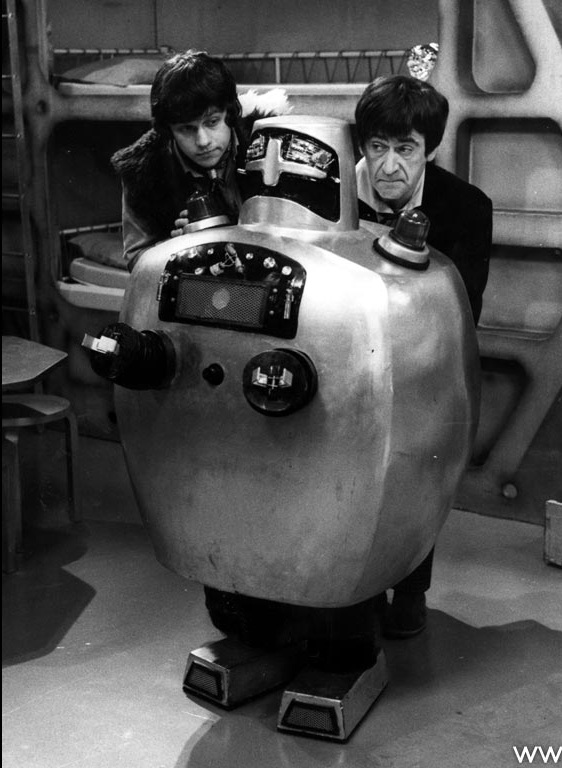
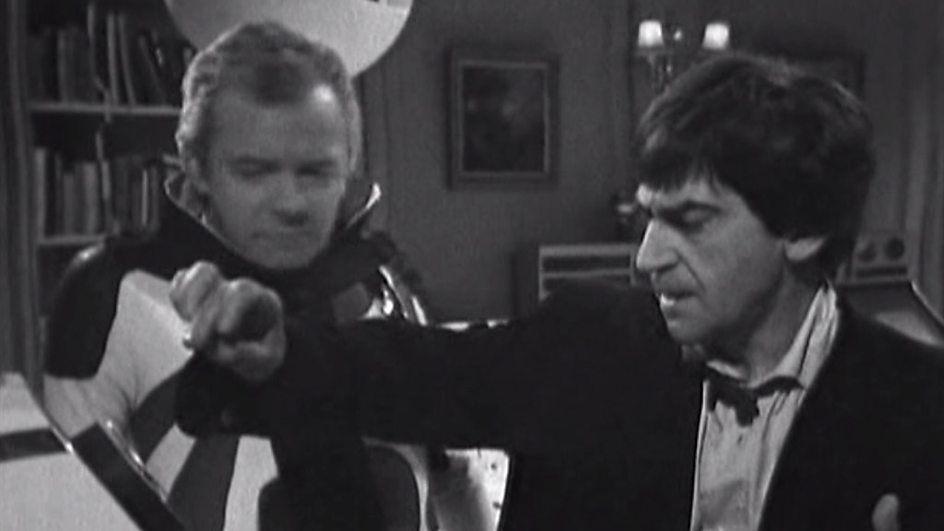
Jamie and the Doctor with the Servo-Robot which subsequently rendered the Doctor unconscious
The Cybermen made their fourth appearance in 18 months in The Wheel in Space. With the temporary retirement of the Daleks in the last serial of Season Four, the Cybermen had assumed the mantle of the Doctor’s number one enemy. Whereas the Daleks were previously guaranteed to appear in two serials per season, Terry Nation’s attempts to sell his creations to the US saw the Cybermen snatch their title as favourite recurring monsters. Their appearance in The Wheel in Space, however, was a great deal more subtle than in previous adventures. Not seen until the cliff hanger of episode two, their screen time was nearly as limited as their speech. The somewhat verbose sing-song voices of The Tenth Planet Cybermen were replaced by almost mute monsters with more human voices. Now possessing three silver fingers, the Cybermen’s principal terror derived from them silently emerging unexpectedly from anywhere on the Wheel.
The companion-in-waiting, Zoe, with two Cybermen
The hints of humanity that the first generation Cybermen possessed were long gone, with the cyber creatures now described by the Doctor thus: “Their entire bodies are mechanical and their brains have been treated neuro-surgically to remove all human emotions, all sense of pain. They’re ruthless, inhuman killers!”. These Cybermen, the Doctor said, need to colonize and have the treasures of earth.
The emotionless Cybermen provide a brilliant juxtaposition to the Doctor’s newest companion, Zoe Heriot. 15 year old Zoe is an astrophysicist and astrometricist first class and employed as the Wheel’s parapsychology librarian. Her perfect recall of scientific facts and ability to undertake mental calculations faster than a hand-held calculator are the consequence of her being brainwashed by the City’s educational institution. The processes by which she was educated are not revealed, although one can only guess that they were somewhat similar to those encountered by the First Doctor’s companion, Vicky. Coming from 2493, Vicky outlined to a stunned Barbara in The Rescue how her schooling comprised of being hooked up to a machine for only an hour a week. Zoe, however, comes from a much earlier time, perhaps the early 21st Century, so it’s possible that the education system was not the same. Wood and Miles in About Time argue that the character of Zoe would never work in a current day series “largely because most of her functions could be served by an idiot with a laptop”. With the digital age not even dreamed of in 1968, Zoe was one of the brainwashed bureaucrats that many feared would envelop us in the future.
Tat Wood & Lawrence Miles, About Time 2
An unfortunate consequence of Zoe’s education is she is entirely logic driven and completely unable to cope in unexpected circumstances. She is described as being without emotion twice in one day by her co-workers on the Wheel. Rob Shearman in Running Through Corridors described her as “a robot wanting to be a human being”. Shearman’s analysis of Zoe on page 266 is so well written as to warrant me quoting it in full.
The Doctor’s latest companion, Zoe Heriot
Someone else enslaved to logic is Zoe Heriot. She’s a much darker character than I’d ever realised. Whitaker’s script rather brilliantly only hints that she comes from a pitiless totalitarian regime, where young children are taken and brainwashed so that they can come out the other end supergeniuses – capable of holding a huge amount of information, but not the wherewithal to respond to it emotionally. She’s just another Cyberman.
Rob Shearman brilliantly analyses Zoe in Running Through Corridors
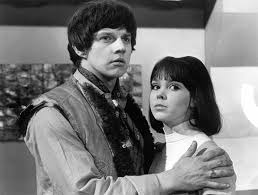
Zoe’s brainwashing was quickly detected by the Doctor who responded to her with perhaps one of his most memorable comments, “Logic, my dear Zoe, merely enables one to be wrong with authority”. During the course of the serial the limitations she faces because of her reliance on logic become painfully clear. Jamie and Zoe’s conversation in the Wheel Operations room during episode five evidences her growing disillusionment, and foreshadows her ultimate decision to stow away in the Tardis.
JAMIE: Oh, there is something you don’t know, then.
ZOE: There’s too much I don’t know. I was trained to believe logic and calculation would provide me with all the answers. Well, I’m just beginning to realise there are questions which I can’t answer.
JAMIE: You’re just not trained for an emergency like this.
ZOE: Well, that’s the whole point. What good am I? I’ve been created for some false kind of existence where only known kinds of emergencies are catered for. Well, what good is that to me now?
JAMIE: Hey, we’re not done yet, you know.
ZOE: And if we survive? What then, Jamie? Suppose we do get ourselves out of this mess. What have I got left? A blind reliance on facts and logic?
The Crew in the Control Room of the Wheel
When Zoe is found in the TARDIS’s magic chest at the story’s end Jamie’s immediate reaction is to say that it’s impossible for her to go with them. This of itself is quite extraordinary given that he voiced no such concerns when Victoria hitched a ride after her father’s death in The Evil of the Daleks. Perhaps Jamie was secretly hoping that the Doctor would pop back and pick up Victoria from Brittanicus Base? The less polite might argue that Jamie wanted the Doctor all to himself! The Doctor responded to Zoe’s request to stay by saying that it wasn’t impossible but “something that we have to decide”. It appears that the TARDIS is a democracy and that the Doctor is not the sole decision maker. This is in stark contrast to the First Doctor’s tenure where the Ship was clearly his own, to do with as he pleased. Kidnapping is something that the Second Doctor would never acquiesce to.
Jamie is initially reticent to accept Zoe as a member of the TARDIS Crew
To help Zoe decide if she wanted to accept the challenges of life in the TARDIS, the Doctor projected his thought patterns onto a monitor and the reprise from episode two of The Evil of the Daleks was seen. In the break between Seasons Six and Seven the BBC aired the first ever Doctor Who repeat, The Evil of the Daleks, and this was scripted into both episode six of The Wheel in Space and episode one of Season Six, The Dominators. This was the first and only time that a repeat was scripted into a serial. The viewers had to wait for Zoe’s decision on whether to stay with the Doctor and Jamie.
The Evil of the Daleks was the first Doctor Who serial ever repeated and the first and only repeat to be scripted into a serial
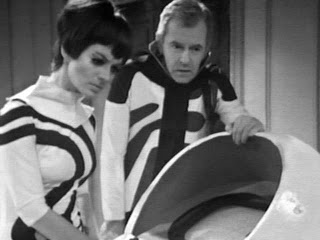
Another first for The Wheel in Space was the use of the Doctor’s pseudonym, John Smith. When Gemma Corwyn, the Second-in-Command of the Wheel and a particularly strong and well developed female character, asked Jamie what the Doctor’s name was he was stumped. “The Doctor” was the only name by which Jamie knew this mysterious man with whom he’d lived and travelled for the past two years. Glancing over at some medical equipment manufactured by John Smith & Associates Jamie replied, “Er. John Smith”. Later, when the Doctor recovered from his Servo-Robot induced unconsciousness and Corwyn introduced him to Zoe, Jamie had to nudge the Doctor into recognizing that his name was John.
The piece of medical equipment which inspired (the now literate) Jamie to give the Doctor the alias “John Smith”
The Doctor would go onto use the alias John Smith dozens of time thereafter. It could be argued that Jamie’s naming of the Doctor was a mere coincidence and that he was already known by that alias. In the Series Five episode, The Vampires of Venice, the Doctor produced a library card with the First Doctor’s image on it and the address 76 Totter’s Lane. This may well be another example of retroactive continuity as previously discussed in my review of The Abominable Snowmen. Interestingly enough, on one occasion when the Doctor didn’t use the alias of John Smith (Tooth and Claw) he adopted the name James McCrimmon instead. What a lovely nod to Jamie that was.
The Eleventh Doctor shows his library card bearing the name and photo of Dr John Smith in The Vampires of Venice (2010)
The Tenth Doctor identifies himself as James McCrimmon in Tooth and Claw(2006)
It is important to be mindful, however, of the voluminous amounts of criticism that have been directed at The Wheel in Space. Frequently dismissed for being the last of an almost continuous stream of “Base under Siege” stories in Season Five, The Wheel is somewhat slow and features a great deal less of the Doctor then generally seen. Patrick Troughton was on holidays during episode two when the Doctor is conveniently unconscious for the whole episode. When he does appear not a great deal happens. This general disaffection with the story is perhaps best summed up by Cornell, Day and Topping in The Discontinuity Guide (1994) when they describe the serial like this:
Dull, lifeless and so derivative of other base-under-siege stories that it isn’t really a story in its own right. Despite the detailed Wheel setting, the galloping lack of scientific credibility is annoying, and the Cybermen are so bland and ordinary that they could have been any other monster. Generic speed-written tosh.
Paul Cornell, Martin Day & Keith Topping, The Discontinuity Guide
Notwithstanding this criticism, The Wheel in Space was placed at 156 in the 2009 Doctor Who Magazine Mighty 200. That was well above several other Troughton serials including The Krotons (166), The Dominators (191), The Underwater Menace (194) and The Space Pirates (195). As two episodes are held in the BBC Archives, and have been released on the Lost in Time DVD, it is well worth disregarding the consensus and giving The Wheel in Space a view. It’s worth it just to see the lovely Wendy Padbury introduced as Zoe.
The Wheel in Space was originally broadcast in the UK between 27 April and 1 June 1968. Episodes 3 and 6 of The Wheel in Space are held in the BBC Archives and have been released on the triple DVD set, Lost in Time.
Paul Cornell, Martin Day & Keith Topping, The Discontinuity Guide,Virgin Publishing Ltd: London,1995.
Robert Shearman & Toby Hadoke, Running Through Corridors. Rob & Toby’s Marathon Watch of Doctor Who. Volume 1: The 60s,Mad Norweigan Press: Illinois, 2010.
Tat Wood & Lawrence Miles, About Time. The Unauthorized Guide to Doctor Who 1966-1969 Seasons 4 to 6 Volume 2.Mad Norweigan Press: Illinois, 2010.
Whether there’s a relationship between the resurrection of seemingly deceased Doctor Who monsters and the sale of Classic Series DVDs is an issue worth pondering. Released in late August in the UK and Australasia, and mid September in the US, The Ice Warriors DVD emerged four months after an Ice Warrior appeared in the Mark Gatiss penned Cold War after a 39 year absence from Doctor Who. Prior to the episode’s broadcastSteven Moffat stated that a lot of persuasion was needed to convince him that the Ice Warriors should return.
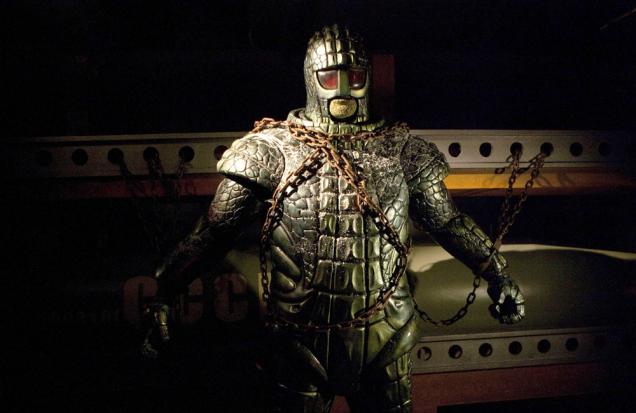
Grand Marshall Skaldak, a 2013 model Ice Warrior
“It was Mark Gatiss’s idea and it was very much his pitch – he’d been pitching the Ice Warriors for a while. I wasn’t tremendously persuaded. I’ll be honest. I thought they were maybe the default condition for what people thought of as rubbish Doctor Who monsters – things that moved very, very slowly and spoke in a way that meant you couldn’t hear a word they said. Mark came up with a couple of very clever ideas, which he pitched to me over the phone in what was meant to be a Sherlock conversation. He had a couple of really stormingly good ideas, and it’s a great episode, an absolute cracker of an episode”.
One is left wondering if perhaps Moffat failed to mention that the marketing department of the BBC was instrumental in the decision to have the Ice Warriors return.
Trailer for the return of the Ice Warriors in 2013’s Cold War.
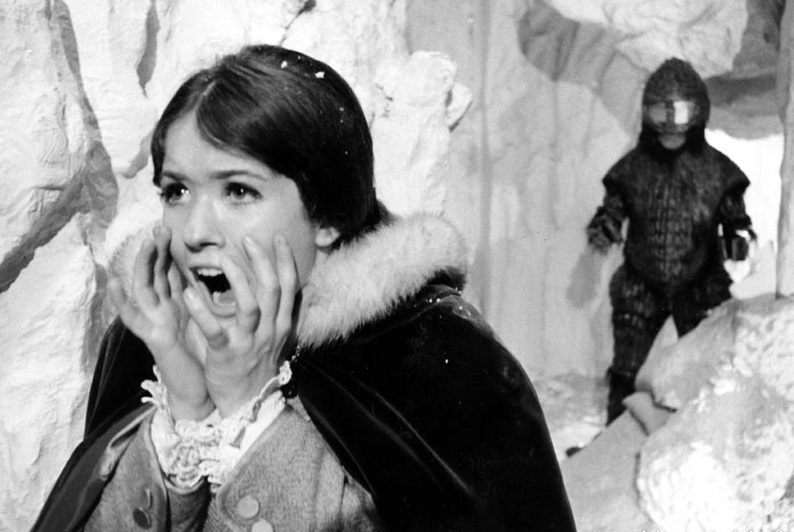
Are the Ice Warriors the default “rubbish” monsters that Moffat suggests? They were certainly slow and unfortunately restricted by their large fin like feet. In the special feature, Cold Fusion, actor Sonny Caldinez tells several amusing anecdotes about his time as an Ice Warrior and particularly the filming of The Ice Warriors. He had such difficulty chasing Deborah Watling through the ice caves because of his costume’s feet that they had to slow down Watling’s running speed. That the design of the Ice Warrior in Cold War very faithfully reproduced the 1967 model says much for the integrity of the Mark 1 models.
Victoria chased by Turoc (Sonny Caldinez)
One of the “stormingly good ideas” that Gatiss had about the 2013 Ice Warriors was undoubtedly Grand Marshall Skaldak emerging from his armour for the first time. Strangely, the slightly jerky head movements of the original Ice Warriors, a little akin to a person with mild Parkinson’s Disease, is absent from the current model Warriors. Similarly, Nicholas Briggs toned down the hissing of Skaldak’s speech in Cold War. There wasn’t anything much more shocking in The Ice Warriors then when Zondal says that Storr was “ussselesss and uneccesssssary” just before killing him.
The Scot Storr is killed by an Ice Warrior
Interestingly, the 50th Anniversary Special on 23 November features the Zygons in only their second appearance in Doctor Who. Their first and only appearance was with the Fourth Doctor in the 1975 serial Terror of the Zygons, which incidentally will be released on DVD in Australia and New Zealand on 2 October 2013. Is this a coincidence? Who knows.
The Zygons will be returning in the 50th Anniversary special in November
With the Classic Series range of DVD releases quickly coming to an end I’m left wondering if Season 8 will see the return of The Underwater Menace’s Fish People. Rumour has it that the missing two episodes will be animated and the DVD released sometime in 2014. I can only hope that all of Galaxy 4 is recovered so my long held wish for the return of the Chumblies might be granted!
As outlined in my review of the First Doctor’s adventure Planet of Giants, I’ve always had a soft spot for Doctor Who serials with an environmental message. The Ice Warriors is such a story, albeit one where the science is decidedly fiction and not fact. The Doctor, Victoria and Jamie find themselves at Brittanicus Base, one of a number of such bases established to stem the tide of ice glaciers which have been steadily engulfing the earth’s surface. The New Ice Age which the Earth is confronted by is said to have arisen because of deforestation and the consequential loss of carbon dioxide from the atmosphere. Even a person as ignorant as myself in things scientific is aware that deforestation (and the burning of fossil fuels) is the cause of global warming, not global cooling. During photosynthesis trees convert carbon dioxide and water into sugar molecules and oxygen. Less trees equals more carbon dioxide. I wonder where the writer, Brian Hayles, received his scientific knowledge on this one?
Although the Doctor can operate an artificial food dispenser (with retro telephone dial) he is a little confused about the relationship between plants and carbon dioxide. He is pictured here with Leader Clent.
The obstinate leader of Brittanicus Base, Clent, outlined to the Doctor and his companions how this catastrophic environmental disaster occurred.
“You know how efficient our civilisation is, thanks to the direction of the great World Computer. As you also know how we conquered the problem of world famine a century ago by artificial food. On the land that was once used to grow the food we needed, we built up to date living units, to house the ever-increasing population … So, the amount of growing plants on the planet, was reduced to an absolute minimum. Then suddenly, one year, there was no spring. Even then it wasn’t understood. Not until the ice-caps began to advance”.
During the course of the conversation the Doctor added the comment ,”No plants, no carbon dioxide.” Is it any wonder that when the Doctor met with the Ice Warriors, Zondal stated “You do not look like a scientist”. “Looks aren’t everything, you know” replied the Doctor.
Together with Ice Warriors, glaziers threaten the earth
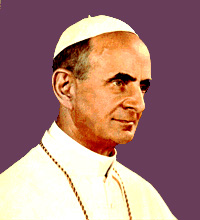
Although the consequences of deforestation is the exact opposite to what The Ice Warriors claims, i.e. global warming rather than global cooling, the essence of the message is not lost on the audience. Human manipulation of the environment, even if at the behest of a “great World Computer”, has horrendous consequences on the planet and its human occupants. Population growth is also shown to have negative effects. During the 1960s there was much debate about population growth and artificial birth control. Little more than six months after the broadcast of The Ice Warriors Pope Paul VI released his much discussed encyclical letter Humanae Vitae on human reproduction. In reaffirming the Catholic Church’s traditional teachings against contraception, Humanae Vitae contradicted a report of Paul’s own commission, two years previously, which had recommended limited contraceptive use for married couples.
Pope Paul VI
The Ice Warriors shares the anti-computer rhetoric of TheWar Machines. Leader Clent and Senior Control Technician Miss Garrett have an unwavering confidence in the great World Computer’s ability to answer all questions logically and in society’s best interests. As would be expected in 1967, the computer is futuristic and answers questions verbally. It’s very difficult to understand, particularly in episode one where the soundtrack is very muddy. The disaffected scientist Penley shares the Doctor’s distain for them. “I refused to be sucked into that computerised ant-heap you call a civilisation. I’m a man, not a machine”, Penley says to Miss Gifford. When speaking to the Doctor, Penley delivered a further sentence of superior anti-computer verbosity when he stated “You don’t expect me to face Clent alone. That mouth piece of the computer? He’s got a printed circuit where his heart should be”. It’s all very beautifully written and elucidates the same fear of computerization that I outlined in my The War Machines review.
Clent and Miss Gifford with the futurist great World Computer. The Brittanicus Base crew had the most fabulous close fitting outfits
The computer is revered almost as God like in its decisions. “Our trust is in the great computer. With its aid, we cannot fail”, Gifford stated. As the story proceeds, however, it is evident that this deification is undeserved. When Clent reserves the right to consult the computer on whether they should use the ioniser when the alien spacecraft is powered by an iron reactor, the computer spins and gibbers. Jamie cried, “It’s as though it’s gone mad”. The final decision is left to the human Penley, who not surprisingly chose the best option.
In a rather clever premonition of Little Britain’s Carol, Clent says “The computer says no!”. Little Britain – The Computer says no.
The Ice Warriors succeeds because of its superior cast, magnificent set design and absolutely fabulous outfits. Peter Barkworth as Leader Clent is outstanding as he shuffles around the base with his walking stick. Barkworth would later go on to win two BAFTA awards for best TV actor. Peter Sallis generously plays the scientist Penley and is perhaps most famous for his 37 years spent as Last of the Summer Wine’s Norman Clegg. Most surprising of all is Bernard Bresslaw as the Ice Warrior Varga. Bresslaw was a comedy actor best known for his roles in the Carry On movies. At 6′ 7″ tall Bresslaw provided the towering height needed for the Ice Warriors and is credited for creating their movements and hissing speech.
Bernard Bresslaw played the head Ice Warrior, Varga
The Ice Warriors was originally broadcast in the UK between 11 November and 16 December 1967
 Hooray! Having completed Season Five of Doctor Who I’m now two-thirds of my way through Patrick Troughton’s tenure as the Second Doctor. Soon the long three seasons of missing episodes will be but a distant memory as I dive into the largely intact Season Six. Please join me as I continue my journey through 50 years of Doctor Who.










 The Doctor Who Mind Robber