Category Archives: Second Doctor

The Enemy of the World

Standard

Image

Appearing exactly half way through Patrick Troughton’s tenure as the Second Doctor, The Enemy of the World is an oft forgotten gem hidden amidst the monster laden fare of Season Five.  With only one of its six episodes held in the BBC Archives, The Enemy of the World is frequently overlooked because the single episode released on Lost in Time is so dissimilar to the other five. When I first watched episode three of Enemy I was knocked out by Reg Lye’s characterization of Griffin the chef.  The forthright Australian with the phenomenal panache for black humour explodes from the screen with an eccentric disposition that, despite its quirks, is readily identifiable with.  That being said, exactly what it meant and why it was included left me totally confused. Upon re-watching the episode during a viewing of Loose Cannon’s reconstructions, it quickly made sense. Griffin is the audience’s identification in a tale of multi-cultural, worldwide intrigue.

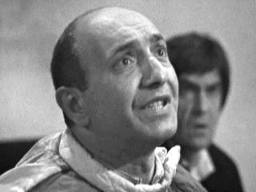
Reg Lye was phenomenal as the chef, Griffin

Reg Lye was phenomenal as the chef, Griffin

The Enemy of the World is Doctor Who’s first foray into James Bond action style conspiracies for world domination. As Barry Letts’ debut to the series as director, it foreshadows a style which will become quite familiar during Jon Pertwee’s tenure as the Third Doctor. With Letts as Who’s producer, action scenes such as those in the first half of episode one of Enemy of the World will become a great deal more common.  The hovercraft and helicopter scenes in Enemy are but a prelude to the chase extravaganzas of 1970’s serials such as episode two of Planet of the Spiders. It’s such a shame that all we have left to gauge the success of these Enemy scenes are telesnaps and the audio.
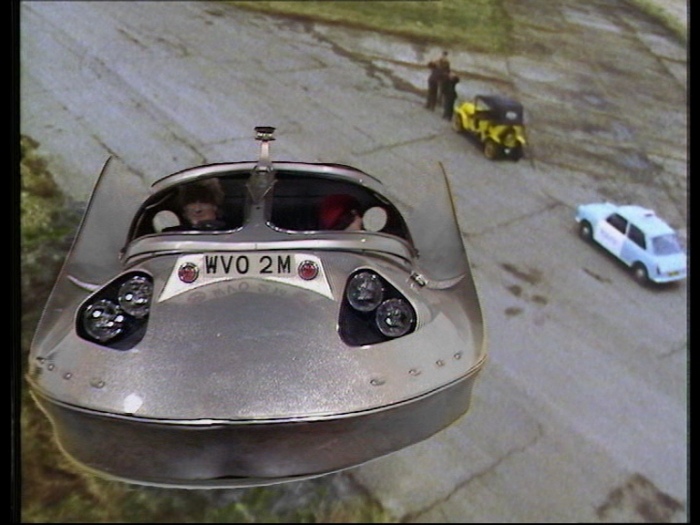
One of the many chase scenes from the Third Doctor's final serial, Planet of the Spiders

One of the many chase scenes from the Third Doctor’s final serial, Planet of the Spiders

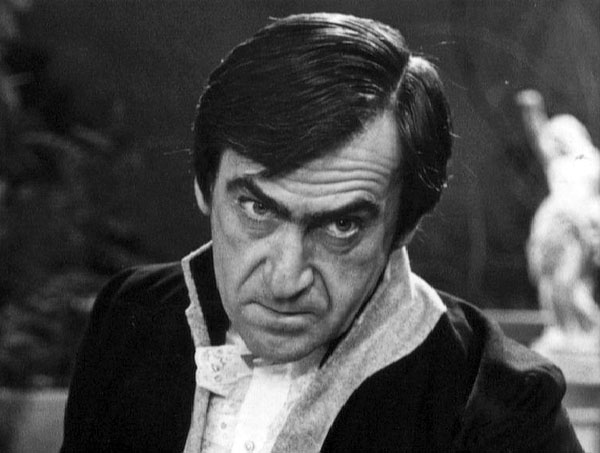
What differentiates The Enemy of the World most from the other Season Five serials is that the only monster is a human.  Patrick Troughton was afforded the opportunity to play two characters in the serial with the second being perhaps the most sinister of all Who villains, the dictator Salamander. A Mexican national, Salamander is perceived as a hero to a world confronted by the ravages of war and world famine.  He invented the Suncatcher Mk VII, a device which collects and stores concentrated sun-rays. In a film clip showed to the Doctor by Giles Kent, an Australian whom the audience initially believes to be a principled opponent of Salamander, the impression Victoria receives is that the Mexican is indeed a generous public benefactor. Speaking of the successes of the Sun Conservation establishment at Kanowa, in the Australasian zone, Salamander states that his Sun Catcher has allowed the sun’s rays to be shone upon those areas most needing them.  Wheat is growing on the Canadian plains and the Ukraine is the grain field of the planet.  Corn is ripening on the Dnieper River where 10,000 robot harvesters are gathering fifty million tons of flour.  The impression given is that Salamander is the world’s saviour from starvation.
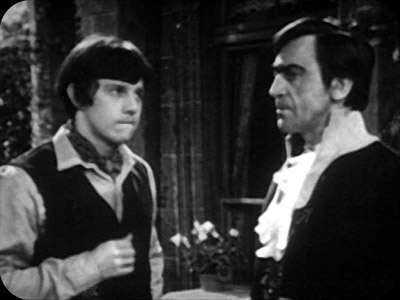
Salamander is not the virtuous philanthropist that he claims to be.  He is pictured here with Jamie

Salamander is not the virtuous philanthropist that he claims to be. He is pictured here with Jamie

The philanthropic ventures of Salamander are, however, a veil behind which he hides his plans for world-domination. Unbeknownst to all but Giles, Salamander has kept a group of English scientists captive underground for five years. The scientists are under the mistaken belief that a nuclear holocaust has devastated the planet and that it is not yet safe to venture outside.  Believing Salamander’s claims that the war is still ongoing, the scientists, by means unknown to the viewers, are creating a series of natural disasters with the intention of thwarting the “enemy”.  These supposedly natural disasters, such as a volcano in Hungary, are in effect part of Salamander’s plan to wrest control of all of earth’s regions.

I have to admit that my immediate thought on learning about Salamander’s enslavement of the scientist was the 1993 Australian movie, Bad Boy Bubby. In that film a man is kept captive in a putrid flat by his incestuous mother for 35 years. She claims that the air outside is poisonous and whenever she leaves to collect supplies she dons a gas mask. I wonder if Bad Boy Bubby’s  writer, Rolf de Heer, was watching Doctor Who in May 1968?
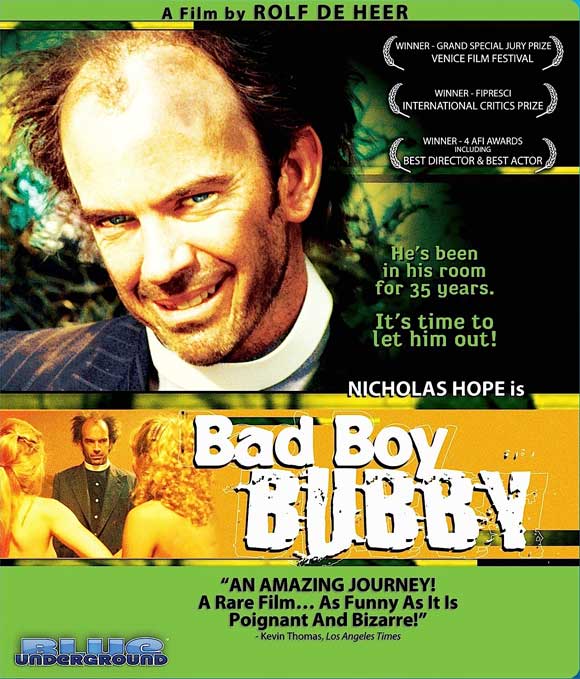
The 1993 Australian movie Bad Boy Bubby

The 1993 Australian movie Bad Boy Bubby

The exact environmental message that the writer, David Whitaker, is intending to make is a little difficult to discern.  Whilst concentrated solar power is perhaps seen as a favourable development, human intervention has devastating effects on the environment. Perhaps an analogy is being made between the deliberate human destruction wrought by the enslaved scientists, and the deterioration suffered by the environment from everyday human activity.

What’s less difficult to ascertain is the anti-corporate and anti-big government messages that Whitaker peddles in The Enemy of the World. In the 21st Century we are used to large scale corporations controlling large segments of the economy.  A cursory perusal of the Forbes listing of the World’s Biggest Companies exhibits that six of the top 10 provide banking and financial services, three have oil and gas holdings and one is a conglomerate.  Industry was much more local and small-scale in the 1960s, however the consequences of allowing the accumulation of much power into the hands of few was nonetheless appreciated by some.

Salamander with the short-lived Fedorin

Salamander with the short-lived Fedorin

Similarly, The Enemy of the World evidences a concern for the consequences of big government.  In the serial the world is divided into a small number of zones which presumably contain previously independent countries. Zones named in the serial include the Central European, African and Australasian.  Travel between zones is undertaken by rockets, with the journey between the Australasian and Central European zones taking only two hours. Transport costs are presumably reasonable and certainly within the means of government and corporation officials.  Even without the internet, the world of the near future is much smaller. The dismantling of small nation states has made the possibility of multiple zones being controlled by one person or organization frightfully real.  In the decades following the Second World War and Hitler’s conquest for European domination, such fears were well founded.
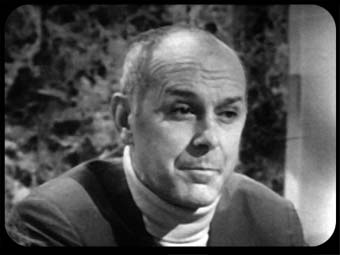
Australian actor Bill Kerr played Giles Kent

Australian actor Bill Kerr played Giles Kent

Imagine for a moment, if you will, that The Enemy of the World  was set in our current era. Substitute Bill Gates for Salamander and you may begin to understand the concerns raised.  Having established one of the world’s largest corporations, Microsoft, which is currently number 41 in the Forbes listing, Gates is revered by many for his generous philanthropic works.  Just imagine that there were some who believed that Gates had an ulterior motive, viz, to take control of the governments of the world. I’m not suggesting that Gates’ philanthropy is anything but wholly virtuous, however the scenario should be sufficient to contextualize Salamander’s motives within a 21st Century schema.

Mary Peach, a contender as Diana Rigg's replacement in The Avengers, played Astrid

Mary Peach, a contender as Diana Rigg’s replacement in The Avengers, played Astrid

That the serial is set in the near future is only a presumption because nowhere in the script is it specifically stated.  As Wood and Miles point out in About Time 2, this question could be easily resolved if episode five was recovered.  A close up telesnap of a newspaper shows a masthead, however the photo is not clear enough to enable the date to be read. Given that the recovery of The Enemy of the World  is mooted in the current missing episodes rumours, it’s somewhat possible that this question may be answered in the future.

Special Feature – Enemy of the World – Lost Serial

When Salamander was ultimately defeated at the serial’s end by the TARDIS, of all things, I was left somewhat concerned by the Doctor’s inaction. In the fifth Series episode, The Time of  Angels, the Doctor saves River Song who, like Salamander (and Katarina before him), was swept out into the vortex.  Clearly the Doctor is able to navigate the TARDIS with such precision as to be able to collect persons left floating around in space. Whilst acknowledging that David Whitaker was not Steven Moffat, and the whole concept of the TARDIS as a mid-space rescue vessel had not been dreamed up in 1967, it’s nonetheless disturbing that the Doctor’s stated aim of Salamander facing judicial justice was allowed to dissipate with the blast of air out of the TARDIS.

The Eleventh Doctor saves River Song in The Time of Angels.

May I conclude with a short discussion on casting.  The Enemy of the World has the distinction of being the first Doctor Who serial to feature a black female in a speaking part.  Carmen Munroe played the role of Fariah, Salamander’s official food taster, a position that reminded me of the First Doctor’s The Romans in which poisoning was perhaps the most common means of homicide.  Fariah is one of many well rounded characters which also includes Giles Kent, which was played brilliantly by Australian Bill Kerr, Donald Bruce (Colin Douglas) and Benik, Salamander’s assistant (Milton Johns).  Enemy was the first of three appearances by Johns in Doctor Who. Mary Peach, who played the Bond type girl, Astrid, was at the time of filming in the running to be Diana Rigg’s replacement in The Avengers. Finally, I would be remiss to forget Patrick Troughton in his role of the Doctor’s doppelgänger, Salamander.

Carmen Munroe as Salamander's official food taster, Fariah

Carmen Munroe as Salamander’s official food taster, Fariah

Episode 3 of The Enemy of the World is held in the BBC Archives and has been released on the triple DVD set, Lost in Time.  It was originally  broadcast in the UK between 23 December  1967 and 27 January 1968.

Episode 3 of The Enemy of the World is held in the BBC Archives and has been released on the triple DVD set, Lost in Time. It was originally broadcast in the UK between 23 December 1967 and 27 January 1968.

Vivien Fleming

©Vivien Fleming, 2013.


REFERENCE:

Tat Wood & Lawrence Miles, About Time. The Unauthorized Guide to Doctor Who 1966-1969 Seasons 4 to 6 Volume 2. Mad Norweigan Press: Illinois, 2010.

Missing Episodes Hysteria – Delayed Confirmation of Hartnell Interview Find Brings Hope

Standard

Image

An article posted today in the TV & Radio Blog of UK newspaper, The Guardian, has brought hope to some fans that the BBC may be withholding confirmation of missing episode finds.  In the post by Charles Norton it has been revealed that the rediscovered interview with William Hartnell was actually located by researcher Richard Bignell four years ago in 2009.  It had long been believed that no television interviews with William Hartnell existed. The interview, which had been held in the Bristol office of the BBC, was not digitized until the summer of 2011 and withheld from the public until a suitable DVD release. It will now be included as a special feature in The Tenth Planet DVD which is due to appear in November 2013.

Perhaps the most telling aspect of this find is Richard Bignall’s comment concerning keeping it a secret.  “It’s been quite a difficult thing not to say anything about it”, said Bignell. One is left wondering what else the BBC is not letting on that it has.  Four years of clock and dagger secrecy about a three minute television interview is bizarre, to say the least.

You can read Charles Norton’s blog post here. It also includes a quite fascinating insight into William Hartnell’s personality. My post about the BBC’s Hartnell interview discovery can be read here.

A fan produced mock DVD sleeve for The Tenth Planet.  Source http://blog.project76.tv/2006/06/5506/

A fan produced mock DVD sleeve for The Tenth Planet. Source http://blog.project76.tv/2006/06/5506/

Vivien Fleming

©Vivien Fleming, 2013.

The Ice Warriors – Region 4 DVD Release 28 August 2013

Standard

Image

It is at this time in my chronological marathon of Doctor Who that I should be posting my review of The Ice Warriors. For the first, and most probably last time in this marathon, I’m been unable to watch a serial in its correct order because it has yet to be released on DVD.   As luck would have it, the six part serial The Ice Warriors will be released in Australia and New Zealand on 28 August 2013.  The Region 2 release is set for 26 August and the Region 1 for 17 September.  Despite what I said in my Complete DVD Collection post, I’ve pre-ordered the DVD and anticipate receiving it by the end of next week. I’m not very good at practising what I preach 🙂  Please stay posted for my review.

Episodes two and three, which are missing from the BBC Archives, have been animated for this DVD release

Episodes two and three, which are missing from the BBC Archives, have been animated for this DVD release

Together with the four episodes held in the BBC Archives, The Ice Warriors will include animations of the two lost episodes two and three. Together with a number of audio commentaries, the special features include Cold Fusion – Making the Ice Warriors (a making of documentary); Beneath The Ice (a featurette on the making of the animated episodes); VHS Links from the original VHS release; Blue Peter (Design-A-Monster segment); Doctor Who Stories – Frazer Hines (Part 2);  and Animated reconstruction of the original The Ice Warriors  trailer.

Whilst we wait for the release of The Ice Warriors DVD please enjoy the Coming Soon to DVD Trailer and the BBC’s exclusive animation preview.

The Ice Warriors – Coming Soon to DVD Trailer

The Ice Warriors – BBC’s Exclusive Animation Preview


ADDENDUM: You read my review of The Ice Warriors now.

Vivien Fleming

The Abominable Snowmen – Rare Yeti Photographs

Gallery

The Abominable Snowmen – Loose Cannon Reconstructions

Standard

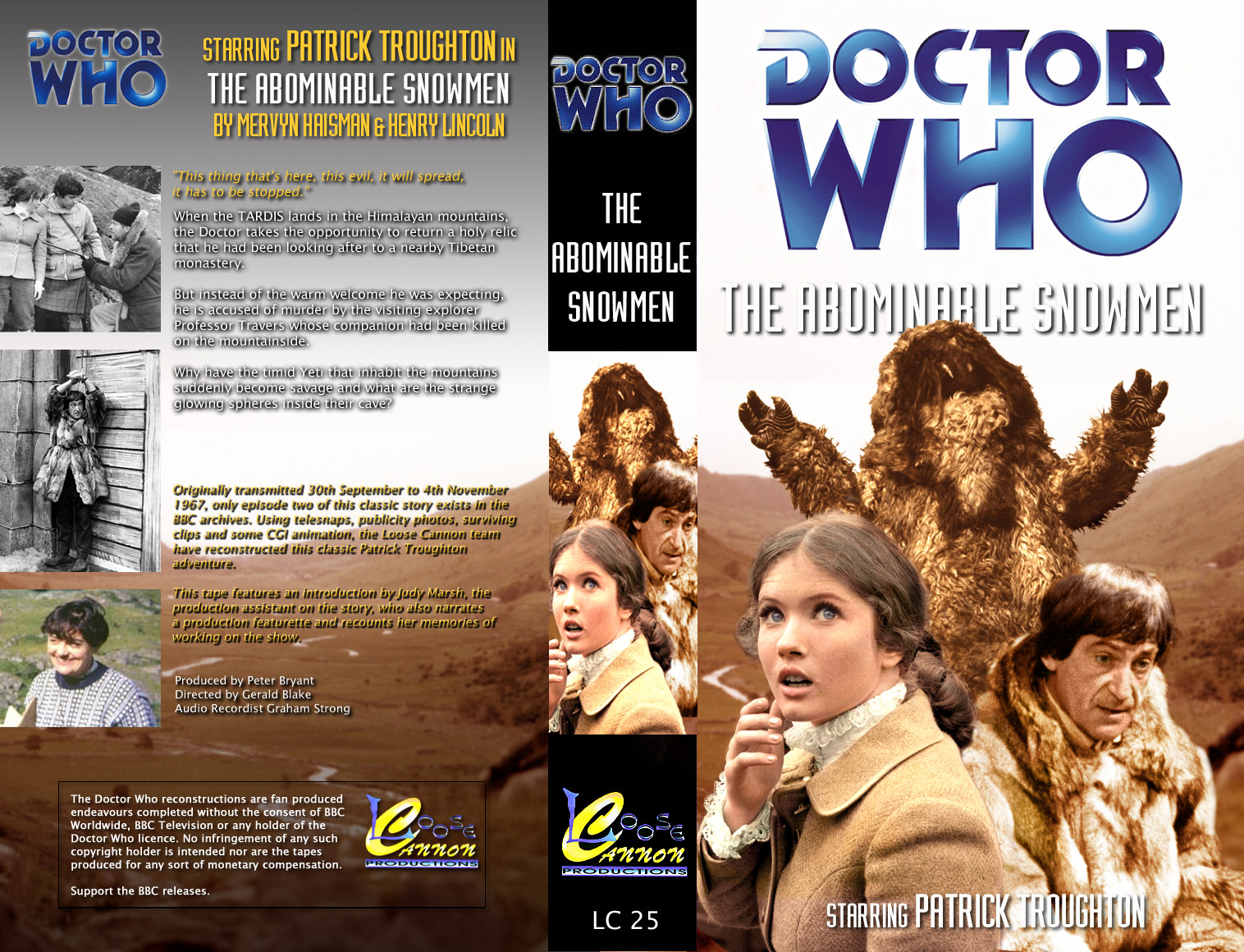
ImageOnly one of the six episodes of The Abominable Snowmen is held in the BBC Archives and has been released on the triple DVD set, Lost in Time. The remaining five episodes can be viewed as reconstructions by Loose Cannon Productions.

Loose Cannon’s The Abominable Snowmen, Episode 1 Part 1

Loose Cannon’s The Abominable Snowmen, Episode 1 Part 2

Loose Cannon’s The Abominable Snowmen, Episode 3 Part 1

Loose Cannon’s The Abominable Snowmen, Episode 3 Part 2

Loose Cannon’s The Abominable Snowmen, Episode 4 Part 1

Loose Cannon’s The Abominable Snowmen, Episode 4 Part 2

Loose Cannon’s The Abominable Snowmen, Episode 5 Part 1

Loose Cannon’s The Abominable Snowmen, Episode 5 Part 2

Loose Cannon’s The Abominable Snowmen, Episode 6 Part 1

Loose Cannon’s The Abominable Snowmen, Episode 6 Part 2

Episode 2 of The Abominable Snowmen is held in the BBC Archives and has been released on the triple DVD set, Lost in Time.  The Abominable Snowmen was originally broadcast in the UK between 30 September and 4 November 1967.

Episode 2 of The Abominable Snowmen is held in the BBC Archives and has been released on the triple DVD set, Lost in Time. The Abominable Snowmen was originally broadcast in the UK between 30 September and 4 November 1967.

The Abominable Snowmen

Standard

Image

The 1960s saw the dawning of Western interest in Eastern religions.  Perhaps premier among the spiritualities investigated was Buddhism. It was in 1967 that a Trappist monk of the Abbey of Gethsemane, Thomas Merton, published his collection of essays, Mystics and Zen Masters.  More than 40 years later, two of the top five Google search results on “Merton and Buddhism” return a conservative Catholic article entitled, “Can You Trust Thomas Merton?” Yes, there are still many orthodox Catholics who would prefer to imagine that the Second Vatican Council never occurred, and fear that enlightened spiritual writers such as the late Fr Merton are a threat to the very fabric of Christendom.

Thomas Merton with the Dalai Lama

Thomas Merton with the Dalai Lama

It should come as no surprise, therefore, that Doctor Who should enter into this stream of consciousness with its Tibetan tale of Buddhist Monks and Yeti, The Abominable Snowmen.  Five of the six episodes of this serial are among the 106 currently missing from the BBC Archives.  Thankfully the good people at Loose Cannon Productions have come to our rescue, yet again, with their masterful reconstructions.  Episode two is available on the triple DVD set, Lost in Time.  An excellent precise of the serial was provided by David J Howe and Stephen James Walker in their 2003 publication, The Television Companion. The Unofficial and Unauthorised Guide to Doctor Who.  Rather than reinventing the wheel I’ll let them summarise the plot for you:

Songsten, Khrisong and a fellow monk

Songsten, Khrisong and a fellow monk

“The TARDIS arrives in Tibet in 1935 and the Doctor visits the remote Detsen (sic) monastery in order to return a sacred bell, the ghanta, given to him for safe keeping on a previous visit.  There he meets and Englishman, Travers, on an expedition to track down the legendary Abominable Snowmen or Yeti.  It transpires that the Yeti roaming the area are actually disguised robots, which scare away or kill anyone who approaches.  The High Lama Padmasambhava, whom the Doctor met hundreds of years earlier on his previous visit, had been taken over by a nebulous alien  being, the Great Intelligence, which has artificially prolonged his life and is now using him to control the Yeti by way of models on a chessboard-like map.  The Intelligence’s aim is to create a material form for itself and take over the Earth.  The Doctor banishes it back to the astral plane, allowing Padmasambhava finally to die in peace”.

David J Howe & Stephen James Walker's The Television Companion was published in 2003 by Telos Publishing

David J Howe & Stephen James Walker’s The Television Companion was published in 2003 by Telos Publishing

The Abominable Snowmen’s writers, Mervyn Haisman and Henry Lincoln, sought to authenticate the serial by utilizing some real life names from the history of Tibetan Buddhism. The Master of the monastery was Padmasambhava, so named after the eighth century Buddhist Master who is said to have brought Vajrayana (tantric) Buddhism to Tibet. History names Padmasambhava as the author of Liberation Through Hearing During the Intermediate State (Bardo Thodol) which is known colloquially in the Western world as The Tibetan Book of the Dead. Given that the Bardo Thodol is in effect a treaty on how to ensure an absolute death and escape from the cycle of reincarnations, it is profoundly ironic that Padmasambhava of The Abominable Snowmen should be caught in a state of suspended life for hundreds of years. His death at the conclusion of the serial is more in accord with Buddhist philosophy as Padmasambhava at last finds peace in absolute death.

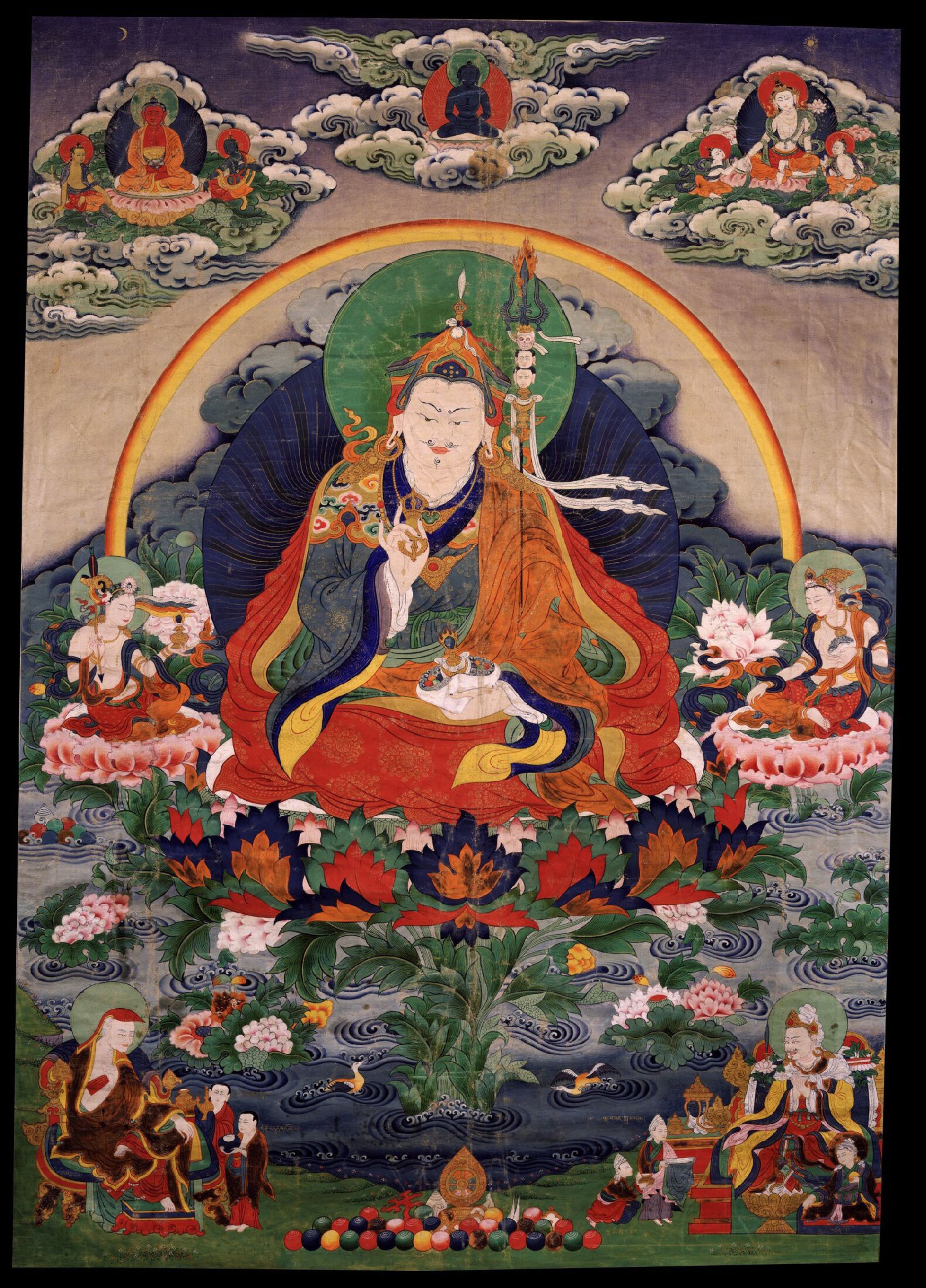
An image of Padmasambhava

An image of Padmasambhava

The name of monastery’s Abbot, Songsten, is taken from seventh Century Tibetan Empire founder, Songtsän Gampo, whilst the young monk Thonmi is so named after Thonmi Sambhota, the person traditionally credited for the invention of the Tibetan script. When the script was novelized by Terrance Dicks in 1974 as Doctor Who and the Abominable Snowmen, it was on the suggestion of Doctor Who’s then producer, Barry Letts, that these names should be changed.  As a Buddhist Letts considered the appropriation of the names inappropriate and accordingly they were slightly amended to Padmasambvha, Songtsen, and Thomni . At face value it appears that perhaps the Abbot’s name would best have remained as Songsten, as that is further from the real spelling of Songtsän than Songtsen.

An image of Songtsan Gampo

An image of Songtsan Gampo

An image of Thonmi Sambhota

An image of Thonmi Sambhota

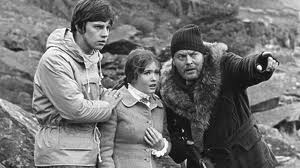
Whereas The Tomb of the Cybermen was resplendent with crazed archaeologists, The Abominable Snowmen instead has a “mad anthropologist”.  This at least is how the fictional press of the serial refer to the explorer Travers as. Incidentally Travers is played by Jack Watling, the father of companion Deborah Watling. Watling reprised his role of Travers three serials later in the sequel, The Web of Fear. Watling, the elder, did a fine job in the serial, as did Deborah who was quite mesmerizing in the scene where she speaks the same phrase automatically whilst under Padmasambhava’s trance.

Jamie, Victoria and the "mad anthropologist", Travers. Jack Watling, the father of Deborah Watling, played Travis

Jamie, Victoria and the “mad anthropologist”, Travers. Jack Watling, the father of Deborah Watling, played Travis

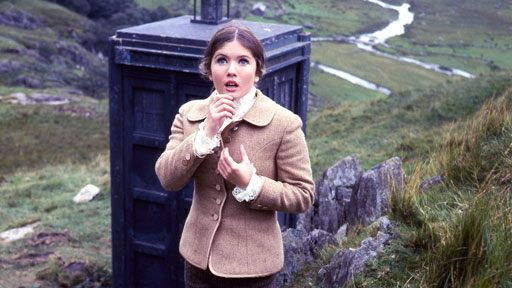
Victoria emerges from the TARDIS and is shocked by what she sees

Victoria emerges from the TARDIS and is shocked by what she sees

The necessity for compassion is perhaps the integral moral of this story.  Although the monk-warrior Khrisong is murdered by the Abbot, Songsten, he is forgiven of his crime by both the victim on his death bed, and by his fellow monks thereafter.  As the young monk Thonmi rightly concludes, Songsten had been put under a trance by the Master, Padmasambhava.  He was but a puppet, as was Padmasambhava whom the Doctor identified as also being controlled. The entity that was the source of this control was the Great Intelligence.  This theme of forgiveness is not restricted only to Buddhism, but also to Christianity. Khrisong’s final words are reflective of one of Jesus Christ’s seven final sayings, “Father, forgive them, for they do not know what they do” (Luke 23:34).  Judeo-Christian links in this story can also be gleaned from Padmasambhava’s use of the words “I am” on several occasions when describing himself.  Padmasambhava at one point states, “But our brother must not be allowed to depart in the knowledge that I am other than what I am”. “I am that I am” is the common English translation of God’s response to Moses when asked for his name (Exodus 3:14).

Khrisong is unforgiving to the Doctor as he is put out as Yeti bait.  In death, however, Khrisong forgives his murderer, Songsten

Khrisong is unforgiving to the Doctor as he is put out as Yeti bait. In death, however, Khrisong forgives his murderer, Songsten

The Doctor and the young monk, Thonmi

The Doctor and the young monk, Thonmi

The Great Intelligence returned, like Travers, in The Web of Fear, but the character would not be reprised for a third time for over 44 years, the longest period in abeyance of any monster, alien or foe in Who’s  history.  Manifesting itself as snow in the 2012 Christmas Special, The Snowmen, the Great Intelligence planned to invade the earth with Snowmen in lieu of Yeti.  The Great Intelligence eventually gained control of Walter Simeon’s body and would appear again as the Doctor’s main protagonist in the 2013 episodes The Bells of Saint John and The Name of the Doctor. A brief history of the Great Intelligence from The Abominable Snowmen  to The Name of the Doctor is set out in the video below.

The Great Intelligence Through the Ages 1967 -2013

The character’s long dormancy was most probably a consequence of the rift between its creators, Haisman and Lincoln, and the producers of Doctor Who following the pair’s ill-fated third Who script, The Dominators. Interestingly, no acknowledgement appears for Haisman and Lincoln as the creators of the Great Intelligence in the final credits of the Series 7 episodes in which the entity appears. Monsters created by other freelance writers, such as Terry Nation’s Daleks, are still credited to their originators to this day.

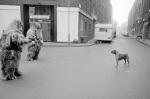
The Yeti taking a stroll

Haisman and Lincoln’s creations, The Yeti, taking a stroll

A final fascinating note on the Great Intelligence is that its appearance in The Snowmen predates chronologically its presence in The Abominable Snowmen and The Web of Fear.  With the Abominable Snowmen set in around 1935 and The Web of Fear in the UNIT era, which is probably sometime in the 1970s, the Victorian tale of The Snowmen well predates the Troughton era stories.  John Hussey in his article on the history of the Great Intelligence published in Doctor Who TV, posits that the Doctor’s battles with the Great Intelligence in The Snowmen  could have actually been the inspiration for the two earlier stories. As evidence Hussey directs the reader’s attention to the London Underground map which the Eleventh Doctor showed the Great Intelligence. In outlining to the Intelligence the weaknesses in the system the Doctor may in fact have been responsible for Intelligence’s subsequent (but shown on TV, earlier) attack utilizing the London Underground in The Web of Fear.

The Eleventh Doctor shows the Great Intelligence a map of the London Underground in The Snowmen

The Eleventh Doctor shows the Great Intelligence a map of the London Underground in The Snowmen

A snowman from 2012's The Snowmen

A snowman from 2012’s The Snowmen

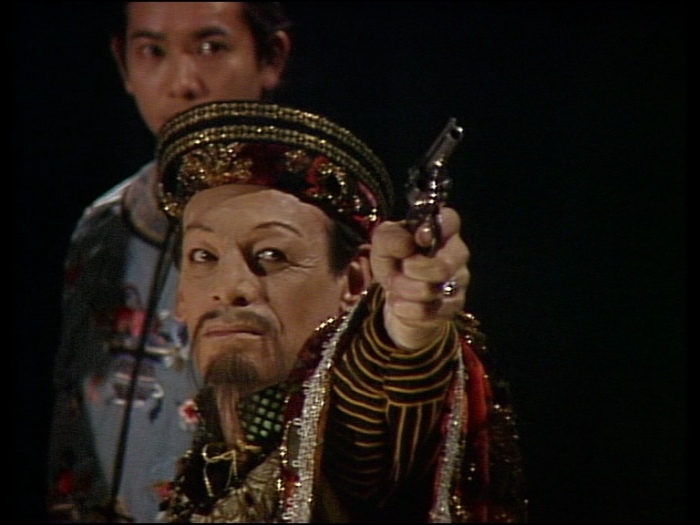
Being so critical of racism in the last serial, The Tomb of the Cybermen, I would be remiss not to point out that the Tibetan characters in The Abominable Snowmen are all played by Caucasian males. Unlike other Who serials such as the Third Doctor’s Planet of the Spiders and the Fourth Doctor’s The Talons of Weng-Chiang , the characters’ facial make up isn’t overtly reminiscent of Asian identity.  This early example of the Doctor Who production team erring in its moral duty to employ a more multi-cultural cast could perhaps, in this instance only, be overlooked if the viewer chooses to regard all the monks as Western converts to Buddhism.

The Abominable Snowmen's Padmasambhava

The Abominable Snowmen’s Padmasambhava

An unfortunate example of racism in the Third Doctor's Planet of the Spiders

An unfortunate example of racism in the Third Doctor’s Planet of the Spiders

White men were still being cast as Asian males in The Talons of Weng-Chiang, a Fourth Doctor Adventure

White men were still being cast as Asian males in The Talons of Weng-Chiang, a Fourth Doctor Adventure

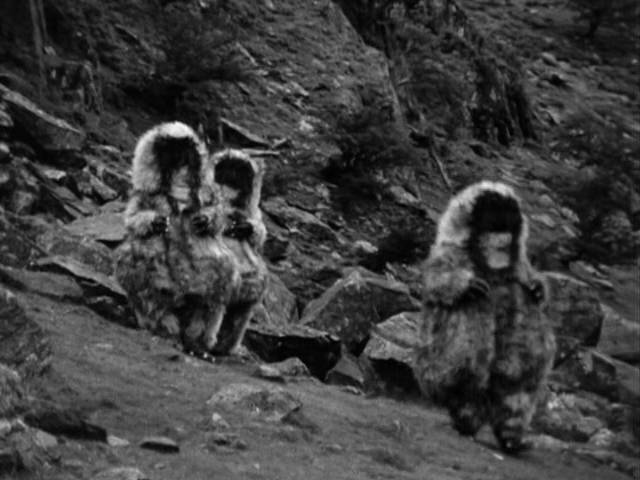
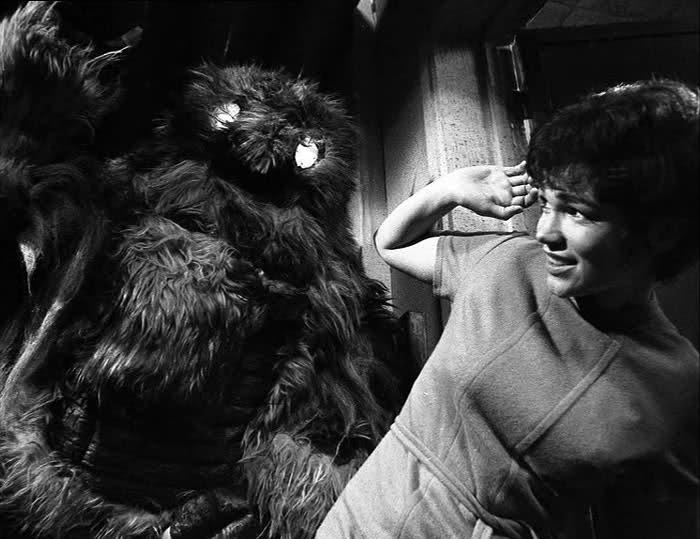
I couldn’t fail to conclude this review without saying a word or two on the most loveable of Doctor Who monsters, the Yeti.  By the writers’ making these mythical Himalayan creatures robots, the designers were given the most perfect excuse for their creation of a less than realistic monster. If the Yeti looked pair shaped and cuddly, rather than mammoth and scary, the designers could always claim that realism was not their intention.  Perhaps they could retrospectively claim that the Monoids of The Ark were really robots!  All told, The Abominable Snowmen is a cracking good yarn and comes highly recommended.  By me at least!

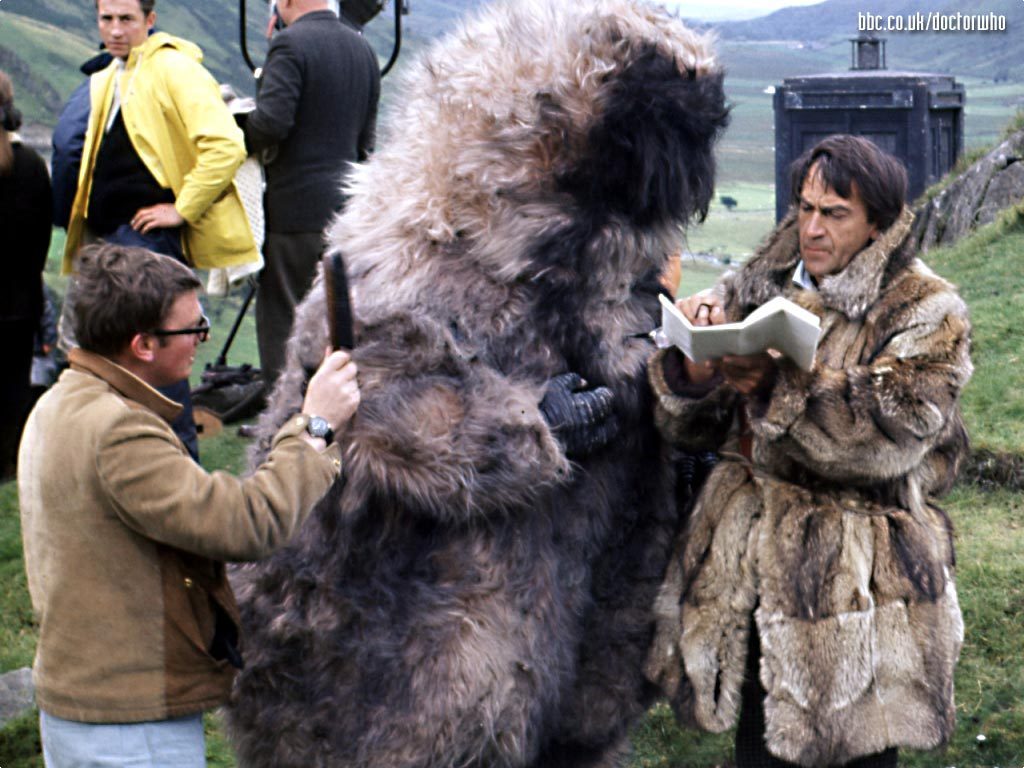
The Yeti were so cute as to attract children during the filming of The Abominable Snowmen in Wales

The Yeti were so cute as to attract children during the filming of The Abominable Snowmen in Wales

Perhaps The Ark's Monoids should have been robots.  It would help explain their appalling design!

Perhaps The Ark’s Monoids should have been robots. It would help explain their appalling design!

Episode 2 of The Abominable Snowmen is held in the BBC Archives and has been released on the triple DVD set, Lost in Time.  The Abominable Snowmen was originally broadcast in the UK between 30 September and 4 November 1967.

Episode 2 of The Abominable Snowmen is held in the BBC Archives and has been released on the triple DVD set, Lost in Time. The Abominable Snowmen was originally broadcast in the UK between 30 September and 4 November 1967.

Vivien Fleming

©Vivien Fleming, 2013.

REFERENCES:

David J Howe & Stephen James Walker, The Television Companion: The Unofficial and Unauthorised Guide to DOCTOR WHO. Telos Publishing Ltd, Surrey: 2003,

John Hussey, “Attack of the Snowmen: The Story of the Great Intelligence”, Doctor Who TV, 7 January 2013, http://www.doctorwhotv.co.uk/attack-of-the-snowmen-the-story-of-the-great-intelligence-44236.htm.  Retrieved on 20 August 2013.

The Tomb of the Cybermen

Standard

Image

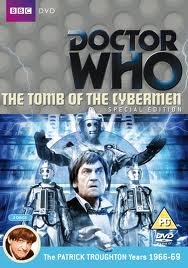
I first watched The Tomb of the Cybermen in the wake of Matt Smith’s much publicized disclosure that Tomb was his favourite Doctor Who serial. It’s often said that Smith is channelling Patrick Troughton.  I was somewhat bemused, therefore, when I walked away with a rather flat feeling at the serial’s end.  It was okay, I thought, but nothing spectacular.  My second view, for this marathon,  was somewhat more enjoyable, perhaps only because of the elation felt in watching the earliest and first complete Second Doctor serial in the BBC Archives. Nine incomplete serials in a row is a somewhat daunting undertaking so my relief is perhaps entirely understandable.

The men are amazed to see the Cybermen emerge from their frozen tombs

The men are amazed to see the Cybermen emerge from their frozen tombs

The second viewing, however, did nothing to soften my discontent with the unnecessary and detrimentally racist stereotypes.  For the second serial in a row there is a huge and mute black strongman.  In The Evil of the Daleks the character of Kemel was meant to be a Turkish Wrester.  The actor who played him, Sonny Caldinez, however was black.  In Tomb of the Cybermen we have an equally large black strongman, this time named Toberman, and the “manservant” to the equally mysterious, and racially ambiguous, Kaftan.  Early drafts of the script had Toberman (played by Roy Stewart) wearing a hearing aid, however this was written out of the final script.

Roy Stewart played the mute strongman and "man servant" of Kaftan, Toberman

Roy Stewart played the mute strongman and “man servant” of Kaftan, Toberman

Shirley Cooklin was the wife of Story Editor, Peter Bryant, and the role of Kaftan was written specifically for her.  In the Special Feature, The Lost Giants, which is included the Special Edition of The Tomb of the Cybermen DVD, Cooklin describes the difficulties she faced as an actress.  As someone who was not blond haired and blue eyed, she was constantly cast as characters such as French maids.  What Cooklin failed to mention in the video, however, was that she was made up to have much darker skin than she ordinarily had.  An unspecified accent was used throughout the serial and her very dark complexion was less than subtle in hinting that Kaftan was a mysterious  and potentially dangerous outsider.  So successful were the make-up artists in disguising Cooklin that Frazer Hines, a known ladies man, tried unsuccessfully to pick her up!

The "blacked up" Shirley Cooklin as Kaftan

The “blacked up” Shirley Cooklin as Kaftan

The third member of our trio of crooks was the increasingly manic Klieg, played by George Pastell. Pastell was a Greek Cypriot actor famous for playing swarthy villains.  The instigator of a totally crazy plan for world domination in which the Cybermen were to be conscripted as willing assistants, Klieg considered himself the most intelligent and logical person in the world. Clearly he was neither and his arrogance was his downfall.

George Pastell played the swarthy villain, Klieg

George Pastell played the swarthy villain, Klieg

In between my first and second viewings of The Tomb of the Cyberman I had the misfortune of watching the Series Seven episode, Journey to the Centre of the TARDIS. My choice of the word “misfortune” is quite deliberate because throughout that 2013 episode I experienced the same niggling concerns about racism as I had watching Tomb.  The Doctor and Clara find themselves, and the TARDIS, on board an intergalactic salvage ship. The ship is crewed by the brothers Gregor and Bram Van Baalen , together with a humanoid looking android, Tricky. If this was 1967 it would not have surprised me that the characters being “baddies” would also be “black”. This is 2013 however, and I just shook my head in disbelief as the first black characters in Doctor Who for a long time were also villains. Unfortunately most criticism directed to this episode related to allegedly poor acting on the part of Ashley Walters, Mark Oliver and Jahvel Hall. What is more important is that the actors were given little to work with and subjected to negatively stereotypical characterizations.

Incredibly, the only photos I could find online of the Van Baalen brothers, and Tricky were either from behind or as monsters. Racism was again evident in 2013's Journey to the Centre of the TARDIS

Incredibly, the only photos I could find online of the Van Baalen brothers, and Tricky, were either from behind or as monsters. Racism was again evident in 2013’s Journey to the Centre of the TARDIS

I am not alone in my concerns about racism and Doctor Who.  Philip Sandifer in his blog, and now books, Tardis Eruditorum, is unashamedly critical and has published an excellent essay in the second volume of Tardis Eruditorum, entitled “What do we Make of All These Black Mute Strongmen?”.  He describes the decision by writers Kit Pedler and Gerry Davis to characterize Toberman as a black mute strongman not as a conscious act of malice, but rather an example of  “unconscious failures to even notice that there’s a problem.  More often than not, discrimination is just a particular flavour of stupidity”. In other words, these racist stereotypes are so ingrained that the writers didn’t even realize that they were being inherently racist.  Such racism, I would posit, was inherent in the Stephen Thompson penned 2013 story, Journey.

Philip Sandifer is critical of racism in Doctor Who

Philip Sandifer is critical of racism in Doctor Who

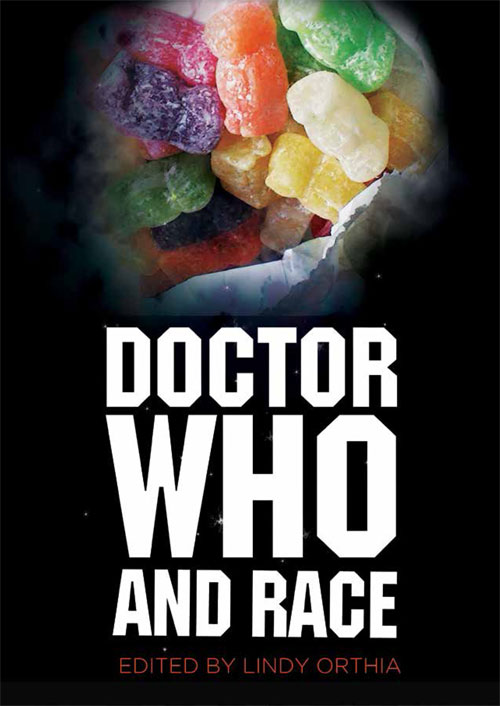
Published in July 2013, the Lindy Orthia edited book, Doctor Who and Race, is a collection of 23 essays on the issue. In May this year there was widespread controversy when Orthia was reported as describing Doctor Who as “thunderingly racist”. The BBC issued a statement which stated as follows:-

Doctor Who has a strong track record of diverse casting among both regular and guest cast.  Freema  Agyeman became the first black companion and Noel Clarke starred in a major role for five years [Mickey Smith].  Reflecting the diversity of the UK is a duty of the BBC, and casting on Doctor Who, is colour-blind. It is always about the best actors for the roles”.

Doctor Who and Race, edited by Lindy Orthia, was released in July 2013

Doctor Who and Race, edited by Lindy Orthia, was released in July 2013

I’m still waiting for Doctor Who and Race to be released on Kindle.  Once it is I will undoubtedly post a review of it on this blog.

The Tomb of the Cybermen does, however, have its positives.  The emergence of the Cybermen from their frozen tombs in episode two is brilliantly done and undeniably iconic. You can even excuse them for using cling wrap as it was as “new” and “exciting” as bubble wrap was to the 1970s Doctor Who designers.

The Cybermen emerge from their icy tombs

The Cybermen emerge from their icy tombs

The Doctor’s discussion with the new companion, Victoria, in episode three is as close to tear-jerking as you’ll get. In discussing the death of Victoria’s father (in The Evil of the Daleks), the Doctor gently tells her of his own family recollections – “I have to really want to, to bring them back in front of my eyes.  The rest of the time they  … sleep in my mind and I forget. As so will you”. The Doctor also discloses for the first time his age and we learn that in earth terms he is roughly 450 years old.

The Doctor and Victoria’s episode three discussion.

Finally, the scene in which the Doctor and Jamie accidently hold hands as they enter the tomb is just fabulous.  Both intending to hold Victoria’s hand, they quickly disengage when the manliness of the other hand becomes apparent.  In the Special Features Frazer Hines describes how he and Patrick Troughton didn’t officially rehearse the scene.  Fearing that their unscripted gag would be cut out, they left its unveiling to the actual filming knowing that cuts were expensive and rarely made.

Frazer Hines and Deborah Watling discussing the making of The Tomb of the Cybermen. 

The Tomb of the Cyberman is unfortunately the only complete serial featuring Deborah Watling as Victoria. It’s back to reconstructions and only one complete episode, when I continue my marathon with The Abominable Snowmen.

The Tomb of the Cybermen was originally broadcast in the UK between 2 September and 23 September 1967

The Tomb of the Cybermen was originally broadcast in the UK between 2 September and 23 September 1967

Vivien Fleming

©Vivien Fleming, 2013.

REFERENCE:

Phil Sandifer, Tardis Eruditorum Volume 2: Patrick Troughton. Self published, 2012.

Missing Episodes Hysteria Update

Standard

Image

Rumours of the recovery of missing episodes of Doctor Who still continue but to date there has been no evidence produced of any finds.

The Yeti's second adventure in The Web of Fear is rumoured to have been found

The Yeti’s second adventure in The Web of Fear is rumoured to have been found

An also rumoured recovery is a television interview with the First Doctor, William Hartnell.  To date no interviews with Hartnell, out of character, are known to exist. The opportunity to hear Hartnell speak in his normal accent is widely sought after.

The Enemy of the World is one of the rumoured Missing Episodes finds.  In this serial Patrick Troughton plays the dictator Salamander who is the spitting image of him

The Enemy of the World is one of the rumoured Missing Episodes finds. In this serial Patrick Troughton plays the dictator Salamander who is the spitting image of the Doctor

Outpost Skaro has reported on its Twitter feed that a “mate of mine is saying that people are beginning to see Enemy of the World … hope it’s true!” The most commonly bandied around number for returned episodes is 17, although claims that as many of 94 of the missing 106 have been returned, have been made. The oft quoted 17 returned would probably entail all seven episodes of Marco Polo, and five each of The Enemy of the World  and The Web of Fear.  Episode three of Enemy and episode one of Web are held in the BBC Archives and have been released on the triple DVD set, Lost in Time.

Episode 3 of The Enemy of the World and Episode 1 of The Web of Fear are held in the BBC Archives and have been released on the tripe DVD set, Lost in Time

Episode 3 of The Enemy of the World and Episode 1 of The Web of Fear are held in the BBC Archives and have been released on the triple DVD set, Lost in Time

Given the decimated nature of the archival material of Patrick Troughton’s tenure as Doctor, it would be an incredible coup to have returned two complete and consecutive Season Five serials.  Season Five hitherto has one complete serial, The Tomb of the Cybermen, and four out of the six episodes of The Ice Warriors.  The two missing episodes of The Ice Warriors  have been animated and the complete serial is being released on DVD later this month.

The Ice Warriors is to be released in late August 2013.  Included with the four recovered episodes are two animated ones

The Ice Warriors is to be released in late August 2013. Included on the DVD release will be the four episodes held in the BBC Archives, together with two animated missing episodes

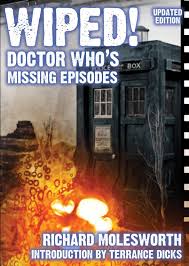
Anyone interested in an in depth analysis of 1960s Doctor Who and the missing episodes is advised to track down the updated edition of Richard Molesworth’s seminal work Wiped! Doctor Who’s Missing Episodes. The revised edition was released by Telos Publishing Ltd earlier this year .  Wiped!  is presently available for purchase online through The Book Depository UK.

The updated edition of Richard Molesworth's book Wiped! was released by Telos Publications Ltd earlier this year

The updated edition of Richard Molesworth’s book Wiped! was released by Telos Publications Ltd earlier this year

You can find my first article on the Missing Episodes Hysteria here.

Vivien Fleming

©Vivien Fleming, 2013.

Four Seasons Down, 29 to Go!

Standard

Image

I’ve just completed watching the most decimated of all Seasons of Doctor Who.  Not a single complete serial exists although the First Doctor’s final story, The Tenth Planet, has fared slightly better. Three out of four episodes are held in the BBC Archives. The lost fourth episode has been animated and the serial will be released in November 2013, just in time for Doctor Who’s 50th Anniversary. This will be the first and only release of any Season Four serial on DVD. Orphan episodes, however, have been released on the triple DVD set, Lost in Time. 

Season Five will be more promising and has one complete serial, the Season premier, The Tomb of the Cybermen, and a further serial, The Ice Warriors, to be released with two animated episodes later this month. Otherwise it will be back to Lost in Time and Loose Cannon’s magnificent reconstructions.

Please join me as I continue my journey through the history of Doctor Who. 

Frazer Hines, Patrick Troughton and Deborah Watling continue their journey

Frazer Hines, Patrick Troughton and Deborah Watling continue their journey

Vivien Fleming

The Evil of the Daleks – Loose Cannon Reconstructions

Standard

ImageOnly one episode of the seven part serial, The Evil of the Daleks, is held in the BBC Archives.  Episode 2 has been released on the triple DVD set, Lost in TimeFor the purposes of this marathon I watched Loose Cannon’s reconstructions of Episodes one, three, four, five, six and seven.

Loose Cannon’s The Evil of the Daleks, Episode 1 Part 1

Loose Cannon’s The Evil of the Daleks, Episode 1 Part 2

Loose Cannon’s The Evil of the Daleks, Episode 3 Part 1

Loose Cannon’s The Evil of the Daleks, Episode 3 Part 2

Loose Cannon’s The Evil of the Daleks, Episode 4 Part 1

Loose Cannon’s The Evil of the Daleks, Episode 4 Part 2

Loose Cannon’s The Evil of the Daleks, Episode 5 Part 1

Loose Cannon’s The Evil of the Daleks, Episode 5 Part 2

Loose Cannon’s The Evil of the Daleks, Episode 6 Part 1

Loose Cannon’s The Evil of the Daleks, Episode 6 Part 2

Loose Cannon’s The Evil of the Daleks, Episode 7 Part 1

Loose Cannon’s The Evil of the Daleks, Episode 7 Part 2

The Evil of the Daleks was originally broadcast in the UK between 20 May and 1 July 1967.  Episode 2 is available on the triple DVD set Lost in Time

The Evil of the Daleks was originally broadcast in the UK between 20 May and 1 July 1967. Episode 2 is available on the triple DVD set Lost in Time