On 26 July The Doctor Who Mind Robber reported an article in the UK’s Sunnewspaper in which an international simulcast of the 50th Anniversary Special was mooted. Yesterday, more than two months after the Sun’sreport, the BBC officially announced that at least 75 countries have agreed to broadcast The Day of the Doctoron 23 November.
Tim Davie, the chief executive of BBC Worldwide said, “the simultaneous broadcast and cinema screening of the special across so many countries will make for a fitting birthday tribute to our time lord”. The special is due to screen in 200 cinemas across the United Kingdom. Steven Moffat was then quoted as saying, “The Doctor has always been a time traveller. Now he’s travelling through time zones”.
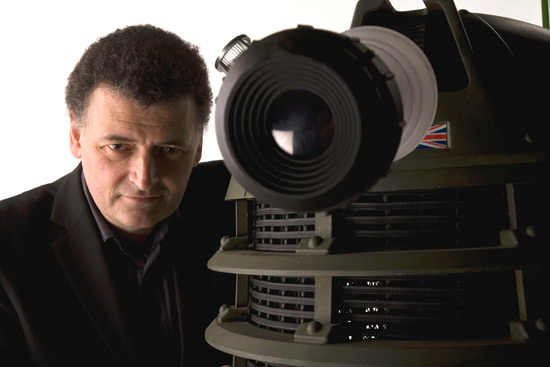
Steven Moffat, Executive Producer of Doctor Who
Together with the Eleventh Doctor and his current companion, the 75 minute special will also feature the Tenth Doctor, David Tennant, and the first companion of new series Doctor Who,Billie Piper. A hitherto unknown incarnation of the Doctor, played by John Hurt, will also appear. It has been widely rumoured that Hurt’s Doctor will be number 8.5, being an incarnation between Paul McGann’s Eighth Doctor and Christopher Eccleston’s Ninth Doctor. There has been no further information forthcoming on a comment by the Fifth Doctor, Peter Davison, several weeks ago. Davison was reported as having said that ”I’m making an appearance somewhere over that period of time but I can’t reveal in what. I can’t reveal anything specific about it. I’m not allowed to. It is a big year for the show and we’re all doing our bit for it. Trust me.”
The ABC yesterday confirmed that The Day of the Doctorwill be simulcast live throughout Australia.
To celebrate Doctor Who’s upcoming 50th Anniversary The Doctor Who Mind Robberwill be counting down the last 50 days to this momentous event. Starting on Friday 4th October (Australian time) we’ll be posting a 1960s Whopost everyday. Utilizing a “best of” format, the posts will examine a myriad of First and Second Doctor topics including Cliff Hangers, Monsters, Billy Fluffs, Firsts. Lasts, Companions, Supporting Actors and Dodgy Special Effects. Any suggestions for “Best” or “Worst” lists would be gratefully appreciated.
William Hartnell as the Doctor in The Celestial Toymaker
Patrick Troughton as the Doctor in The Power of the Daleks
My first post will be rather unimaginatively titled The Ten Most Wanted Missing Episodes. Please join me from the 4th of October for this exciting daily look at retro Doctor Who.
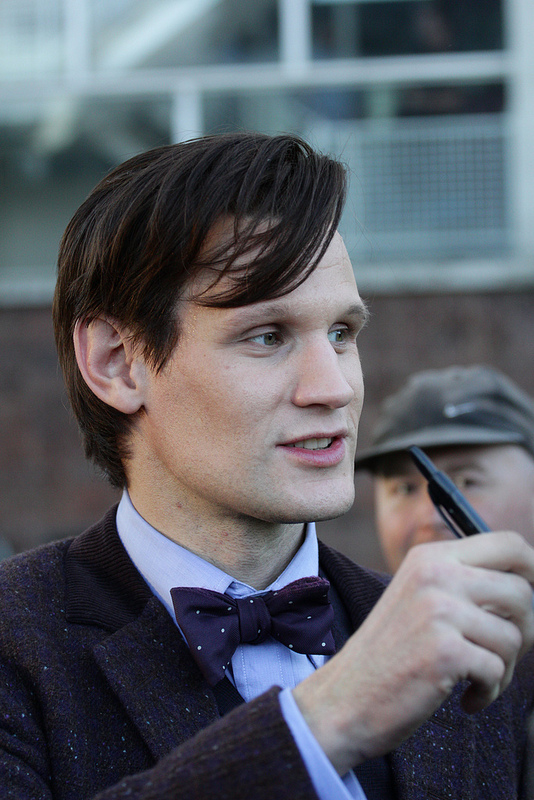
Filming has commenced for the 2013 Doctor Who Christmas Special and on 10 September the crew was spotted in Cardiff. Matt Smith, who is currently bearing a skin-head type hairdo following his filming of How to Catch a Monsterin Detroit earlier this year, donned a floppy hair wig for the occasion. The Christmas Special will be Smith’s last appearance in DoctorWhoand will see him regenerate into the Twelfth Doctor, Peter Capaldi.
Matt Smith in How to Catch a Monster
You can find two pages of photographs on flickr here. No copyright breach is intended.
The Wheel in Spacemarks the end of Doctor Who’s Fifth Season and the almost constant run of missing episodes which have plagued marathon viewers since the beginning of Season Three. Season Six is complete, save for the penultimate serial The Space Pirates, and two episodes of the eight part serial The Invasion. Thanks to the brilliant work of Cosgrove Hall. the two missing episodes of The Invasion have been animated and the complete serial is available for viewing on DVD.
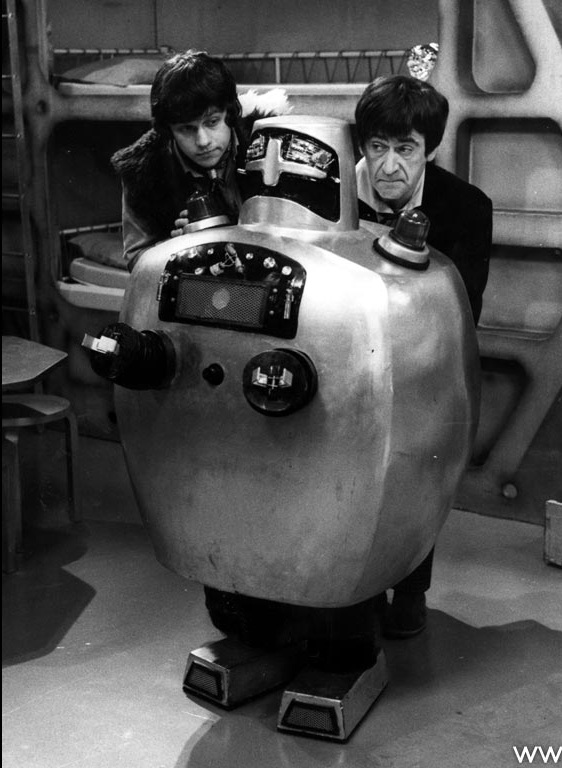
Jamie and the Doctor with the Servo-Robot which subsequently rendered the Doctor unconscious
The Cybermen made their fourth appearance in 18 months in The Wheel in Space. With the temporary retirement of the Daleks in the last serial of Season Four, the Cybermen had assumed the mantle of the Doctor’s number one enemy. Whereas the Daleks were previously guaranteed to appear in two serials per season, Terry Nation’s attempts to sell his creations to the US saw the Cybermen snatch their title as favourite recurring monsters. Their appearance in The Wheel in Space, however, was a great deal more subtle than in previous adventures. Not seen until the cliff hanger of episode two, their screen time was nearly as limited as their speech. The somewhat verbose sing-song voices of The Tenth Planet Cybermen were replaced by almost mute monsters with more human voices. Now possessing three silver fingers, the Cybermen’s principal terror derived from them silently emerging unexpectedly from anywhere on the Wheel.
The companion-in-waiting, Zoe, with two Cybermen
The hints of humanity that the first generation Cybermen possessed were long gone, with the cyber creatures now described by the Doctor thus: “Their entire bodies are mechanical and their brains have been treated neuro-surgically to remove all human emotions, all sense of pain. They’re ruthless, inhuman killers!”. These Cybermen, the Doctor said, need to colonize and have the treasures of earth.
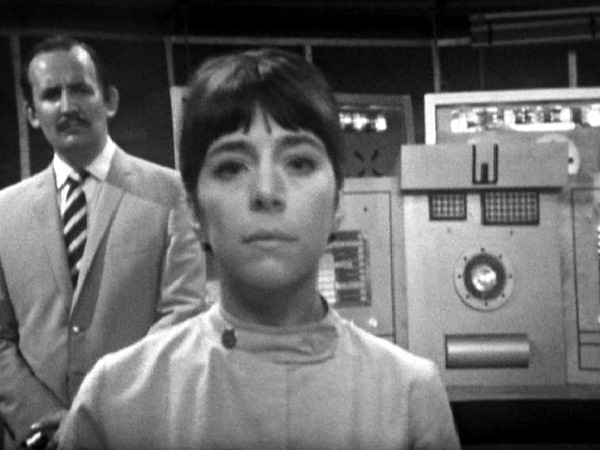
The emotionless Cybermen provide a brilliant juxtaposition to the Doctor’s newest companion, Zoe Heriot. 15 year old Zoe is an astrophysicist and astrometricist first class and employed as the Wheel’s parapsychology librarian. Her perfect recall of scientific facts and ability to undertake mental calculations faster than a hand-held calculator are the consequence of her being brainwashed by the City’s educational institution. The processes by which she was educated are not revealed, although one can only guess that they were somewhat similar to those encountered by the First Doctor’s companion, Vicky. Coming from 2493, Vicky outlined to a stunned Barbara in The Rescue how her schooling comprised of being hooked up to a machine for only an hour a week. Zoe, however, comes from a much earlier time, perhaps the early 21st Century, so it’s possible that the education system was not the same. Wood and Miles in About Time argue that the character of Zoe would never work in a current day series “largely because most of her functions could be served by an idiot with a laptop”. With the digital age not even dreamed of in 1968, Zoe was one of the brainwashed bureaucrats that many feared would envelop us in the future.
Tat Wood & Lawrence Miles, About Time 2
An unfortunate consequence of Zoe’s education is she is entirely logic driven and completely unable to cope in unexpected circumstances. She is described as being without emotion twice in one day by her co-workers on the Wheel. Rob Shearman in Running Through Corridors described her as “a robot wanting to be a human being”. Shearman’s analysis of Zoe on page 266 is so well written as to warrant me quoting it in full.
The Doctor’s latest companion, Zoe Heriot
Someone else enslaved to logic is Zoe Heriot. She’s a much darker character than I’d ever realised. Whitaker’s script rather brilliantly only hints that she comes from a pitiless totalitarian regime, where young children are taken and brainwashed so that they can come out the other end supergeniuses – capable of holding a huge amount of information, but not the wherewithal to respond to it emotionally. She’s just another Cyberman.
Rob Shearman brilliantly analyses Zoe in Running Through Corridors
Zoe’s brainwashing was quickly detected by the Doctor who responded to her with perhaps one of his most memorable comments, “Logic, my dear Zoe, merely enables one to be wrong with authority”. During the course of the serial the limitations she faces because of her reliance on logic become painfully clear. Jamie and Zoe’s conversation in the Wheel Operations room during episode five evidences her growing disillusionment, and foreshadows her ultimate decision to stow away in the Tardis.
JAMIE: Oh, there is something you don’t know, then.
ZOE: There’s too much I don’t know. I was trained to believe logic and calculation would provide me with all the answers. Well, I’m just beginning to realise there are questions which I can’t answer.
JAMIE: You’re just not trained for an emergency like this.
ZOE: Well, that’s the whole point. What good am I? I’ve been created for some false kind of existence where only known kinds of emergencies are catered for. Well, what good is that to me now?
JAMIE: Hey, we’re not done yet, you know.
ZOE: And if we survive? What then, Jamie? Suppose we do get ourselves out of this mess. What have I got left? A blind reliance on facts and logic?
The Crew in the Control Room of the Wheel
When Zoe is found in the TARDIS’s magic chest at the story’s end Jamie’s immediate reaction is to say that it’s impossible for her to go with them. This of itself is quite extraordinary given that he voiced no such concerns when Victoria hitched a ride after her father’s death in The Evil of the Daleks. Perhaps Jamie was secretly hoping that the Doctor would pop back and pick up Victoria from Brittanicus Base? The less polite might argue that Jamie wanted the Doctor all to himself! The Doctor responded to Zoe’s request to stay by saying that it wasn’t impossible but “something that we have to decide”. It appears that the TARDIS is a democracy and that the Doctor is not the sole decision maker. This is in stark contrast to the First Doctor’s tenure where the Ship was clearly his own, to do with as he pleased. Kidnapping is something that the Second Doctor would never acquiesce to.
Jamie is initially reticent to accept Zoe as a member of the TARDIS Crew
To help Zoe decide if she wanted to accept the challenges of life in the TARDIS, the Doctor projected his thought patterns onto a monitor and the reprise from episode two of The Evil of the Daleks was seen. In the break between Seasons Six and Seven the BBC aired the first ever Doctor Who repeat, The Evil of the Daleks, and this was scripted into both episode six of The Wheel in Space and episode one of Season Six, The Dominators. This was the first and only time that a repeat was scripted into a serial. The viewers had to wait for Zoe’s decision on whether to stay with the Doctor and Jamie.
The Evil of the Daleks was the first Doctor Who serial ever repeated and the first and only repeat to be scripted into a serial
Another first for The Wheel in Space was the use of the Doctor’s pseudonym, John Smith. When Gemma Corwyn, the Second-in-Command of the Wheel and a particularly strong and well developed female character, asked Jamie what the Doctor’s name was he was stumped. “The Doctor” was the only name by which Jamie knew this mysterious man with whom he’d lived and travelled for the past two years. Glancing over at some medical equipment manufactured by John Smith & Associates Jamie replied, “Er. John Smith”. Later, when the Doctor recovered from his Servo-Robot induced unconsciousness and Corwyn introduced him to Zoe, Jamie had to nudge the Doctor into recognizing that his name was John.
The piece of medical equipment which inspired (the now literate) Jamie to give the Doctor the alias “John Smith”
The Doctor would go onto use the alias John Smith dozens of time thereafter. It could be argued that Jamie’s naming of the Doctor was a mere coincidence and that he was already known by that alias. In the Series Five episode, The Vampires of Venice, the Doctor produced a library card with the First Doctor’s image on it and the address 76 Totter’s Lane. This may well be another example of retroactive continuity as previously discussed in my review of The Abominable Snowmen. Interestingly enough, on one occasion when the Doctor didn’t use the alias of John Smith (Tooth and Claw) he adopted the name James McCrimmon instead. What a lovely nod to Jamie that was.
The Eleventh Doctor shows his library card bearing the name and photo of Dr John Smith in The Vampires of Venice (2010)
The Tenth Doctor identifies himself as James McCrimmon in Tooth and Claw(2006)
It is important to be mindful, however, of the voluminous amounts of criticism that have been directed at The Wheel in Space. Frequently dismissed for being the last of an almost continuous stream of “Base under Siege” stories in Season Five, The Wheel is somewhat slow and features a great deal less of the Doctor then generally seen. Patrick Troughton was on holidays during episode two when the Doctor is conveniently unconscious for the whole episode. When he does appear not a great deal happens. This general disaffection with the story is perhaps best summed up by Cornell, Day and Topping in The Discontinuity Guide (1994) when they describe the serial like this:
Dull, lifeless and so derivative of other base-under-siege stories that it isn’t really a story in its own right. Despite the detailed Wheel setting, the galloping lack of scientific credibility is annoying, and the Cybermen are so bland and ordinary that they could have been any other monster. Generic speed-written tosh.
Paul Cornell, Martin Day & Keith Topping, The Discontinuity Guide
Notwithstanding this criticism, The Wheel in Space was placed at 156 in the 2009 Doctor Who Magazine Mighty 200. That was well above several other Troughton serials including The Krotons (166), The Dominators (191), The Underwater Menace (194) and The Space Pirates (195). As two episodes are held in the BBC Archives, and have been released on the Lost in Time DVD, it is well worth disregarding the consensus and giving The Wheel in Space a view. It’s worth it just to see the lovely Wendy Padbury introduced as Zoe.
The Wheel in Space was originally broadcast in the UK between 27 April and 1 June 1968. Episodes 3 and 6 of The Wheel in Space are held in the BBC Archives and have been released on the triple DVD set, Lost in Time.
Paul Cornell, Martin Day & Keith Topping, The Discontinuity Guide,Virgin Publishing Ltd: London,1995.
Robert Shearman & Toby Hadoke, Running Through Corridors. Rob & Toby’s Marathon Watch of Doctor Who. Volume 1: The 60s,Mad Norweigan Press: Illinois, 2010.
Tat Wood & Lawrence Miles, About Time. The Unauthorized Guide to Doctor Who 1966-1969 Seasons 4 to 6 Volume 2.Mad Norweigan Press: Illinois, 2010.
The BBC has announced a stellar line-up for Doctor Who Live: The Next Doctorwhich will be simulcast on ABC1 at 4:30 a.m. tomorrow (Monday) morning. Here are the details as posted on the BBC website:
Anyone shouting, ‘Is there a Doctor in the house?’ during tonight’s Doctor Who Live: The Next Doctor won’t be disappointed…
The marvellous Bernard Cribbins (Wilfred Mott) will be there in person and there’ll be contributions from former companions including Anneke Wills (Polly), Katy Manning (Jo Grant), Janet Fielding (Tegan) and Bonnie Langford (Mel). Writer and actor Mark Gatiss also features in the show by way of a specially recorded video.
Celebrity fans in the studio include Rufus Hound, Liza Tarbuck and from Outnumbered, Daniel Roche. There’ll also be video contributions from Professor Robert Winston, Jo Whiley, Bruno Tonioli and following his appearance in The Power of Three, Professor Brian Cox.
The UK’s The Sunnewspaper has reported that Doctor Who’s 50th Anniversary Special on 23 November 2013 will be broadcast simultaneously throughout the world to avoid leaks. Set to air at 8.00 p.m. on BBC1 in the UK, it will be shown on ABC1 at 5.00 a.m. on 24 November in Queensland, and 6.00 a.m. in those eastern Australian States sensible enough to have Daylight Savings. I have yet to see any confirmation by the ABC, although The Sun reports that all global broadcasters have agreed. You can read the The Sun’s article at http://www.thesun.co.uk/sol/homepage/showbiz/tv/5034088/Dr-Who-special-aired-worldwide-at-exactly-same-time.html
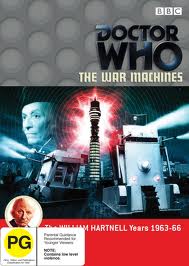
The War Machines ushers in not only the end of Doctor Who’s third season, but also the hasty, and unceremonious, exit of perhaps the most derided of all the Doctor’s companions, Dodo. Having lost Steven only the previous week, when he decamped at the Doctor’s bidding to mediate a new world for the Savages and the Elders in The Savages, it looked for all of a minute that the Doctor might again be companion less. Although the Doctor’s ignorance seemingly lasted seven days until the next serial, The Smugglers, the audience well knew that Ben and Polly were new members of the Tardis Crew. The cycle of companions continued, but more of that later.
Dodo disembarks from the Tardis for the last time. The Doctor hangs an “Out of Order” sign on the Tardis lest it is mistaken for a real Police Box
The last of the First Doctor’s serials which is 100 percent complete, The War Machines, plays upon the increasing fear of the mid 1960s that computers would usurp humans. This was an era almost ten years before the introduction of the first personal computers and 15 years before the release of IBM’s first PC and Microsoft’s MS-DOS computer operating system in 1981. Although personal computers had made inroads into the business markets by the late 1980s (Microsoft Windows was released in 1985) it was not until the mid 1990s that home PCs became more affordable and popular. After borrowing friends’ unwieldy home-made computers to write my BA (Hons) thesis in mid 1980s, it was not until 1990 that I bought my first PC. A clone of the IBM XT, it had a mammoth 128 KB of RAM and a 5¼ inch floppy drive! An early adaptor of computer technology, the wonders of this piece of computer history came at an outrageous price of around $3,000.00.
An IBM XT. My first computer was a clone of this machine
At the time of The War Machines’ transmission, it was unlikely that more than a handful of viewers would have ever personally seen a computer. Computers were massive objects that frequently were the size of a room. Perhaps seen in educational documentaries or on science fiction shows, computers were a great unknown. The playthings of mad scientists and eccentric geniuses, the distance between computers and the general public was such that they were greatly shrouded with mystique. I went through the whole of my schooling in the 1970s without ever seeing a computer, and entered the “real world” under a misapprehension, that was most probably quite commonly shared, that computers were only the domain of mathematical geniuses.
Anyone thinking of computers in the 1960s would probably envisage a machine such as this – The Whirlpool Computer which was designed for strategic air defence applications. Photo courtesy of http://www.clavius.org/techcomp.html
Is it any wonder, therefore, that the ordinary Joe or Joy Bloggs might find a Doctor Who story set in present day London in 1966, about a computer intent on human domination, an altogether feasible possibility. Although plainly science fiction, there was a kernel of fear and mistrust among many that this may one day become science fact. Watching Classic Series Doctor Who with an eye to history exhibits time and again that science fiction sometimes does become reality. In Who’s first episode, An Unearthly Child, Susan predicts the UK’s conversion to decimal currency eight years prior to its eventual introduction in February 1971. “Spooky”, you might think, however The Time Machinesdid it again in mid 1966 when it foreshadowed the internet.
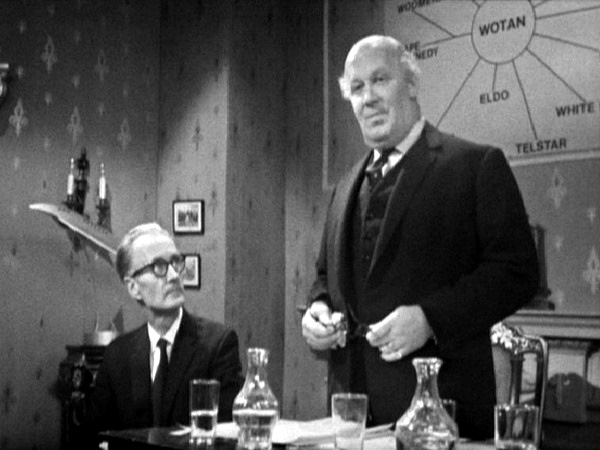
WOTAN, an acronym for Will Operated Thought ANalogue, is the most advanced computer in the world, although not necessarily the largest. It’s advanced technological capacities were a perfect companion for the building in which it was housed, the new Post Office Tower. Officially opened on the 15th July 1966 by the British Prime Minister, Harold Wilson, the Post Office Tower was the tallest building in London. Towering 177 metres from the ground (581 feet), it held that title until 1980. “C Day”, or Computer Day was set for 16th July 1966, the day after the Post Office Tower’s official opening. On that date all computers throughout the world were to be linked together under WOTAN’s (pronounced Votan) central control. The various sites to which WOTAN would be connected included the White House, Cape Kennedy, ELDO, TESTAR, RN, Woomera and EFTA.
Although not the world’s largest computer, WOTAN in the most intelligent
A media conference is held to outline WOTAN’s roll out. A graphic is displayed showing the computers which will be linked to WOTAN
TELSTAR was the name of various telecommunications satellites which were launched in the early 1960s. They provided the first transatlantic satellite television and telephone communications. So heralded was the launch of the first TELSTAR in 1962 that an instrumental tune by the British band The Tornados became the first number one hit in the United States for a UK band. Below, for your listening pleasure, is the Tornados with Telstar. ELDO was an acronym for the European Launcher Development Organisation (now the European Space Agency). RN is presumably the British Royal Navy, EFTA is the European Free Trade Association (formed in 1960), and Woomera is a weapons testing range in South Australia. Between 1946 and 1980 it was location for joint British and Australian weapons testing. The White House and Cape Kennedy require no explanation.
The Tornados – Telstar
The “C Day” linking of the world’s major computers foreshadowed the ARPANET, the first packet switching, in 1969. The Advanced Research Agencies Network (ARPANET) linked four university research centres together in the United States. The World Wide Web as we know it now, did not reach fruition until the early 1990s. It could perhaps be rightly claimed that this serial of Doctor Who was the first television show to predict the emergence of the web. Until I amended Wikipedia, a 1985 episode of Benson claimed to be the first such reference 🙂
Professor Brett – the inventor of WOTAN. The super-computer was to link all the leading computers in the world together
Although the staff designated with WOTAN’s installation and roll-out were quick to dispel fears that the super-computer may eventually become destructive, it does not take long for the malignant nature of WOTAN to become evident. WOTAN can speak and is receptive to voice commands, although ordinarily its answers are printed on a dot matrix type printer. Computer monitors had clearly not been envisaged. More intelligent than humans, WOTAN knows the answer to all questions, including inexplicably, what TARDIS is an acronym for. WOTAN, however, has a hidden agenda. it believes that the world cannot possibly progress with humans at its helm and seeks to usurp them by mobile computer killing machines – the War Machines.
WOTAN has a secret agenda to usurp human control with its clumsy creations, the War Machines
WOTAN uses mind control through the emission of sonic sounds and the humble telephone, to hypnotise humans into its sinister plan. Dodo is amongst its first victims and is instructed to co-opt the Doctor. As luck would have it, his non-human form affords him protection from hypnosis, but not without him suffering physically nonetheless. The Doctor’s magic ring again comes to the rescue as he is able to put Dodo to sleep, and snap her out of her hypnotic trance, merely by waving his hand before her face five times. Upon waking Dodo is dispatched to the country to recuperate and never again seen. Her subsequent decision to remain in London is communicated to the Doctor via a message from the companions-in-waiting, Ben and Polly. A more pathetic companion departure had never been seen.
Dodo is hypnotised by WOTAN
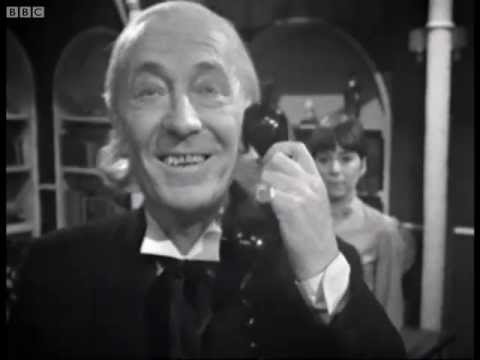
Hypnosis via the humble telephone is attempted on the Doctor. The already submissive Dodo looks on
WOTAN has its staff of hypnotised human slaves building a dozen War Machines in a disused warehouse in Covent Garden. Professor Brett, the computer scientist who invented WOTAN, is quickly a victim of WOTAN’s hypnosis, and dispatched to the warehouse to oversee construction. Polly, Brett’s secretary, also comes under WOTAN’s spell and is rescued by the Cockney sailor, Ben, who was sent on a mission by the Doctor to investigate. These War Machines were mobile computers but not in a form that we have today. Extraordinarily large, they were more like wartime tanks than the laptops, net books and tablets that we know today. Programmed by WOTAN, the War Machines are able to disable the firing mechanisms of Army guns and ammunition, and as such are seemingly unstoppable. In an Army raid of the warehouse, the single operational War Machine is able to effect the deaths of many personnel. On a rampage through the streets of Covent Garden, the War Machine is eventually outwitted by the Doctor’s cunning. After the stupendous cliff hanger of episode three where the Doctor comes face to face with the War Machine and stares it down, he eventually stops the machine in its tracks by setting up an electromagnetic field around it. An adept computer programmer, as he is of all manner of things scientific, the Doctor is able to reprogramme the War Machine. The machine is then sent on a mission to the Post Office Tower where it is able to reach the top floor, where WOTAN is housed, and destroy it. Commentators frequently joke about how the War Machine was able to fit in the lift, let alone press the floor buttons!
WOTAN’s slave labour force construct War Machines
Polly, Professor Brett’s secretary, is hypnotised by WOTAN
Save for the first episode of An Unearthly Child, in which you only see Coal Hill School and 76, Totter’s Lane, and Planet of Giants, where the Tardis Crew are miniaturized in a suburban back yard and house, this is the first time Doctor Who has been set in modern day London. It affords the opportunity for many shots of 1966 London and naturally, the most innovative building of the day, the Post Office Tower. There are a number of very interesting special features on the DVD including Now and Then, a look at the locations used in the making of the story in which those used in 1966 are compared with the present day; Blue Peter, which includes a compilation of segments on the War Machines, and One Foot in the Past, in which the Politician and ex-Postmaster General Tony Benn investigates the history of the Post Office Tower. It’s all fascinating stuff.
The Doctor stops the War Machine by creating an electro magnetic field around it
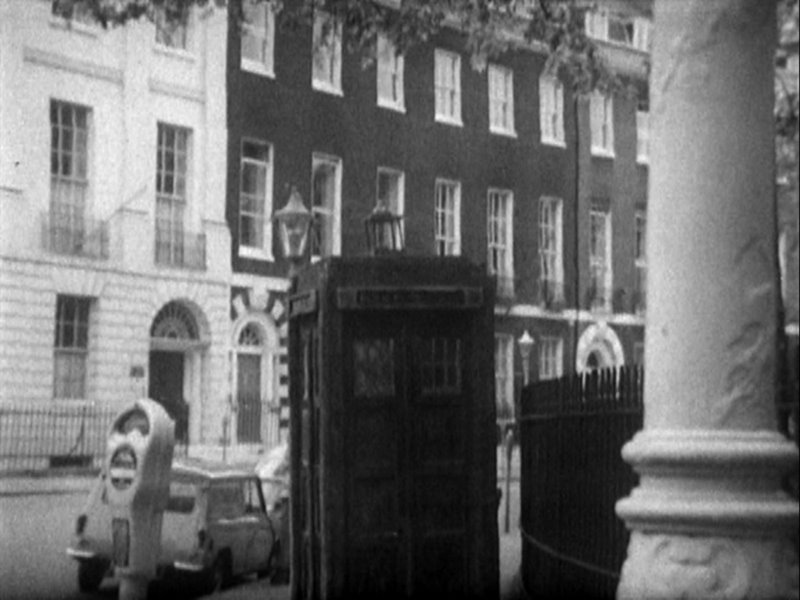
The War Machines has shots a-plenty of London in 1966
Perhaps the most visually memorable part of The War Machines is when the Doctor enters the Inferno nightclub via a flight of stairs. Resplendent in his cape, he enters the “hottest” night club in London, only to be told by one of the hipsters that his gear looked “fab”. It was not many episodes earlier that the Doctor had severely reprimanded Dodo for the use of the word “fab” and questioned if she could speak English properly. Times were a-changing for Doctor Who and this was even more evident by the new companions. Polly is a young London secretary who dresses in trendy clothes and is phenomenally forthright. Ben is a Cockney merchant sailor who breaks the hitherto unwritten rule that all major cast members of Doctor Who must speak in “BBC English” or Received Pronunciation. It was but a mere three months earlier that Dodo’s Manchurian accent lasted but 10 minutes. For the rest of Dodo’s tenure as a companion her accent changed from episode to episode and became increasingly more posh. As groundbreaking as it was to have a companion without an RP accent, it took until the Seventh Doctor’s incarnation in 1987 for the Doctor to have his first regional accent.
Ben and Polly in “The Inferno”, the hottest nightclub in London
The Doctor, in that amazing cape, stares down the War Machine in the episode 3 cliff hanger
Join me for my next review where you’ll encounter the predecessor to 2011’s The Curse of the Black Spot, The Smugglers, in which every conceivable pirate cliché is presented before us. It’s sure to be fun!
The Doctor is about to have two new companions. Dodo and Ben meet the Doctor to pass on a message from the departing Dodo
The War Machines was originally broadcast in the UK between 25th June and 16th July 1966
With all the hype surrounding Doctor Who’s 50th Anniversary on 23rd November, the 50th birthday of the Doctor’s oldest and most deadliest foe, the Daleks, looked like it may well have been forgotten. Born on the screens of the United Kingdom’s 405 line black and white TV sets on 21st December 1963, the Daleks have appeared in over 30 Doctor Who serials, together with a number of cameos and flashbacks. They have battled against 10 of the Doctor’s 11 incarnations and have been killed and resurrected more times than Rory Williams!
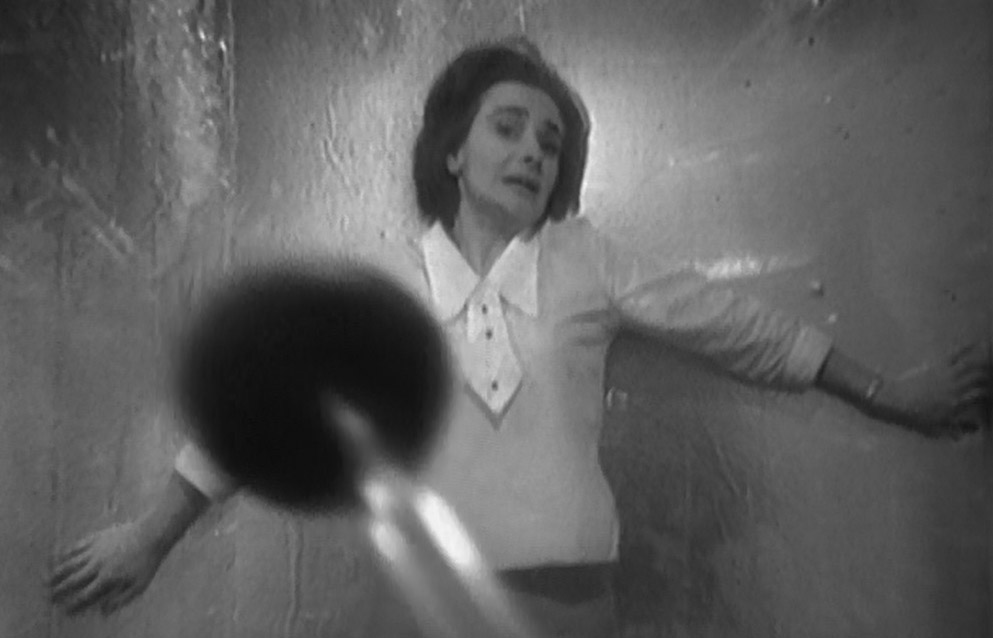
Barbara is pinned against the wall in fear during the Daleks’ first appearance in Doctor Who on 21st December 1963
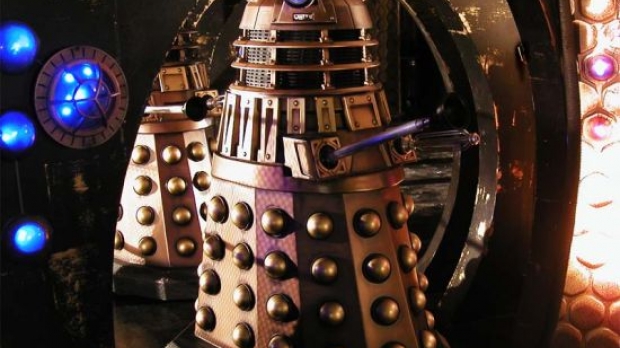
The BBC has today announced that the Daleks will appear in the Doctor Who 50th Anniversary special, together with the shape shifting Zygons who will make only their second appearance – 38 years after their first. Details of the nature of the Daleks battle with the Tenth and Eleventh Doctors, together with John Hurt, a hitherto unknown incarnation, have yet to be revealed. Let’s hope it’s as memorable as the closing shot of 1963’s The Dead Planet where companion Barbara Wright is pinned in fear against wall. Barbara’s screams indicated the presence of a terrifying foe, although for the next seven days the audience could only but imagine what the strange rubber object on the end of a metal rod was. The Daleks were born and there was no looking back. Without the Dalekmania which followed their first story, it’s unlikely that Doctor Who would have celebrated its first birthday, let alone its 50th. Long live the Daleks and may we look forward to another 50 years of terror!
The BBC today released this photograph of the Daleks from the 50th Anniversary special which is to be aired on 23rd November 2013
Recently released to celebrate the 50th anniversary of Doctor Who, Celebrate Regenerate is a fan produced chronicle of every broadcast episode of Who. Available as a free PDF download from http://celebrateregenerate.weebly.com/ this mighty tome features a page long article on every serial. The authors of The Gunfighters article, Mike Greaves and Andrew Boland, succinctly summarize received fan wisdom on this Western adventure. Dreadful, terrible, boring, and badly made are some of the words and phrases used by Greaves and Boland to describe the average fan’s dismissal of this tale. So convinced were they that the viewing experience would be tortuous and entirely unenjoyable that once viewed, they questioned whether they’d watched the right serial. Were there two 1960s Doctor Who Westerns, they wondered. There was indeed only one and clearly there was something peculiar going on. Greaves and Boland had actually thoroughly enjoyed The Gunfighters.
Edited by Lewis Christian, Celebrate Regenerate is a fan produced chronicle of every Doctor Whoepisode
Phil Sandifer in his book Tardis Eruditorum Volume 1: William Hartnell examines this received wisdom in depth and identifies three distinct stages of fan criticism. The first he describes as 1980s fandom; the second as the Great Re-evaluation of the 1990s; and the third, the Reconstructionist era beginning in 2002. The first era occurred in a time when there was neither video releases of Doctor Who nor the internet. Fan opinion was derived from memories of the programmes when originally broadcast and a limited number of books, the most notable of which was Peter Haining’s 1983 Doctor Who: A Celebration. This coffee table book was almost seen as the Bible of Who and its critical analysis of episodes taken as Gospel. Haining’s review of The Gunfighters was scathingly negative and it is most probably from this source that received fan wisdom grew.
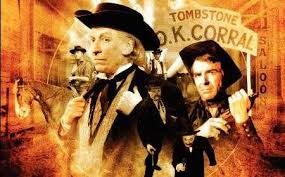
The Doctor and his companions visit Tombstone, Arizona
The Great Re-evaluation that followed the release of stories on VHS cassette was not so much a detailed reappraisal of stories, but rather discussions to produce a general consensus on the relative merits of each story. It was not until all existing stories had been released on VHS, and Loose Cannon had completed their reconstructions, that what Sandifer describes as the democratization of fan criticism began. The ordinary Who fan was now in a position to access the stories for themselves and with the re-launch of Who in 2005, new fans had little concern for what the Classic Series critics of old said. With the pervasiveness of the internet and instant access to television programming everyone had become a media critic.
Steven and Dodo enjoy dressing up as Cowboys and Cowgirls
It is from this new position of fan criticism that The Gunfighters has been reappraised. That the story is unique cannot be denied. It is the only Doctor Who story with a sung narration, in the form of The Ballad of the Last Chance Saloon. Sung by Lynda Baron, the Ballad is heard at times of climatic tension throughout the serial. The lyrics change to reflect the action and it’s also sung by Steven and Doc Holliday’s girlfriend, Kate, in the saloon. It’s the latter renditions that are posted below for your viewing pleasure.
The Ballad of the Last Chance Saloon
Written by Donald Cotton, the author of The Myth Makers, the serial has a similar comedy format to Cotton’s previous Who outing. Again it mirrors the events in Troy when episode four descends into tragedy. The Gunfightersis set in 1881 America and follows the film The Gunfight at the OK Corral as one of its primary sources. Doctor Whowould not return to the American Wild West until the Eleventh Doctor’s 2012 adventure A Town Called Mercy. Having broken a tooth eating one of the Cyril’s lollies in The Celestial Toyroom, the Doctor uses his unexpected arrival in the American mid-west to procure the services of the local dentist, Doc Holliday. He is immediately mistaken for Holliday by the town’s residents and hunted down by the Clanton family. Throw into the mix the Earp brothers, Virgil and Warren, and add Johnny Ringo (who historically wasn’t involved in these Tombstone, Arizona events), and you have a ripping good yarn.
The Doctor has a tooth extracted by Doc Holliday
William Hartnell absolutely shines in The Gunfighters, undoubtedly because it was a comedy and the genre in which he most enjoyed to act. The Doctor is given some fabulous lines and rarely does he stumble on them. Except, of course, when he refers to Steven as a “she”! Peter Purves does a superb job, as always, and Jackie Lane, as Dodo, is at last afforded the opportunity to act. Her scene with Doc Holliday when she threatens him with a gun is just fabulous. The set work was superb even if the stair railings did wobble when Ike Clanton fell to his death. The Doctor Who production team must have recently found the services of an animal wrangler. Less than two months earlier they’d had an elephant in the studio for The Ark and this time a horse. I wonder what the cleaners thought at the end of the day’s filming!
The Doctor in Doc Holliday’s dentist chair. Beside the Doctor is Kate, Holliday’s girlfriend
There are a couple of interesting facts to note in this serial. The original working title was The Gunslingers, and as anyone who has viewed the Series 7 episode, A Town Called Mercy, would be aware, there’s a character by that very same name. The Gunfighters also stared the Thunderbirdsvoice artists, David Graham (Brains) and Shane Rimmer (Alan Tracey). Graham played the unfortunate barman, Charlie, and Rimmer the character of Seth Harper. Lynda Baron, the off camera singer of The Ballad of the Last Chance Saloon appeared in the Series 6 story Closing Time as Val.
The working title of The Gunfighters was The Gunslingers. That name was not forgotten and the character, The Gunslinger, appeared in 2012’s A Town Called Mercy
Guess which two Thunderbirds voice artists appeared in The Gunfighters
The Gunfighters was originally broadcast in the UK between 30 April and 21 May 1966
The Gunfighters DVD was released with the Fifth Doctor adventure The Awakening in the Earth Story Box Set


















 The Doctor Who Mind Robber