YesterdayTheDoctor Who Mind Robberreported an article in Sunday’s Mirrornewspaper alleging the recovery of over 100 missing Doctor Whoepisodes from Ethiopia. As hoped, the reporting of these rumours in the mainstream media appears to have precipitated some movement on the BBC’s part. The Radio Timesis today reporting that two stories, both believed to be from the Troughton era, have been digitally remastered and will be available for purchase on-line from sources such as iTunes on Wednesday. The BBC has yet to confirm or deny the claims in The Radio Times.
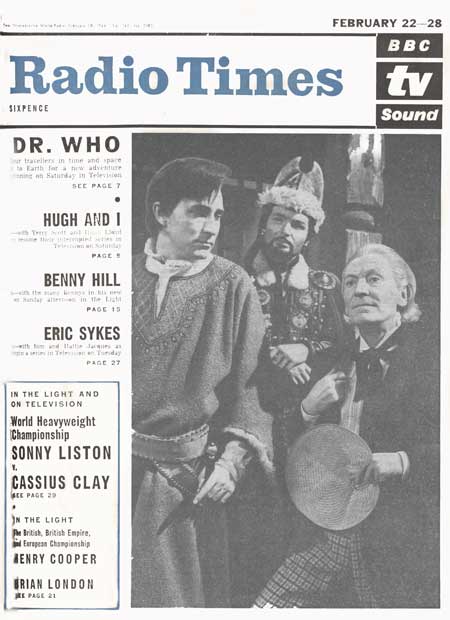
A 1964 Radio Times cover featuring the Doctor Who serial Marco Polo
The Doctor Who Mind Robber understands that there is a small Missing Believed Wipedfunction on Tuesday and that the recovery of some missing episodes could be announced then. Missing Believed Wipedis an annual event run by the British Film Institutewhich showcases recently discovered missing films.
The Mirrorhas published a further story in which they claim that BBC Worldwide has called a press conference and screening for Tuesday evening. The Mirrorreports a BBC source as saying,
“There will be big news this Tuesday regarding lost Doctor Who episodes.
It is great that in the show’s 50th year, fans will now be able to look back with classic episodes as well as looking to the future with the new film-length episode in November.
For some fans watching their lost episodes will be like going back in time.”
The BBC Worldwide logo
Further details will be published as they come to hand.
One of the most frustrating aspects of 21st Century Doctor Who is the almost complete absence of cliff hangers. Very few stories have extended beyond one episode. In a clear nod to William Hartnell era stories, the Series 7 story The Crimson Horror ended with a direct lead-in to the next story, Nightmare in Silver. Arriving back in present-day London, the companion Clara meets with the children she babysits, Angie and Artie, who blackmail her into taking them on her next adventure in the TARDIS.
Clara is blackmailed by Angie and Artie at the conclusion of The Crimson Horror (2013)
In celebration of the great cliff hangers of Classic Series Doctor Who this article will briefly examine the Top 10 Cliff Hangers of the Sixties. So as not to reinvent the wheel, The Doctor Who Mind Robber has directly quoted the episode ending summaries from David J Howe and Stephen James Walker’s seminal book The Television Companion. No copyright infringement is intended.
David J Howe & Stephen James Walker’s The Television Companion was published in 2003 by Telos Publishing
“Maggie Harris and Robson, both infected by the weed creature, meet on the beach. The former tells the latter that he will obey his instructions. Then she turns and walks straight out into the sea, eventually becoming completely submerged beneath the waves”.
The horror of this cliff hanger is the apparent suicide of Maggie Harris, the wife of one of the base employees. It is not until several episodes later that it becomes evident that Mrs Harris is still alive. Incidentally, Fury From the Deep is one of the few Doctor Who serials in which no one dies.
Unfortunately all episodes of Fury From the Deep have been lost, however the soundtrack, telesnaps and Loose Cannon’s excellent reconstruction brilliantly convey the horror.
In the cliff hanger to episode three Maggie Harris walks into the water, as if to commit suicide
“The TARDIS arrives on a Palaeolithic landscape, over which falls the shadow of a man”.
This is the cliff hanger to the very first episode of Doctor Who and it’s the first time that the television viewers see the TARDIS materialize. The ominous shadow of a man in the barren landscape is both frightening and unexpected.
The ominous shadow of a man approaches the TARDIS in the cliff hanger to An Unearthly Child
“The TARDIS is in flight, the travellers having apparently escaped from the void. A low, throbbing hum is heard which grows in intensity until it is unbearable. Suddenly the TARDIS explodes. The Doctor spins away through space while Jamie and Zoe are left clinging to the console as it is engulfed in swirling mist.”
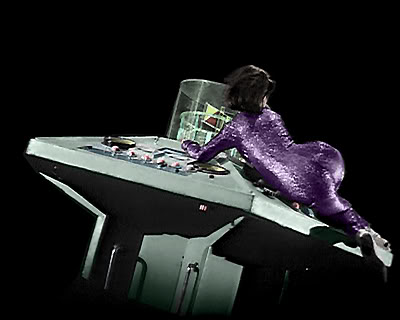
The end of the first episode of The Mind Robber is absolutely brilliant. This is the first time in Doctor Who that the TARDIS explodes and the crew is left floating perilously in space. The image of Zoe clinging onto the TARDIS console has become iconic for all the wrong reasons. Her tight sparkly cat suit clings to her body as the camera focuses on her bottom.
Wendy Padbury in the scene for which, unfortunately, she is perhaps best known
“The Abbot of Amboise lies dead in the gutter, a crowd of angry Catholics gathering around his body. When Steven protests that the Huguenots were not responsible, Roger Colbert incites the crowd against him. Steven flees for his life through the Paris streets …”
The Massacre sees William Hartnell play two roles – the Doctor and the evil Abbot of Amboise. Both characters are absolutely identical in appearance however the audience and companion Steven are unaware if the Doctor is masquerading as the Abbot, or if the Doctor and the Abbot are two different people. It’s for that reason that this cliff hanger is so powerful as it is not clear if it is the Doctor or the real Abbot who is dead.
The Massacre is another of the serials which unfortunately has all episodes missing. As discussed in Fury From the Deep, this does not distract from the potency of the ending.
“The Doctor returns to the TARDIS, closely followed by Ben and Polly. The ship’s controls move of their own accord and the Doctor collapses to the floor. His companions enter and, before their astonished eyes, the Doctor’s face transforms into that of a younger man”.
This episode ending is of course Doctor Who’s first regeneration. The First Doctor, William Hartnell, collapses and with exceptional special effects for the era, his face is transformed into that of the Second Doctor, Patrick Troughton. The audience must wait until the next episode to see all of the new Doctor’s body and to experience his personality. There was no precedent for a change of the lead character in such a manner, and the audience was left stunned as they anticipated the new Doctor’s personality and physical appearance.
Episode 4 of The Tenth Planet has been lost however an amateur film was taken of a television screen during the broadcast of the episode. The episode has also been recently animated and will be released on DVD next month.
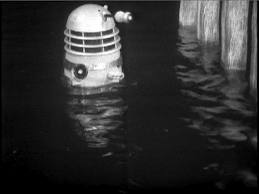
“The Doctor and Ian, menaced by a group of Robomen, prepare to escape by diving into the Thames. As they turn, they see rising slowly from the water the familiar shape of a Dalek.” (Episode 1)
“The TARDIS dematerialises and, comforted by David, Susan moves away. Her TARDIS key lies discarded on the ground, with an image of a starscape superimposed …” (Episode 6)
The cliff hanger of episode 1 derives its force from both the iconic background of the Thames River and the emergence of Doctor Who’s first return monsters, the Daleks. Having been so well received in their first story, the return of the Daleks was eagerly anticipated by fans. As was the common practise in early Doctor Who stories, the monsters rarely appeared on-screen until the end of the serial’s first episode.
The episode six ending marked the first departure of a companion in Doctor Who. Just prior to the episode’s end the Doctor gave an impassioned oration to his grand-daughter Susan whom he was effectively deserting on the 21st Century Earth.
A submerged Dalek emerging from the Thames River
Susan talks to the Doctor through the TARDIS’s PA system
“After cleaning Farrow’s blood from the patio stones outside, Smithers goes into the laboratory to wash his hands, unaware that the Doctor and Susan are hiding in the water outlet from the sink. As a helpless Ian and Barbara watch, he fills the sink with water, washes, and then pulls out the plug”.
The brilliance of the episode 2 cliff hanger of Planet of the Giants is that it successfully made the mundane frightening. Watching a plug pulled from a sink and water cascading down a drain would ordinarily be exciting as watching the kettle boil. Our heroes, however, have been shrunk to less than an inch in height and are as vulnerable as an ant is to the heavy boot of a human. The companions Ian and Barbara, together with the audience, are left paralysed with fear at the imminent drowning of the Doctor and Susan.
The Doctor and Susan before descending into the sink drain
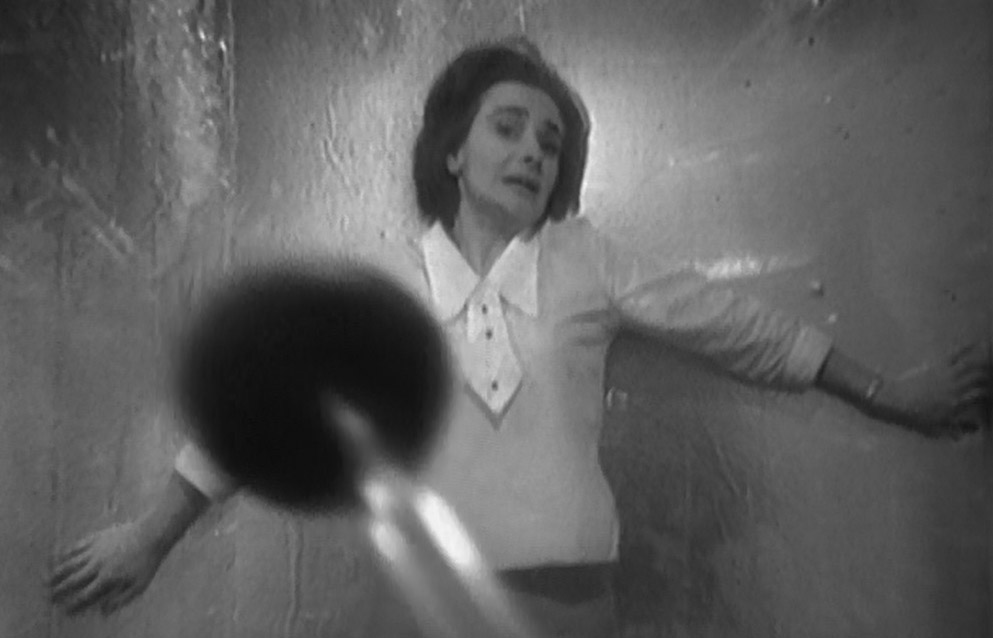
“Exploring their apparently deserted city, Barbara encounters one of the Daleks and is menaced by its telescopic sucker arm.”
As outlined in The Dalek Invasion of Earth, it was standard practice in early Doctor Who for the monsters not to emerge until the cliff hanger of the first episode. This absolutely iconic ending sees Barbara pinned to a wall in fear as a Dalek’s sucker arm menaces her. The audience has not yet seen the rest of the Dalek’s body however the expression on Barbara’s face paints a picture of a horrifying spectacle.
Barbara is pinned against the wall in fear during the Daleks’ first appearance in Doctor Whoon 21st December 1963
2. The War Games – Episode 1 and Episode 10
“In the First World War zone the Doctor has been found guilty of spying against the English forces and is tied up before a firing squad. Captain Ransom brings his men to order, tells them to present arms and opens his mouth to give the order to fire. A shot rings out and the Doctor grimaces” (Episode 1)
“A still protesting Doctor spins away through a dark void to begin his sentence of exile on Earth with a new appearance. His face is shrouded in shadow …” (Episode 10)
By the time the first episode of The War Games was broadcast Patrick Troughton’s decision to leave the role of the Doctor had been made public. Whilst history had shown that the Doctor always escaped serious harm, the audience could not be certain that his luck hadn’t finally ended. Perhaps he would be killed by the firing squad and regeneration was imminent?
Episode 10 is perhaps my all-time favourite as so many mysteries about the Doctor’s past are answered. His forced regeneration at the episode’s end is chilling but perhaps not as sad as Jamie and Zoe’s departure earlier in the episode. The monochrome era of Doctor Who was at an end and things would never be the same again.
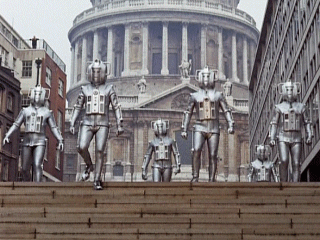
“The Cybermen emerge from the sewers and march through the streets of London as the invasion begins.”
The Cybermen’s emergence from the sewers of London and their march down the steps of St Paul’s Cathedral is justifiably iconic. By placing the monsters in an easily recognizable London landscape genuine fear would have been instilled in the audience. Although the Daleks had visited tourist spots such as Westminster Bridge in The Dalek Invasion of Earth, the Cybermen were in current day London. This wasn’t one of the Daleks’ futuristic tales but rather a genuine invasion in our own time. As Jon Pertwee said, there’s a “Yeti on the Loo in Tooting Bec”.
Arguably the most iconic cliff hanger in classic series Doctor Who. The Cybermen on the steps of St Paul’s Cathedral
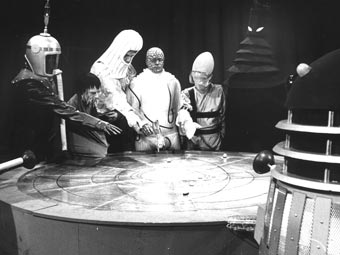
Written by the Daleks’ creator, Terry Nation, the Mechonoids appeared in the penultimate serial of Season 2, The Chase. Together with the farewell of companions Ian and Barbara, The Chase was the first attempt by Terry Nation to create a rival to the Daleks’ popularity. The Mechonoids were created to protect humans on the planet Mechanus however ultimately no humans colonized the planet. The Daleks battled the Mechonoids during this story. Not unlike many early Doctor Who monsters, the Mechonoids were large, cumbersome and totally unsuited for most of their tasks.
The Chase was the Mechonoids only television appearance on Doctor Who, although they did appear in comics and had several items of merchandise produced.
A mechonoid with two Daleks in The Chase
9. The Macra – The Macra Terror
Although revived in the Series 3 episode Gridlock, the providence of the Macra would probably have been lost on most New Series Doctor Who fans. With all four episodes of The Macra Terror lost, it is of little surprise that the Macra have long faded from memory. Giant crab like creatures, they inhabited underground tunnels and were reliant upon toxic gases to breath.
Thanks for the vigilance of the Australian Censorship Board, several censored clips from The Macra Terror have survived. A 15 second clip of a Macra grabbing Polly and another 7 second clip of Ben and Polly watching an approaching Macra, have survived from Episode Two. A two second clip of the Controller being attacked by a Macra survives from Episode Three.
A publicity shot of the Controller and Macra taken prior to filming
8. The Krotons – The Krotons
Robert Holmes’ first serial for Doctor Who produced yet another one-off monster, the Krotons. In my review of The KrotonsI described these monsters thus:
“ Yet another attempt at a Dalek replacement, the Krotons were a poor substitute. With arms that looked like the robot’s from Lost in Space, the Krotons were disabled by their strange and inflexible metal hands. Possessed of a rather cool spinning head, the poor Krotons were not so lucky with that part of their costume below the waist. A rubber skirt was merely tacked on to disguise the operators’ legs”.
The Krotons spoke with South African accents
7. The Quarks – The Dominators
Created by Mervyn Haisman and Henry Lincoln, the writers of the two Yeti stories The Abominable Snowmen and The Web of Fear, the Quarks of The Dominatorswere nowhere near successful as Haisman and Lincoln’s first monsters. The Quarks were less than convincing monsters and were ostensibly a box with legs, two pieces of wood for arms, and a quite fancy round head. The creatures were so small that school children were hired as operators.
Haisman and Lincoln believed that they’d created “the next big thing” and as a consequence a dispute between the writers and the BBC ensued. The writers’ sought exclusive rights for the marketing of the Quarks however unbeknownst to them, the BBC had already sold the comic rights to the Quarks. An injunction against the airing of The Krotons was threatened, although legal action was not forthcoming. The Dominators was the last Doctor Who serial that Haisman and Lincoln worked on. Although never again appearing on TV, the Quarks had a short career as comic book characters.
The Quarks were less than convincing as monsters
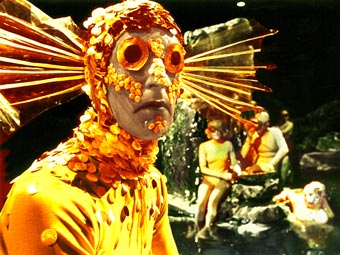
6. The Fish People – The Underwater Menace
Of The Underwater Menace’s four episodes, two are held in the BBC Archives and only one has been released on the Lost in Time compilation DVD. Another of the Troughton era serials that is generally held in low regard by fandom, The Underwater Menace featured Fish People. These strange creatures were once humans but had been operated on to enable them to breath underwater. These surgically modified humans, who now had gills, flippers and scales, were slaves to the Atlaneans. Polly narrowly escaped being transformed into a Fish Person.
The Fish People’s costumes included many sequins and they spent much of their time engaged in synchronised swimming. The rest of the time they collected a constant supply of fresh plankton which was required by the Atlaneans who were bereft of refrigeration. Alas, the plankton of The Underwater Menace were not as cute as the SpongeBob SquarePants character.
A rare colour photo of the Fish People
5. WOTAN – The War Machines
Making its first and only appearance in the Season Three finale, The War Machines, WOTAN was the world’s most sophisticated computer. Pre-empting the internet, WOTAN was designed to link together all of the world’s computers. Located on the top floor of the newly opened Post Office Tower in London, WOTAN was a malignant machine which sought world domination. WOTAN evidenced the fear of many that the newfangled room-sized computers would usurp humans.
Although not the world’s largest computer, WOTAN is the most intelligent
4. The Rill – Galaxy 4
Although technically a monster, the Rill of Galaxy 4were actually benign creatures who had long been the victims of a campaign of aggression by the Drahvins, a race of aggressive females. Enormous and obscenely ugly green creatures, the Rill can only breathe ammonia. In a tale with the well worn moral of “you can’t judge a book by its cover”, the beautiful blonde Drahvins are the evil and the ugly Rill are the good.
A Chumbley with four Rills in the background
3. The Menoptra and The Zarbi – The Web Planet
Hailed by some fans as a masterpiece, the First Doctor adventure The Web Planetalso has a sizeable number of critics. I was so bored and uninspired by the painfully slow six part serial that I was unable to gather the enthusiasm to write a review. Instead I posted a fan made YouTube clip which although only three minutes in duration, was immeasurably better than the 150 minute serial. Is it any wonder that the Menoptra and the Zarbi are forgotten Doctor Who monsters?
Creatures of The Web Planet
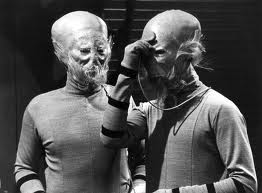
2. The Sensorites – The Sensorites
The penultimate story of Season One, The Sensoriteswas Doctor Who’s first attempt to create a monster to rival the Daleks. The Sensorites, who are near neighbours to the New Series monsters, the Ood, are a strange race of creatures who communicate by telepathy. With unusually shaped bald heads, the Sensorites have a fine head of hair growing onwards and upwards from their chins. Like the Ood, the Sensorites are nameless and genderless and have a tube which hangs from their bodies. The cord is not the external brain of the Ood, however, but rather a stethoscope to facilitate their communication by telepathy.
A Sensorite using telepathy.
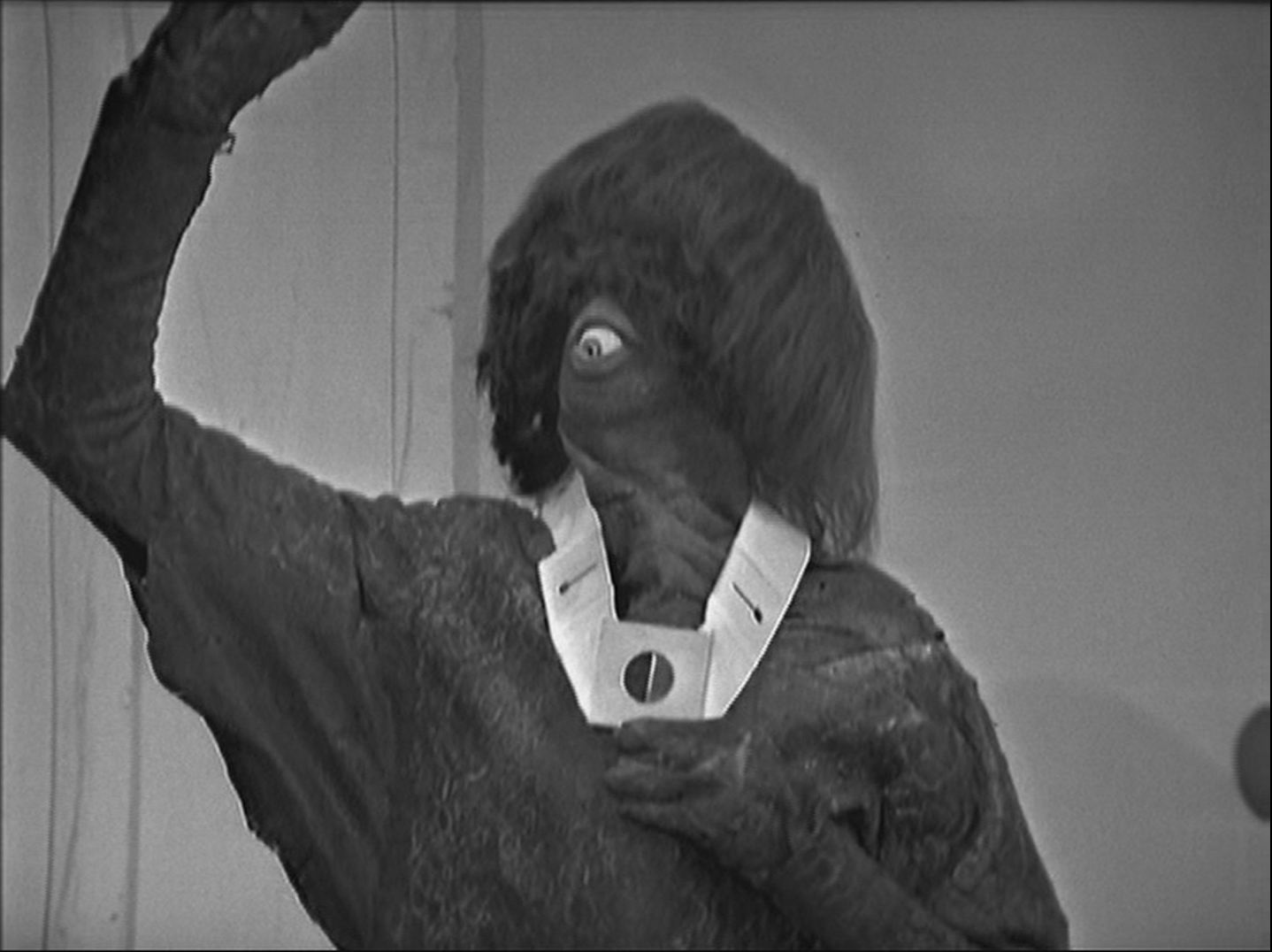
1. The Monoids – The Ark
Surely the worst designed of all Sixties Doctor Who monsters, the Monoids were originally the servants of the Guardians. In my review of The ArkI described the Monoids in this way:
“.. .a peculiar mute race whose most distinctive feature is their one eye. This single eye is in their mouths, or at least what would’ve been their mouths if they had human anatomy. These eyes are actually painted ping pong balls which the actors held in place with their mouths. Now that’s ingenious small budget special effects for you! On the top of their heads is a long Beatles style mop top wig, whilst the rest of their bodies are clothed in green ill fitting garb. They have webbed hands and feet and move slowly”.
A lowly regarded serial, The Ark is nonetheless a stunningly directed four part story which is always met by sighs of relief by marathon watchers. After five lost serials in succession, including the 12 part The Daleks’ Master Plan, watching The Ark on DVD is almost like winning the lottery!
I was recently browsing YouTube and came upon this fabulous compilation of colourized clips from William Hartnell’s tenure as the First Doctor. Here’s what the producer, who is known only by the alias of “It’s far from being all over”, says about his work:
“My Tribute to the man that started it all, William Hartnell.
I always felt many of his adventures deserved to be seen in colour, so I set to work. It’s taken about three months and I’ve colourised something in the region of 2,125 frames – one by one, frame by frame.
Some clips work better than others – as I reached the end I found myself dropping shots I didn’t like and recreating new ones! It’s been a labour of love and I hope you enjoy seeing some classic 60’s Doctor Who – in Colour!
Big thanks to ‘Pelham Cort aka @johnxgin3’ for his colour references and support throughout – I’ll do some Troughton soon! “
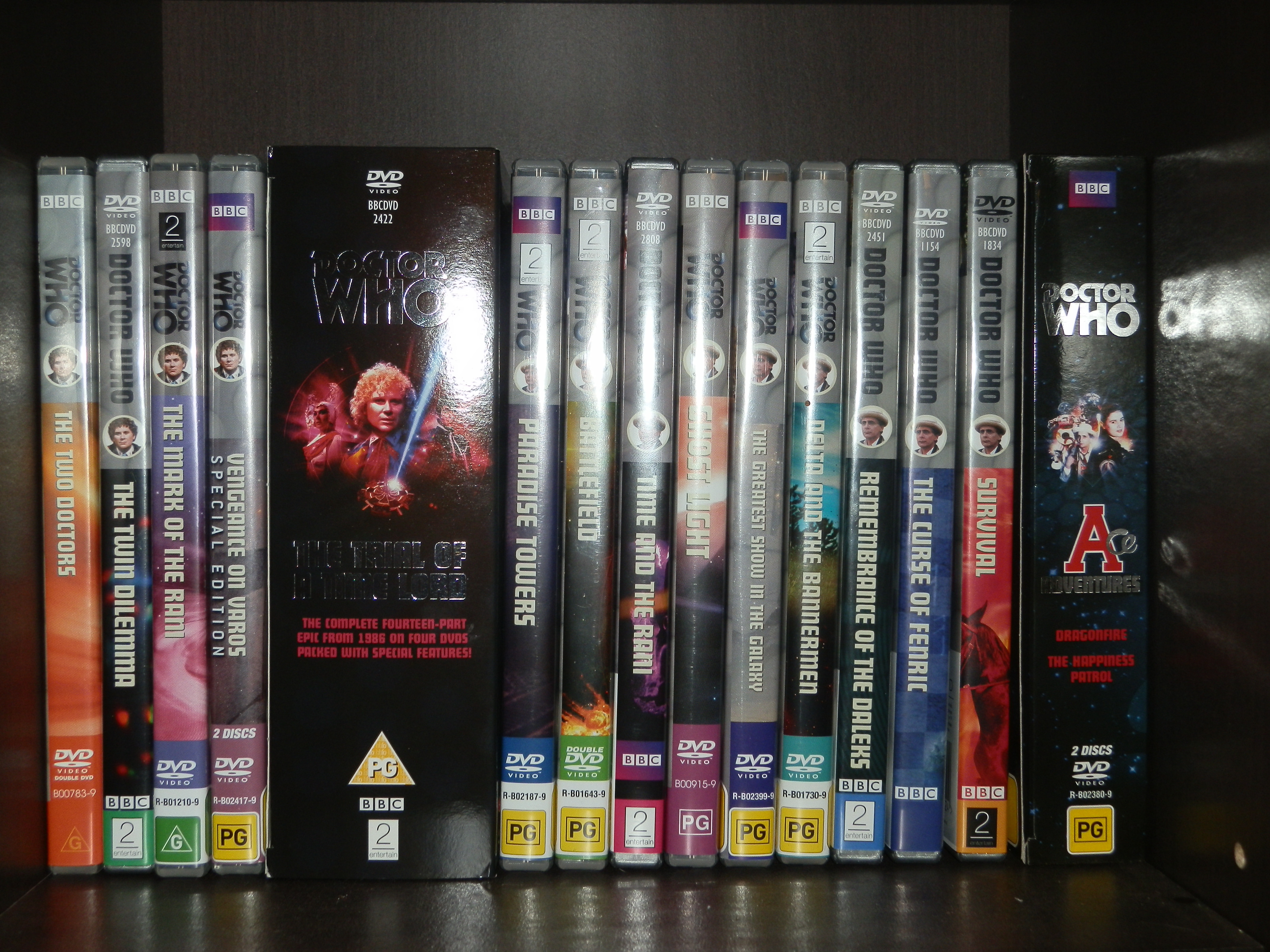
Having just received in the mail the last two Classic Series Doctor Who DVDs required to complete my collection, it’s probably an appropriate time to discuss the best ways to build a DVD collection. With the exception of Spearhead fromSpace, the Third Doctor’s debut, Classic Series Doctor Who is only available on DVD. Spearhead from Space has been released on Blu Ray as it is the only Classic Series serial produced entirely on film. New Series DoctorWho is now released on both DVD and Blu Ray, although Series One through to Four and the 2009 Specials are DVD only. Please note that this article is written from an Australian perspective. Unless otherwise stated, all references to box sets refer to Region 2 and Region 4 releases only. American Region 1 Classic Series Doctor Who DVDs have been released by individual serial only. To the best of my knowledge there are no American Classic Series box sets.
1. BUY ONLINE
This is probably stating the obvious, however procuring a complete Doctor Who DVD collection would be prohibitively expensive if all your titles are purchased from bricks and mortar stores. Also, finding any one title that you require in a physical store could very likely see you traipsing the length and breadth of your city. Retailers of DVDs/Blu Rays tend not to stock extraordinarily large catalogues of Doctor Who DVDs. JB Hi Fi is perhaps one exception and you can generally find a very long shelf full of Who titles in each store. Even then, you’ll only find a small percentage of releases at any one store. JB Hi Fi’s website has search functions enabling you to search by title and then ascertain stores with stock. Delivery is available from JB Hi Fi for only 0.99c per DVD.
First Doctor DVDs
When considering purchasing online look for stores that offer free postage. Postage charges can be a real killer and you can potentially save a great deal with free or low cost postage. Online retailers in Australia that offer free postage include Fishpond and The Nile.
2. BUY FROM OVERSEAS
For Australian purchasers it is unfortunate that the prolonged period of a high Australian dollar has come to an end. After reaching a high of around 108c US, the dollar has now plummeted to 91c US. I was fortunate enough to do the bulk of my collecting when the Australian dollar was at its peak but nonetheless, significant savings can still be made. Region 4 DVDs can be prohibitively expensive however Region 2 DVDs are frequently more affordable. Please see the paragraph below on UK Region 2 DVDs for further details. In recent times I’ve found the most competitive prices are available at Fishpond.
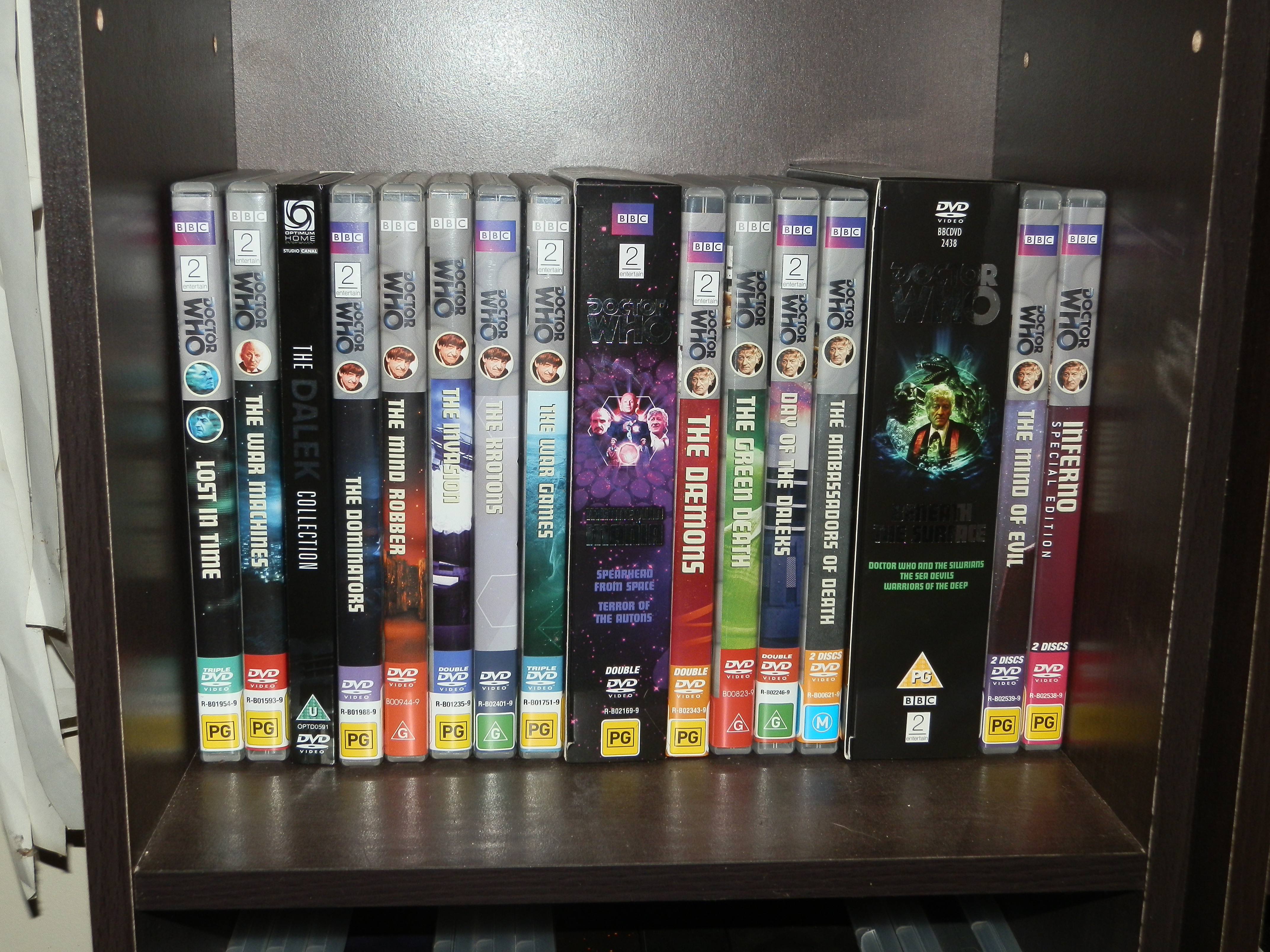
First, Second and Third Doctor DVDs
When purchasing from overseas be prepared to wait for your titles to arrive rather slowly. Between four and six weeks is not an uncommon time frame for arrival from the UK.
3. UK REGION 2 DOCTOR WHO DVDS ARE DUAL CODED REGIONS 2 AND 4
When perusing an online store such as Fishpond you will generally find up to three listings for each DVD title – one for each of Regions 1, 2 and 4. Region 1 titles are from the US and are even more expensive than the Australian and New Zealand Region 4 titles. Region 2 titles, from the UK, are nine times out of ten the cheapest.
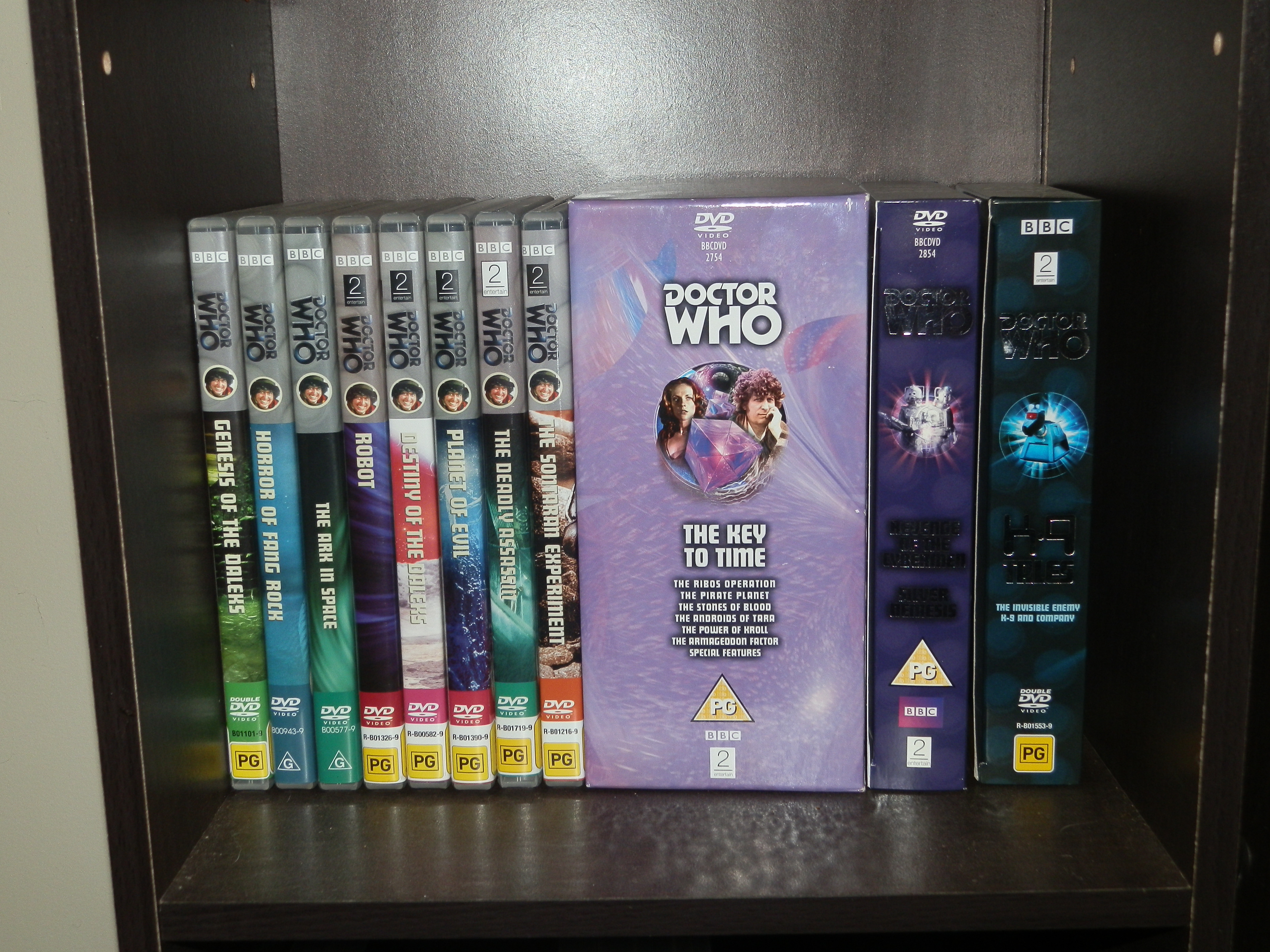
Third and Fourth Doctor DVDs
What these websites invariably don’t tell you is that the BBC’s Doctor Who DVDs are dual coded for Regions 2 and 4. Instead the titles are generally listed as Region 2 only, with the usual disclaimer stating that you will require a multi-region player. It’s only when you have the DVD in your hands that the dual coding is obvious . Once you’ve bought your first Region 2 advertised Doctor Who and seen for yourself that it’s dual coded, you’ll wonder why you’ve been wasting your money on the higher priced Region 4 ones for so long.
The Region 2 release of The Five Doctors. You will note from the back cover that it is dual coded Region 2 and Region 4
Region 2 DVDs are also more attractively packaged than the Region 4 ones. Nearly all DVDs have the whole of the disc covered in a colour graphic from the serial. The Region 4 DVDs are generally a solid colour only with no pictures. Region 2 DVDs also have a 4 page brochure setting out the production details and special features. This is a great deal handier than the Australian and New Zealand releases that have this information printed on the reverse side of the cover. This necessitates removing the printed cover from the sleeve if you wish to read it. The Region 2 brochure is also in a larger font than the Region 4 releases, therefore making reading easier.
An example of a Region 4 Doctor Who disc. Note that it doesn’t have any photographs or otherwise interesting artwork
An example of a Region 2 New Series disc. Classic Series Region 2 discs also generally have photographs and interesting graphics
4. EVEN CHEAP REGION 4 DVD PLAYERS MAY BE MULTI-REGION
If you’re still not convinced that the BBC’s region 2 DVDs are dual coded for Region 4, consider that even your cheap Region 4 DVD player may be multi-region. My Studio Canal release of The Dalek Collection which includes the two Dalek movies, Dr. Who and the Daleks and Daleks: Invasion Earth 2150 AD, is listed as Region 2 only. It’s a non BBC release. It plays perfectly on one of my $25.00 K-Mart Region 4 DVD players. You can read two interesting articles from the Sydney Morning Heraldhere and here. In these articles, and the numerous comments to them, you will find discussion of Multi-Region (Region-Free) DVD players being marketed in Australia as Region 4 only.
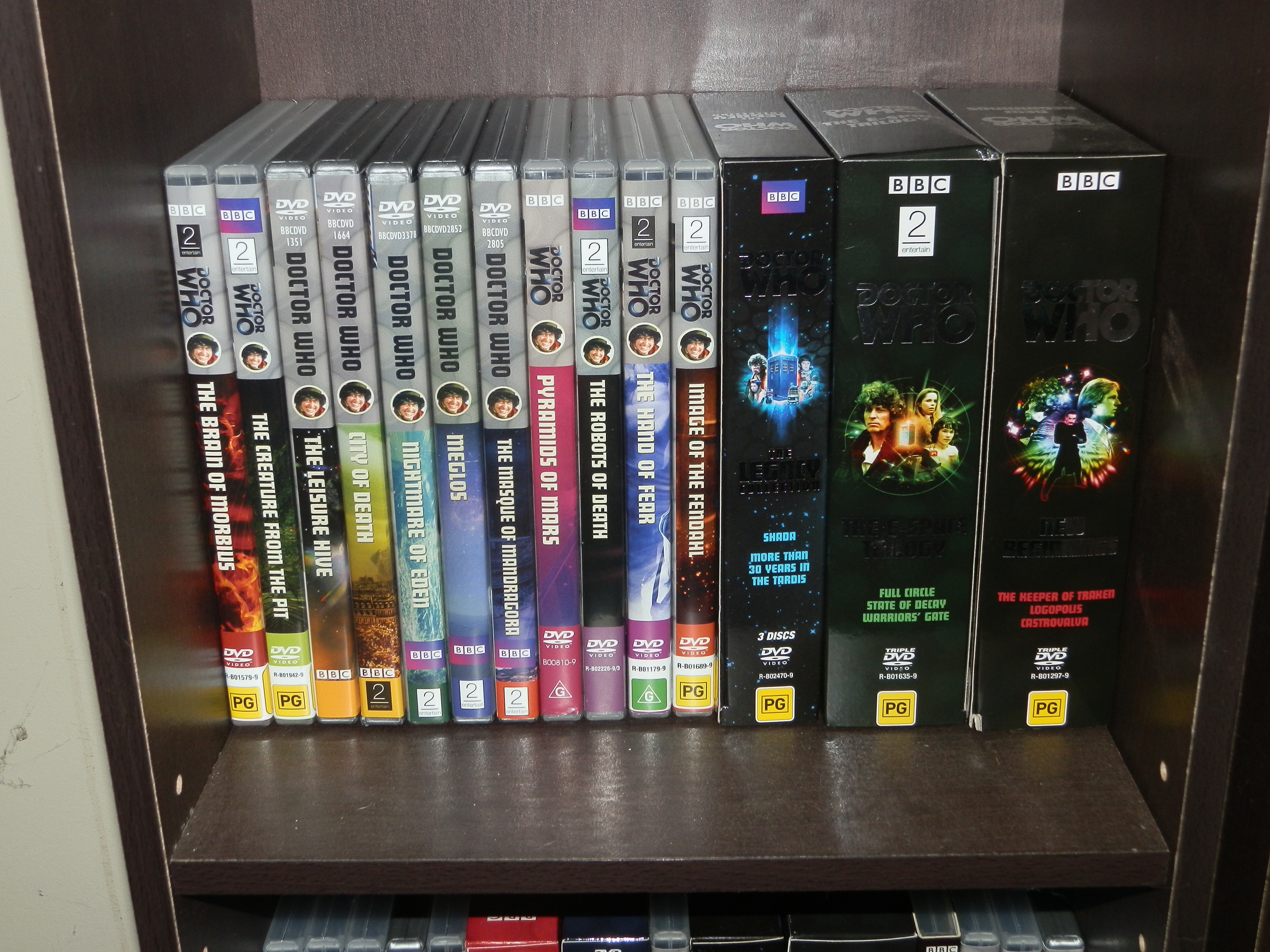
Fourth Doctor DVDs
If you want to be 100% certain then I would suggest buying a multi-region DVD player which can be picked for as little as $35.00. You’ll make the purchase price up dozens of times over with the savings you’ll obtain buying Region 2 DVDs.
5. COMPARE PRICES and BUY DURING SALES
It is more than worthwhile to shop around a number of websites and compare prices before every purchase. In my experience prices can vary frequently so what is cheaper one day at a store may not be so the next day. Try eBay as well. Also be on the lookout for sales. JB Hi Fi seem to have 20% off DVD sales every few weeks. It’s worthwhile subscribing to the stores’ emails so that you can be advised of upcoming sales.
Fourth and Fifth Doctor DVDs
6. COLLECT BY CHEAPEST FIRST RATHER THAN FAVOURITE TITLES
If you are looking to buy the complete collection then it’s worthwhile purchasing titles when you find them on special even if they’re not your favourites. If you’re going to buy them all eventually you’ll be kicking yourself that you missed the chance for a bargain.
Fifth and Sixth Doctor DVDs
7. DON’T BUY IMMEDIATELY UPON RELEASE
Especially when it comes to Special Editions, don’t buy your DVDs immediately upon release. Prices for new releases are always at a premium so if you are prepared to wait you can often save up to $10.00 on the purchase price.
Sixth and Seventh Doctor DVDs
8. KEEP A LIST AND MARK OFF TITLES ORDERED AND RECEIVED
This is another fairly obvious point however it’s easily overlooked. There are 155 Classic Series serials, 90% of which have been released as individual stories and not as part of a box set. Unless you’ve rote learnt the names of every title then you’re sure to forget what you’ve bought and also ordered. In completing my collection I used Mark Campbell’s Doctor Who. The Complete Guide, to mark off the serials as I ordered then, and again as they were received. The book has the added advantage of allowing me to see what’s next in my marathon and also quickly consult a list of cast members, writer, directors and the like for each serial.
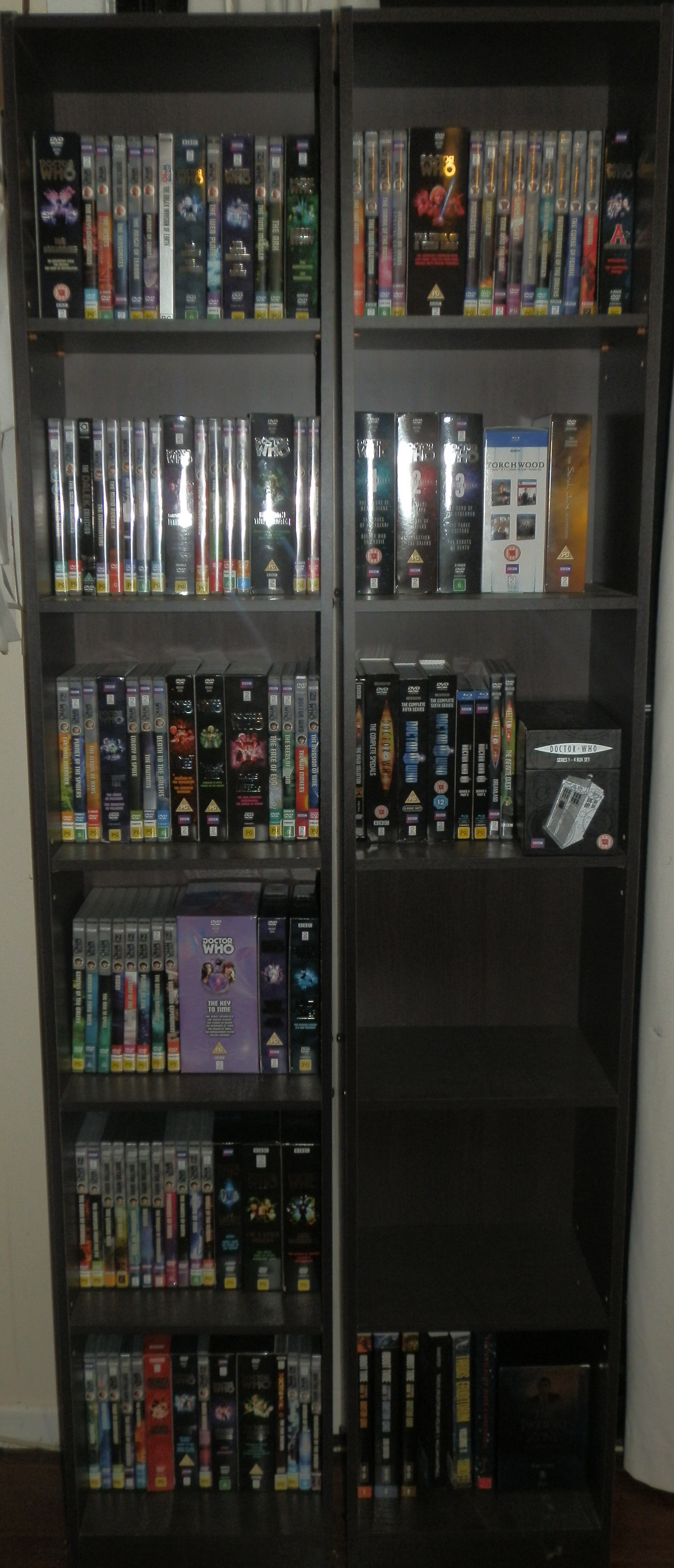
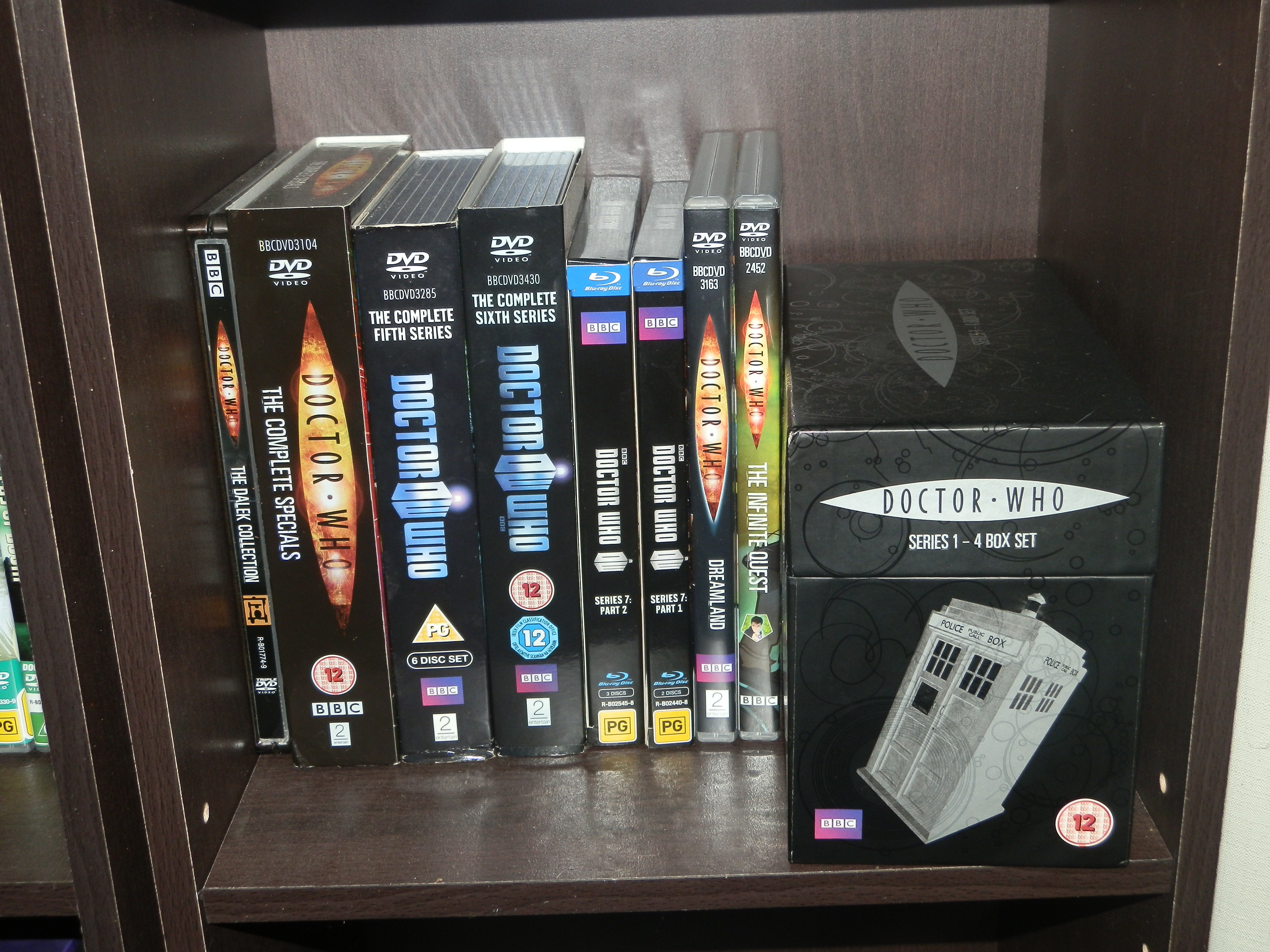
Classic Series Revisitations Box Sets, Torchwoodand Sarah Jane Adventures
9. ACQUAINT YOURSELF WITH THE CONTENTS OF BOXED SETS
Probably around 10% of Classic Series titles have been released as part of a box set. Find out what serials are included in each box set as generally you can’t search by story title for those serials contained in a box set. A complete list of DVD releases can be found here.
New Series Doctor Who
Although New Series DVDs are packaged as Series box sets, Classic Series DVDs are generally sold by single serial only. The only Classic Series Seasons released in a single box set are Season 16 (the Fourth Doctor and Romana I) The Key toTime,and Season 23 (the Sixth Doctor, Peri and Mel) The Trial of a Time Lord.This unfortunately means that Classic Series collecting can be an expensive past time and also takes up a great deal of shelf space.
The Key to Time is Season 16 of Doctor Who. It is one of only two Classic Series Seasons released as a box set
The Trial of a Time Lord is Season 23 of Doctor Who
The most inexpensive (and shelf efficient) way of buying Series 1 through to 4 of Doctor Who (2005-2008) is by the Complete Box Set. Purchased from the UK this Box Set costs around $70.00
10. DISPLAY YOUR COLLECTION WITH PRIDE
Once you’ve finished your collection display it with pride and sit back and enjoy watching 50 years of DoctorWhohistory. You’re in for a great ride!
Mark Campbell’s Doctor Who The Complete Series Guide provides a good introductory summary of each Doctor Who serial. This book has been of invaluable assistance to me in building my complete collection of Doctor Who DVDs
I’ve posted several UK based online retailers with free or low cost world-wide delivery here.
DISCLAIMER: The information provided in this article is of a general nature only and the author does not purport to be an expert in the sale or operation of DVDs or DVD players. The information is made available on the understanding that the author is not engaged in rendering professional advice. Buyers of DVDs and DVD players should make their own inquiries in respect of compatibility issues.
As the months countdown to Doctor Who’s 50th Anniversary on 23 November 2013, so the rumour mill concerning lost Doctor Who episodes escalates exponentially. To the best of fans’ knowledge 106 episodes remain missing from the BBC Archives, however the blog site Bleeding Cool has today reported two new rumours. One unnamed person associated with the Doctor Who production team is said to believe that there have been at least 40 episodes returned to the BBC, whilst another alleges 93. These rumours can be added to the pile which also includes claims that 90 episodes have been discovered somewhere in Africa. Dubbed the omnirumour (or omnirumor for those in America), the Africa 90 story has been circling for months and has set Who internet forums alight.
The 12 part Daleks’ Master Plan is one of the most sought after missing Doctor Who serials
Unfortunately absolutely no evidence has been forthcoming of any finds, not even one single screen capture. Hearsay is the sole testimony offered, with information only forthcoming from friends of friends. There has been talk of the BBC having compelled the signing of non disclosure agreements, delicate negotiations with film collectors and/or dictators, and all manner of other theories to justify the complete absence of evidence. The BBC has issued at least one statement denying that it has lost episodes in its possession, however the rather ambiguous nature of the statement did little to stem the flow of rumours.
The first Doctor Who regeneration (although it was not so named at the time) is among the 106 missing episodes
Having watched 11 straight missing episode reconstructions in the last several days, and with another two tomorrow before a one episode breather (episode three of The Underwater Menace), there’s not much more that I’d love than for a hoard of missing episodes to turn up. I won’t be holding my breath, however. Here’s hoping, though, that one day the hardened Doctor Who marathon viewers will be watching a lot fewer of the brilliant Loose Cannon Reconstructions.
The triple DVD Lost in Time contains many orphan Doctor Who episodes from the First and Second Doctor’s tenures
In terms of seasons, I’m now an eleventh of the way through my Doctor Who marathon – three seasons down and only 30 to go! William Hartnell has only two serials remaining as the Doctor, The Savages and The Tenth Planet, before Who’s first ever regeneration. I look forward to continuing my marathon with the Second Doctor, Patrick Troughton, even though every serial in Season 4 is incomplete. Thank goodness for Loose Cannon’s superb reconstructions and the orphan episodes on Lost in Time. Please join me for Season 4, as my journey through Doctor Who continues.
The War Machines ushers in not only the end of Doctor Who’s third season, but also the hasty, and unceremonious, exit of perhaps the most derided of all the Doctor’s companions, Dodo. Having lost Steven only the previous week, when he decamped at the Doctor’s bidding to mediate a new world for the Savages and the Elders in The Savages, it looked for all of a minute that the Doctor might again be companion less. Although the Doctor’s ignorance seemingly lasted seven days until the next serial, The Smugglers, the audience well knew that Ben and Polly were new members of the Tardis Crew. The cycle of companions continued, but more of that later.
Dodo disembarks from the Tardis for the last time. The Doctor hangs an “Out of Order” sign on the Tardis lest it is mistaken for a real Police Box
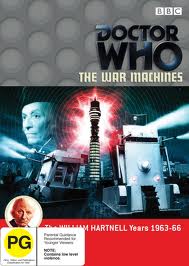
The last of the First Doctor’s serials which is 100 percent complete, The War Machines, plays upon the increasing fear of the mid 1960s that computers would usurp humans. This was an era almost ten years before the introduction of the first personal computers and 15 years before the release of IBM’s first PC and Microsoft’s MS-DOS computer operating system in 1981. Although personal computers had made inroads into the business markets by the late 1980s (Microsoft Windows was released in 1985) it was not until the mid 1990s that home PCs became more affordable and popular. After borrowing friends’ unwieldy home-made computers to write my BA (Hons) thesis in mid 1980s, it was not until 1990 that I bought my first PC. A clone of the IBM XT, it had a mammoth 128 KB of RAM and a 5¼ inch floppy drive! An early adaptor of computer technology, the wonders of this piece of computer history came at an outrageous price of around $3,000.00.
An IBM XT. My first computer was a clone of this machine
At the time of The War Machines’ transmission, it was unlikely that more than a handful of viewers would have ever personally seen a computer. Computers were massive objects that frequently were the size of a room. Perhaps seen in educational documentaries or on science fiction shows, computers were a great unknown. The playthings of mad scientists and eccentric geniuses, the distance between computers and the general public was such that they were greatly shrouded with mystique. I went through the whole of my schooling in the 1970s without ever seeing a computer, and entered the “real world” under a misapprehension, that was most probably quite commonly shared, that computers were only the domain of mathematical geniuses.
Anyone thinking of computers in the 1960s would probably envisage a machine such as this – The Whirlpool Computer which was designed for strategic air defence applications. Photo courtesy of http://www.clavius.org/techcomp.html
Is it any wonder, therefore, that the ordinary Joe or Joy Bloggs might find a Doctor Who story set in present day London in 1966, about a computer intent on human domination, an altogether feasible possibility. Although plainly science fiction, there was a kernel of fear and mistrust among many that this may one day become science fact. Watching Classic Series Doctor Who with an eye to history exhibits time and again that science fiction sometimes does become reality. In Who’s first episode, An Unearthly Child, Susan predicts the UK’s conversion to decimal currency eight years prior to its eventual introduction in February 1971. “Spooky”, you might think, however The Time Machinesdid it again in mid 1966 when it foreshadowed the internet.
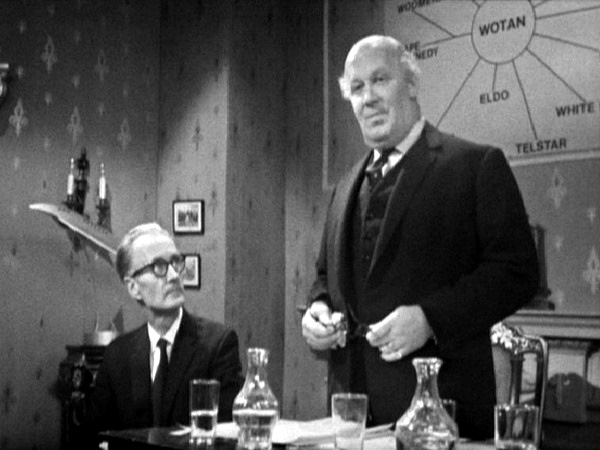
WOTAN, an acronym for Will Operated Thought ANalogue, is the most advanced computer in the world, although not necessarily the largest. It’s advanced technological capacities were a perfect companion for the building in which it was housed, the new Post Office Tower. Officially opened on the 15th July 1966 by the British Prime Minister, Harold Wilson, the Post Office Tower was the tallest building in London. Towering 177 metres from the ground (581 feet), it held that title until 1980. “C Day”, or Computer Day was set for 16th July 1966, the day after the Post Office Tower’s official opening. On that date all computers throughout the world were to be linked together under WOTAN’s (pronounced Votan) central control. The various sites to which WOTAN would be connected included the White House, Cape Kennedy, ELDO, TESTAR, RN, Woomera and EFTA.
Although not the world’s largest computer, WOTAN in the most intelligent
A media conference is held to outline WOTAN’s roll out. A graphic is displayed showing the computers which will be linked to WOTAN
TELSTAR was the name of various telecommunications satellites which were launched in the early 1960s. They provided the first transatlantic satellite television and telephone communications. So heralded was the launch of the first TELSTAR in 1962 that an instrumental tune by the British band The Tornados became the first number one hit in the United States for a UK band. Below, for your listening pleasure, is the Tornados with Telstar. ELDO was an acronym for the European Launcher Development Organisation (now the European Space Agency). RN is presumably the British Royal Navy, EFTA is the European Free Trade Association (formed in 1960), and Woomera is a weapons testing range in South Australia. Between 1946 and 1980 it was location for joint British and Australian weapons testing. The White House and Cape Kennedy require no explanation.
The Tornados – Telstar
The “C Day” linking of the world’s major computers foreshadowed the ARPANET, the first packet switching, in 1969. The Advanced Research Agencies Network (ARPANET) linked four university research centres together in the United States. The World Wide Web as we know it now, did not reach fruition until the early 1990s. It could perhaps be rightly claimed that this serial of Doctor Who was the first television show to predict the emergence of the web. Until I amended Wikipedia, a 1985 episode of Benson claimed to be the first such reference 🙂
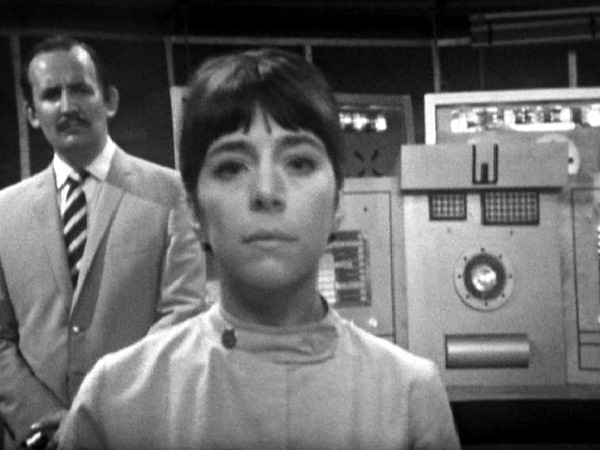
Professor Brett – the inventor of WOTAN. The super-computer was to link all the leading computers in the world together
Although the staff designated with WOTAN’s installation and roll-out were quick to dispel fears that the super-computer may eventually become destructive, it does not take long for the malignant nature of WOTAN to become evident. WOTAN can speak and is receptive to voice commands, although ordinarily its answers are printed on a dot matrix type printer. Computer monitors had clearly not been envisaged. More intelligent than humans, WOTAN knows the answer to all questions, including inexplicably, what TARDIS is an acronym for. WOTAN, however, has a hidden agenda. it believes that the world cannot possibly progress with humans at its helm and seeks to usurp them by mobile computer killing machines – the War Machines.
WOTAN has a secret agenda to usurp human control with its clumsy creations, the War Machines
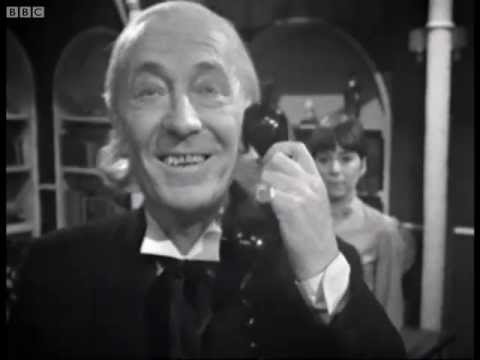
WOTAN uses mind control through the emission of sonic sounds and the humble telephone, to hypnotise humans into its sinister plan. Dodo is amongst its first victims and is instructed to co-opt the Doctor. As luck would have it, his non-human form affords him protection from hypnosis, but not without him suffering physically nonetheless. The Doctor’s magic ring again comes to the rescue as he is able to put Dodo to sleep, and snap her out of her hypnotic trance, merely by waving his hand before her face five times. Upon waking Dodo is dispatched to the country to recuperate and never again seen. Her subsequent decision to remain in London is communicated to the Doctor via a message from the companions-in-waiting, Ben and Polly. A more pathetic companion departure had never been seen.
Dodo is hypnotised by WOTAN
Hypnosis via the humble telephone is attempted on the Doctor. The already submissive Dodo looks on
WOTAN has its staff of hypnotised human slaves building a dozen War Machines in a disused warehouse in Covent Garden. Professor Brett, the computer scientist who invented WOTAN, is quickly a victim of WOTAN’s hypnosis, and dispatched to the warehouse to oversee construction. Polly, Brett’s secretary, also comes under WOTAN’s spell and is rescued by the Cockney sailor, Ben, who was sent on a mission by the Doctor to investigate. These War Machines were mobile computers but not in a form that we have today. Extraordinarily large, they were more like wartime tanks than the laptops, net books and tablets that we know today. Programmed by WOTAN, the War Machines are able to disable the firing mechanisms of Army guns and ammunition, and as such are seemingly unstoppable. In an Army raid of the warehouse, the single operational War Machine is able to effect the deaths of many personnel. On a rampage through the streets of Covent Garden, the War Machine is eventually outwitted by the Doctor’s cunning. After the stupendous cliff hanger of episode three where the Doctor comes face to face with the War Machine and stares it down, he eventually stops the machine in its tracks by setting up an electromagnetic field around it. An adept computer programmer, as he is of all manner of things scientific, the Doctor is able to reprogramme the War Machine. The machine is then sent on a mission to the Post Office Tower where it is able to reach the top floor, where WOTAN is housed, and destroy it. Commentators frequently joke about how the War Machine was able to fit in the lift, let alone press the floor buttons!
WOTAN’s slave labour force construct War Machines
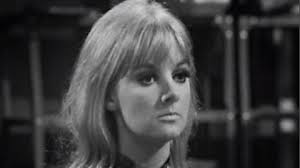
Polly, Professor Brett’s secretary, is hypnotised by WOTAN
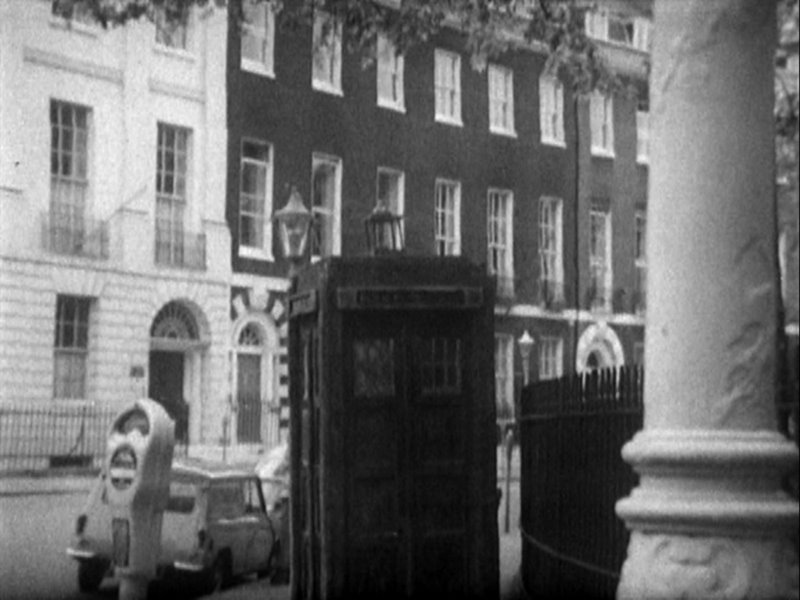
Save for the first episode of An Unearthly Child, in which you only see Coal Hill School and 76, Totter’s Lane, and Planet of Giants, where the Tardis Crew are miniaturized in a suburban back yard and house, this is the first time Doctor Who has been set in modern day London. It affords the opportunity for many shots of 1966 London and naturally, the most innovative building of the day, the Post Office Tower. There are a number of very interesting special features on the DVD including Now and Then, a look at the locations used in the making of the story in which those used in 1966 are compared with the present day; Blue Peter, which includes a compilation of segments on the War Machines, and One Foot in the Past, in which the Politician and ex-Postmaster General Tony Benn investigates the history of the Post Office Tower. It’s all fascinating stuff.
The Doctor stops the War Machine by creating an electro magnetic field around it
The War Machines has shots a-plenty of London in 1966
Perhaps the most visually memorable part of The War Machines is when the Doctor enters the Inferno nightclub via a flight of stairs. Resplendent in his cape, he enters the “hottest” night club in London, only to be told by one of the hipsters that his gear looked “fab”. It was not many episodes earlier that the Doctor had severely reprimanded Dodo for the use of the word “fab” and questioned if she could speak English properly. Times were a-changing for Doctor Who and this was even more evident by the new companions. Polly is a young London secretary who dresses in trendy clothes and is phenomenally forthright. Ben is a Cockney merchant sailor who breaks the hitherto unwritten rule that all major cast members of Doctor Who must speak in “BBC English” or Received Pronunciation. It was but a mere three months earlier that Dodo’s Manchurian accent lasted but 10 minutes. For the rest of Dodo’s tenure as a companion her accent changed from episode to episode and became increasingly more posh. As groundbreaking as it was to have a companion without an RP accent, it took until the Seventh Doctor’s incarnation in 1987 for the Doctor to have his first regional accent.
Ben and Polly in “The Inferno”, the hottest nightclub in London
The Doctor, in that amazing cape, stares down the War Machine in the episode 3 cliff hanger
Join me for my next review where you’ll encounter the predecessor to 2011’s The Curse of the Black Spot, The Smugglers, in which every conceivable pirate cliché is presented before us. It’s sure to be fun!
The Doctor is about to have two new companions. Dodo and Ben meet the Doctor to pass on a message from the departing Dodo
The War Machines was originally broadcast in the UK between 25th June and 16th July 1966
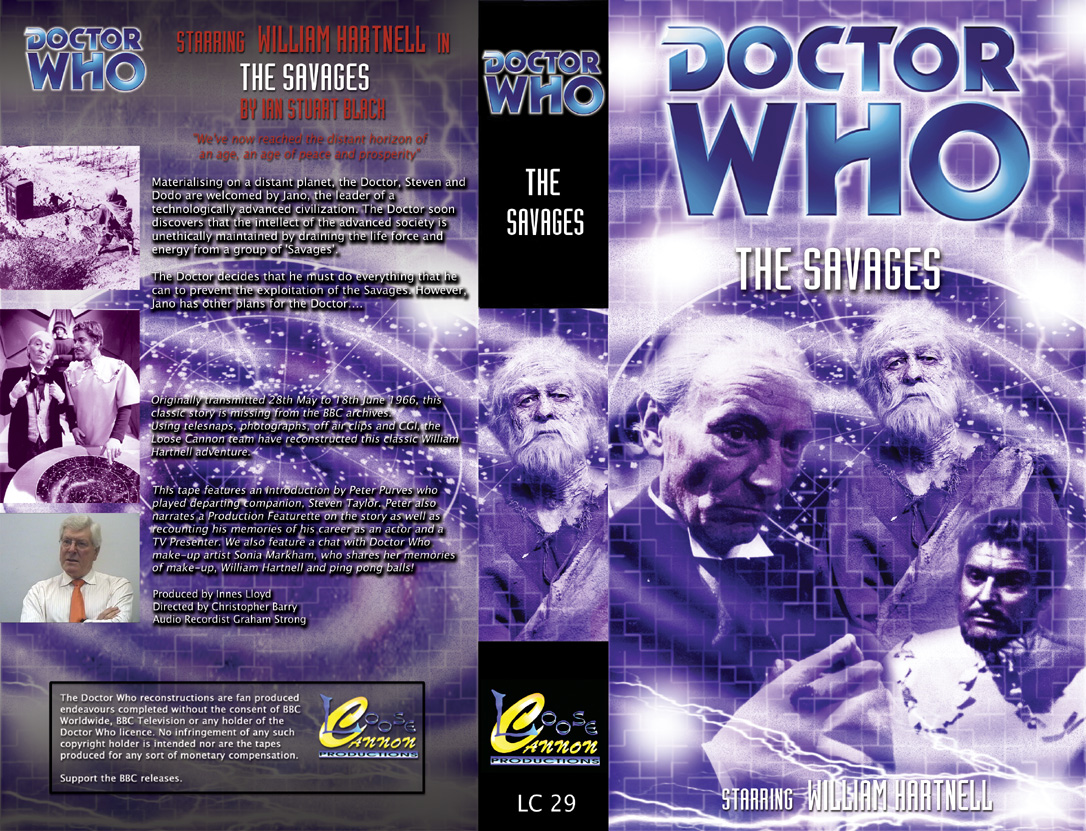
All four episodes of The Savages are missing from the BBC Archives. For the purposes of this marathon I viewed Loose Cannon’s reconstructions, the links for which are below.
































 The Doctor Who Mind Robber