After whipping up excitement with a press release headed Trailer, Stings and Other Things … the BBC produced a damp squid when they released two short previews preceding and following Saturday’s episode of Atlantis. The previews, of a mere five and ten second duration, feature no scenes, photographs or dialogue from the 50th Anniversary Special, The Day of the Doctor. Instead viewers simply learnt that the phenomenally unimaginative hashtag #SaveTheDay would be used to promote the Anniversary Special. The hashtag is now trending, but principally with exclamations of disappointment. Let’s hope that the promised trailer is more enticing.
Meanwhile, my day has been saved by finding this rather cool photo of the five surviving Classic Series Doctors. Perhaps the official 50th Anniversary audio adventure, The Light at the End, will be more exciting than The Day of the Doctor.
The five surviving Classic Series Doctors. From left to right, Colin Baker (6th), Sylvester McCoy (7th), Tom Baker (4th), Paul McGann (8th) and Peter Davison (5th)
You can view a more imaginative BBC Doctor Whoident here.
In the BBC’s continued drip feeding of The Day of the Doctordetails, a photograph was today released from behind the scenes of the 50th Anniversary Special. Together with several Dalek bottoms, it also appears to feature at least one damaged Dalek. Could this perhaps hint at the Time War?
The BBC has also revealed that the Twitter hashtag for the Day of the Doctor,and ‘stings’ that will reveal the ident for the Special, will be unveiled on BBC One this evening. I have to admit to not knowing what an ident or a sting were prior to reading the BBC’s press release. I’m not a great deal wiser now, however I believe that an ident is the Station Identification (the branding of the station) and a sting is a brief glimpse of what’s forthcoming. If anyone can enlighten me further it would be greatly appreciated.
In the meantime, here’s the BBC One 2009 Christmas Ident featuring the Tenth Doctor, David Tennant. You learn something every day!
The Doctor had long shown himself to be adept at time travel, however it was not until the 1969 serial The Seeds of Death that he was seen to man a more conventional form of space transportation, a rocket. That the Doctor and his friends should find themselves on a rocket to the Moon should come as no surprise given that this serial was broadcast in early 1969 and the Apollo 11 landed the first humans on the Moon on 20 July 1969. What is more astounding is that in the world of Doctor Who rockets are perceived to be outdated and an anachronism. In The Seeds of Death Professor Eldred is the curator of a space museum who spends his spare time secretly working on a rocket. All transportation is now carried out by T-Mat, otherwise known as transmit, a form of instantaneous particle matter transfer. Even motor cars have become redundant and the T-Mat system is used to transport people and produce throughout the world. There is a T-Mat relay on the Moon and it is from there that the Ice Warriors intend to commence their conquest of the Earth.
Jamie, the Doctor and Zoe arrive on Earth following their adventures with The Krotons
The Doctor is covered in foam as he attempts to gain entry to the Weather Station
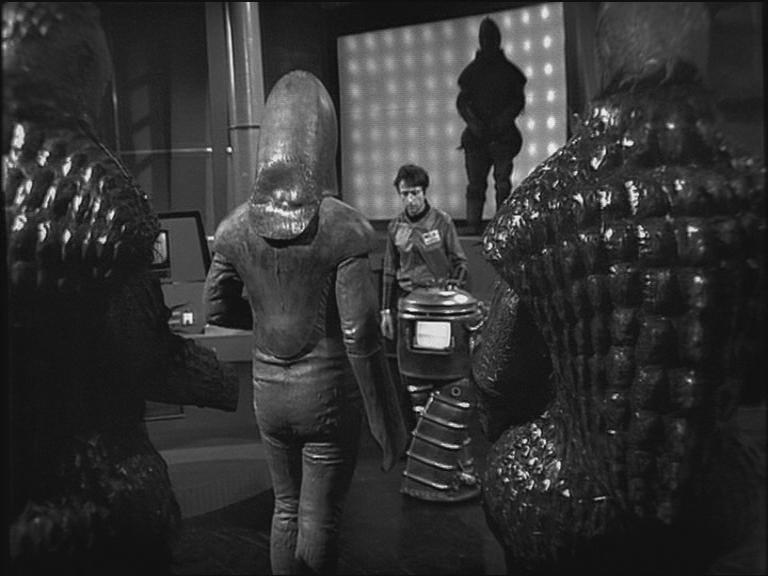
That there is no alternative transport to T-Mat is extraordinary, particularly as the sustenance of the whole world is dependent upon its operation. This extreme example of “putting all your eggs in one basket” was what led the Doctor and his companions to risk their lives in an untested experimental rocket. It appears that together with world famine, local stock-piling of goods has long since ended. Although the details provided in The Seeds of Death are sketchy, it appears that the T-Mat system is operated, if not wholly owned, by a corporation named Travel-Mat. What Travel-Mat’s relationship is to the governments of the world is not specified. Perhaps Travel-Mat is the world government? Travel-Mat certainly has some relationship with the United Nations as Professor Eldred describes Sir James Gregson as the United Nations Plenipotentiary. Radnor clarifies this by saying that Gregson is the Minister with special responsibility for T-Mat. I suspect that the climate change sceptics with whom I frequently debate would revel in declaring The Seeds of Death to be an accurate prediction of their New World Order conspiracies. Come to think of it, most climate change deniers know so little about science that they’d probably think the mistaken “science” of The Ice Warriors is correct. Distinguishing fact from fiction can at times be difficult for some, hence the premise behind The Mind Robber!
T-Mat employees wear an unfortunate uniform with their underpants on the outside
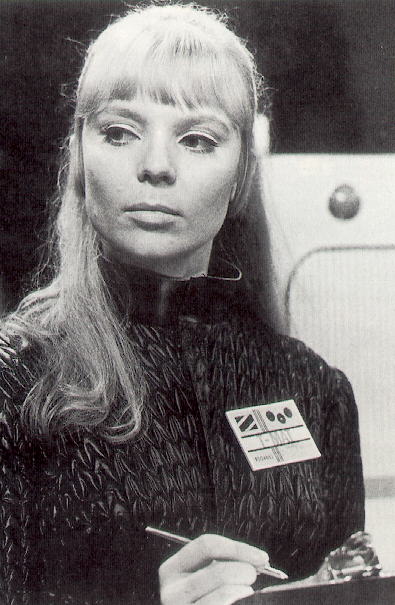
Arguably the most powerful person employed by Travel-Mat is Miss Gia Kelly, the Assistant Controller, who inexplicably is the only person who completely understands T-Mat. Again the question arises as to what would happen to this world-wide transport system, on which the distribution of all Earth’s food is dependent, if Miss Kelly suddenly became indisposed. It’s a pleasant development in Doctor Who to have a women in such a powerful role and not be denigrated for her gender by fellow on-screen workers. Kelly even managed to escape the sexism inherent in the UNIT soldiers’ praise for Zoe in The Invasion, when they said that she was “prettier than a computer”. That being said, I’m at a loss to understand why Kelly was portrayed as so officious and unable to smile. What does this say about our perceptions of powerful women? Do women that attain the giddy heights of success necessarily relinquish all vestiges of humanity in the minds of others? Even a casual observer to Australian politics in recent years would be cognisant of sexist vitriol thrown at our former Prime Minister, Julia Gillard. Being “deliberately barren” was perhaps the most offensive of them all. I would posit that the writer Brian Hayles’ portrayal of Kelly is an example of this offensive stereotyping of successful women.
Miss Kelly is the only person who truly understands T-Mat. She is pictured here with the rocket countdown reflected onto her face
Gia Kelly is arguably the most powerful person working for Travel-Mat
Unfortunately I have a concern with the Doctor’s ethics in The Seeds of Death. At the serial’s end the Doctor sent the Ice Warriors’ rockets onto an orbit close to the Sun by transmitting a fake homing signal. When the Warrior Slaar told the Doctor that he has destroyed their whole fleet, the Doctor’s response was that “you tried to destroy an entire world”. Given that the Doctor believed these Warriors to be the only survivors of their species, he was effectively committing genocide. Whilst we all now know that the fleet didn’t comprise the last of the Ice Warriors, that’s not the point. The Doctor acted in a similar manner to the Daleks in The Evil of the Daleks and to the Drahvins in Galaxy 4. In my review of Galaxy 4I discussed in some detail how the Doctor’s apparent genocide of a race was at odds with his classic moral deliberations in The Genesis of the Daleks.
The Doctor kills the first of many Ice Warriors
Akin to Brian Hayles’ problems with science in The Ice Warriors, The Seeds of Death is similarly tainted. Remarkably, whilst the Ice Warriors collapsed when the temperate reached 60 degrees Celsius, the humans exhibited no ill effects at all. Not a bead of sweat was seen to develop on a single brow. This story did, however, again exhibit Hayles’ apparent concern for things environmental. The plant consuming foam which emerged from the Ice Warrior’s seeds would eventually result in the removal of all oxygen and the death of humans as the atmosphere became more akin to that of Mars.
The Doctor discovers that water destroys the Ice Warriors’ seeds
Technology had also caught up with Doctor Who by the Ice Warrior’s second appearance. Filmed inserts for episodes were by then being produced during the recording of the previous stories. Because of the 1968/1969 Christmas/New Year break, some inserts were filmed up to six weeks prior to the recording of the episodes. It’s for that reason that careful observation will show that within the same episode the Doctor can at one point have particularly bushy side-burns, and the next moment has none.
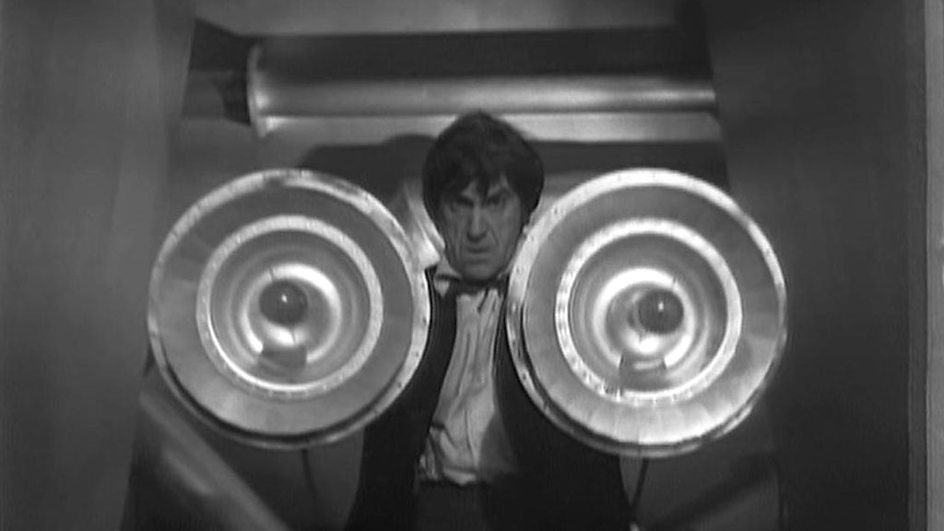
The Doctor discusses retro rockets with Professor Eldred
When Jamie suggested that the Doctor should use the TARDIS to travel back to the Moon the Doctor was quick to advise that “the TARDIS is not suited to short range travel”. It’s a shame that the Eleventh Doctor didn’t remember that when he decided to take the TARDIS for a quick hop to the Moon to run her in during The Eleventh Hour (2010). He didn’t come back to Amy until two years later! The Doctor also seemed to have forgotten exactly how much of an unpleasant time he’d had when last he visited a space museum (The Space Museum). Quite naturally Zoe knows how to pilot a rocket so she necessarily went up in my esteem, yet again. She also has a photographic memory.
Clearly the Eleventh Doctor had forgotten that the TARDIS was not suited to short range travel in The Eleventh Hour (2010)
Amongst her many skills, Zoe can pilot a space rocket
With the conclusion of The Seeds of Death we say goodbye to the last monster story of Patrick Troughton’s tenure. Not only is it the final monster serial of the 1960s but also of Doctor Who’s monochrome era. Troughton’s penultimate adventure, The Space Pirates, has no aliens although it does have a space cowboy who is almost as bad, in a frightening sort of way!
The Seeds of Death was originally broadcast in the UK between 25 January and 1 March 1969
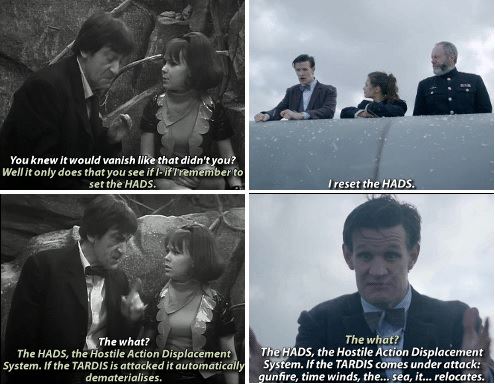
The second part of Series 7 of Doctor Who, which is also referred to as Series 7B, has been said by some to be a “love letter” to Classic Doctor Who. Resplendent with obscure references to Who’s 50 year history, the Eleventh Doctor’s final complete season also contained “shout outs” to the Second Doctor’s tenure. Together with the re-appearance of the Great Intelligence after a 44 year absence and the Ice Warriors following a 39 year hiatus, Series 7 also made reference to the mysterious HADS, the Hostile Action Displacement System. In the same episode that heralded the Ice Warrior’s return, the TARDIS dematerialized from a sinking submarine in the South Pole to the North Pole (Cold War). When functioning correctly the HADS dematerializes the TARDIS to a close-by location when it is under external attack. It needs to be manually set, however, and the Doctor usually forgets to set it. The first and only on-screen reference to HADS prior to Cold War was in the 1968-1969 serial, The Krotons. In that instance the TARDIS relocated several metres up a hill after being attacked by Krotons.
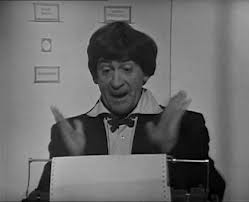
That a story as humble and lowly regarded as The Krotons should be alluded to more than four decades later is a testament to the high regard in which the Patrick Troughton era is generally held. Even “bad” Troughton stories have their redeeming features, not least of which is the very presence of the Second Doctor himself. Troughton has some charming scenes in this story including his classic encounter with the Kroton’s intelligence testing machine. As seen in the clip below, the Doctor decides to take the test after Zoe accidently completes it and receives a score twice as high as the Gonds’ previous best students. “Zo-Gond” (Zoe) is chosen to be a Companion of the Krotons and the Doctor won’t allow her to enter the Kroton’s Ship, the Dynatrope, alone. Easily flustered, the Doctor has difficulties at the commencement of the test which precipitates a wonderful banter between the pair. After assisting the Doctor to put on his headset and press the correct button, the Doctor barks at Zoe, “All right, there’s no need to shout! Now go away and don’t fuss me. No, come back. What’s this? It’s all right, I know. Right, fire away, I’m ready”.
Great Jumping Gobstoppers, The Krotons.
“Oh, my giddy aunt” is one of the better known Second Doctor’s expressions, however it’s in The Krotons that it makes its debut – less than six months before the end of Troughton’s tenure. As shown in the video posted, “great jumping gobstoppers” is also a lovely Troughtonism.
The Doctor and Zoe are approached by a Kroton
Zoe’s extraordinarily high intelligence is remarked upon several times in The Krotons. She tells Selris that the “Doctor’s almost as clever as I am” whilst earlier the Doctor had said to him, “Yes, well, Zoe is something of a genius. Of course it can be very irritating at times”. The Doctor, however, is never seriously concerned by Zoe’s brilliance. There’s no sense of threat and never a suggestion that her intellect is unbecoming of a young woman. Similarly, the Doctor is not dismissive of Jamie, notwithstanding his apparent dimness. What Jamie lacks in schooling and cultivation he more than compensates for in gut instinct and cunning. The Doctor is equally as accepting of both his companions.
The Doctor is almost as clever as Zoe
Zoe helps the Doctor take the Krotons’ test
I have little doubt that if I’d watched Zoe as an impressionable young girl then she’d have been my heroine. Able to complete any mathematical task better than a male and even the Doctor on occasion, Zoe had intellect in abundance and was gorgeous to boot. If I was 6” shorter, numerous kilos lighter and a few decades younger, playing Zoe would be my ultimate Cosplay ambition! The Third Doctor’s first companion, Liz Shaw, continued and expanded upon Zoe’s keen intellect and abilities, although her tenure was regrettably cut short. I will extrapolate upon this when Season Seven in reached.
The delightful Wendy Padbury as Zoe Heriot
The moral that I took from The Krotons were the dangers of indoctrination and limitations to free scientific enquiry. The Gonds had been in a state of self-perpetuating slavery to the Krotons for thousands of years. They were educated by machines created by the Krotons and forbidden to study chemistry. As the Doctor noted, there were tremendous gaps in the Gonds’ knowledge. He asked why the Gonds had never thought to question why the prohibition on chemistry existed. That people would be educated by machines in the future was a prediction considered several times in 1960’s Doctor Who. The First Doctor’s companion Vicki, an orphan from the 25th Century, had been educated for only one hour a week on machines and considered the History teacher Barbara’s 1963 curriculum to be infantile. The manner of Zoe’s education is unclear, however as a product of City’s Educational institution she, like the Krotons, had enormous gaps in her knowledge. Whilst able to undertake mental calculations in a second, she was bereft of social skills.
The Gonds have been in self perpetuating slavery to the Krotons for thousands of years
The 1960’s fear of educational indoctrination would most certainly have had its genesis in the Nazi’s brainwashing of the German people. Technophobia is also likely to have been influential. Distain for computers was evident in The War Machines and The Invasion. Inthe latter the Doctor loudly proclaimed his hatred for computers on several occasions. The Luddite-like smashing of the Kroton’s educational machines by a group of Gonds further evidences this fear of technology.
The growing awareness of South African apartheid, in which the minority whites enslaved the black population, could also have influenced Robert Holmes in the writing of this story. On the suggestion of Roy Skelton, he and Patrick Tull voiced the Krotons with a slightly South African inflection.
The Krotons spoke with South African accents
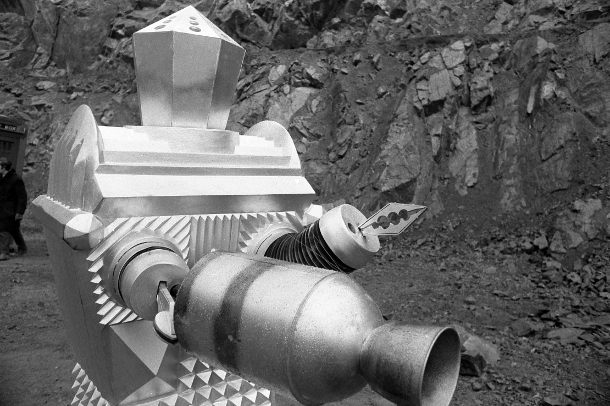
Yet another attempt at a Dalek replacement, the Krotons were a poor substitute. With arms that looked like the robot’s from Lost in Space, the Krotons were disabled by their strange and inflexible metal hands. Possessed of a rather cool spinning head, the poor Krotons were not so lucky with that part of their costume below the waist. A rubber skirt was merely tacked on to disguise the operators’ legs. The concept behind the Kroton’s creation was rather more interesting. Crystalline beings, the Krotons survive in their space-craft, the Dynatrope, in suspended animation in a form of slurry. To reconstitute themselves they must absorb sufficient mental energy. It is for this reason that every year they have taken the best two Gond students, drained them of their mental powers, and then killed them. Rather than exterminating them as the Daleks do, the Krotons “disperse” them in a process in which the victim in essence disintegrates.
The Krotons with Jamie
Join me for my next review when the Ice Warriors return in their second adventure, The Seeds of Death. Our time with Patrick Troughton is fast coming to an end.
The Krotons was originally broadcast in the UK between 28 December 1968 and 18 January 1969
Whilst browsing through YouTube I came upon this marvellous Radio Timescommercial. Can anyone enlighten me any further on it? Any ideas on what year it’s from?
Big Finishhas released a video publicising its 50th Anniversary Audio and the three editions available soon. Together with the Standard Edition CD, there is also a Limited Collector’s Edition CD and a Limited Vinyl Edition. The Vinyl Edition, which retails for a whopping AUS $171.20, includes four 180g vinyl records in deluxe premium packaging, a 30cm x 30cm lenticular image, four-way gatefold sleeve and rigid slipcase. Like all editions it also includes an MP3 download. The 120 minute audio adventure is on three LPs, whilst the fourth LP is a 40 minute documentary, The Making of the Light at the End.The Limited Vinyl Edition is limited and numbered to 500.
The Special Edition CD is a five CD collection. Discs one and two are the audio adventure, The Light at the End,Disc three is a 70 minute documentary, The Making of the Light at theEnd.Disc four is a 70 minute documentary, This is Doctor Who at Big Finish, whilst Disc five is Doctor Who – The Companion Chronicles: The Revenantsperformed by William Russell as Ian. Also included is a 32 page collectors edition book featuring a stunning array of photographs. The Special Edition CD is limited to 10,000 copies.
The Standard Edition CD includes the 2 CD audio adventure, The Light at the End,and an eight page booklet.
The Synopsis for The Light at the End,which was written and directed by Nicholas Briggs, is as follows:-
November 23rd 1963 proves to be a significant day in the lives of all eight Doctors…
It’s the day that Bob Dovie’s life is ripped apart…
It’s also a day that sets in motion a catastrophic chain of events which forces the first eight incarnations of the Doctor to fight for their very existence. As a mysterious, insidious chaos unfolds within the TARDIS, the barriers of time break apart…
From suburban England through war-torn alien landscapes and into a deadly, artificial dimension, all these Doctors and their companions must struggle against the power of an unfathomable, alien technology.
From the very beginning, it is clear that the Master is somehow involved. By the end, for the Doctors, there may only be darkness.
Due for release in November The Light at the End stars Tom Baker, Peter Davison, Colin Baker, Sylvester McCoy, Paul McGann (The Doctor), Louise Jameson (Leela), Sarah Sutton (Nyssa), Nicola Bryant (Peri),Sophie Aldred (Ace), India Fisher (Charley Pollard), Geoffrey Beevers (The Master) with special guest stars!
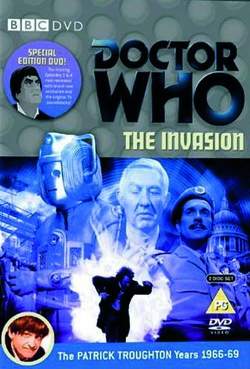
One of the greatest benefits of watching Doctor Who in chronological order is discovering hitherto unknown continuities. The Invasion was one of the first Patrick Troughton serials I watched. Simple incidents, like the Doctor and his crew deciding to drop in on their old friend Professor Travers, were lost on me. Had I watched The Abominable Snowmen, and its sequel The Web of Fear prior to my first viewing of The Invasion then the significance would have been obvious. Similarly, that The Invasion was to some extent a remake of The Web of Fear would have been reasonably self-evident. The apparent absence of story arcs in Classic Series Doctor Who, and the presumption that all serials are entirely self contained, makes casual viewing of stories a joy. Jumping between seasons and different Doctor’s tenures ensures the viewer of a diverse and eclectic range of material. The handicap, however, is the loss of character and series development.
This series’ monsters, The Cybermen
Defeated Cybermen
Seeing the evolution of characters that have been iconic is a real joy. The Invasion is the story which introduces UNIT, the United Nations Intelligence Taskforce, to the world of Doctor Who. It is not, however, our first introduction to Alistair Gordon Lethbridge-Stewart. Our first encounter with the then Colonel was in The Web of Fear where Lethbridge-Stewart was a suspicious unknown entity. Arriving in the embattled London Tube, as if out of nowhere, the Colonel could well have been the feared Yeti collaborator. A relationship of trust took some time to develop. A camaraderie from a past battle fought was evident when the Doctor and Jamie again met the promoted Brigadier in The Invasion. It was four years since their last meeting, the Brigadier noted. The character with which we become so familiar during the tenure of Jon Pertwee’s Doctor is not yet fully formed, though. It will be some time before we encounter “classic” Brig moments like the eye-patched alter ego of Inferno or the “Chap with wings, there. Five rounds rabid” of The Daemons. Although often experiencing difficulties with women, Lethbridge-Stewart was particularly Neanderthal in The Invasion, an issue that I will address when discussing the character of Isobel Watkins.
The Brigadier proudly informs the Doctor and Jamie that he’s been promoted since last they met
It’s not often that I disagree with anything that Rob Shearman or Toby Hadoke say in their excellent marathon watch diary, Running Through Corridors. It’s with Shearman, however , that I have issue with concerning the portrayal of Isobel Watkins who was played by Sally Faulkner. Isobel is the niece of Professor Watkins, a professor of computer engineering and friend of the Professor Travers previously referred to. Travers had decamped to the United States, letting his home to Watkins and Isobel during his absence. In his discussion of episode two I believe that Shearman is unfairly critical of the character. He describes her variously as “a talentless pseud”, “friendless”, and a “selfish, utterly insane cow”. Shearman doesn’t end there. He’d sooner have lunch with the psychopath Tobias Vaughn than Isobel who is the “sort of social misfit that will try to muscle her way into other people’s jokes”. Shearman is then extraordinarily critical of Isobel’s feminist defence to Lethbridge-Stewart in episode five. In his defence, Shearman believes that Isobel is a caricatured feminist, badly written by a male, who is made to look like an idiot. That’s not how I see Isobel who is not unlike the former companion Polly. A little akin to my squeals of delight at Maaga’s comments about men in Galaxy 4 (see my review for details), Isobel’s defence of women was one of those rare “stand up and cheer” moments. It’s worth extracting it in full here.
Rob Shearman and Toby Hadoke, Running Through Corridors
Isobel takes shots of Zoe
BRIGADIER: And how do I prove that in the sewers of London there are creatures from outer space waiting to attack us. Go and get one?
ZOE: You wouldn’t stand a chance against them, Isobel.
ISOBEL: Ah, you wouldn’t have to go anywhere near them. Photograph them.
BRIGADIER: That’s not a bad idea. Now, wait a minute, it’d be pitch dark down in those tunnels.
ISOBEL: You could use an infrared film, a twenty five filter on a thirty five mil camera with a telephoto lens, and why, you could take frame after frame without getting anywhere near them.
BRIGADIER: Is that all gibberish or do you really know what you’re talking about?
ISOBEL: Of course I know.
BRIGADIER: If you’re right, it could well be the sort of proof I need to get some action.
ISOBEL: Well, all I need is my cameras from the house and then I’m all set.
BRIGADIER: Well, you’re a young woman. This is a job for my men.
ISOBEL: Well, of all the bigoted, anti-feminist, cretinous remarks.
BRIGADIER: This is no job for a girl like you. Now that’s final.
ISOBEL: Oh, you, you, you man!
BRIGADIER: I’ll get in touch with my photographic unit and get them onto it.
ISOBEL: Oh, that stupid bigoted idiotic.
Isobel and Zoe in colour
Isobel descends into the sewers to take photos of the Cybermen
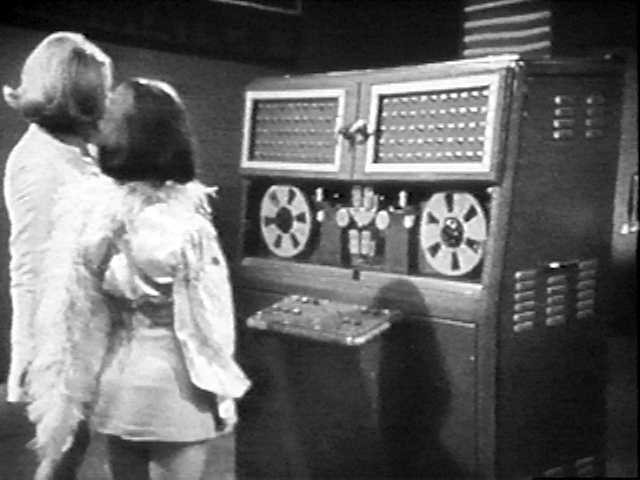
Zoe, who then stood up to Jamie when he expressed agreement with the Brig, was also afforded the opportunity in the serial to combat sexist assumptions. To Jamie she said, “Just because you’re a man you think you’re superior, don’t you?” To the automated answering machine at International Electromatics she gave an ALGOL problem which, being unable to be answered made the machine blow up. Zoe finally calculated complex missile trajectories in her head which facilitated the programming of the Russian missiles and the destruction of the Cybermen’s mother ship. The UNIT soldiers thought that she could be kept on as she’s “much prettier than a computer”. Who dared say that girls know nothing about computers and maths!
Zoe takes great delight in blowing up an automated answering machine
The Doctor and Jamie have some wonderful physical comedy moments in The Invasion. A fast walk away from the mysterious UNIT undercover agents quickly turns into a run. When eventually they’re cornered in a lane, with a wry smile the Doctor sits down in the gutter and produces a pack of cards which he shuffles whilst awaiting their imminent capture. Jamie gets in the rear driver’s side door of a Jaguar, slides across to the passenger side door, disembarks and then hops in the front passenger seat. The Doctor does some wonderfully comic running and jumping whilst evading bullets and grenades on two occasions. All of these are done silently and are just superb.
The Doctor protects his hearing as he runs from a Cyberman
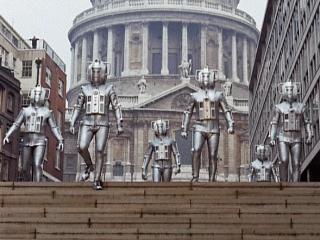
The Invasion has arguably the most iconic of all Doctor Who images, the Cybermen emerging from the sewers and descending, on mass, the steps of St Paul’s Cathedral. The phenomenal cliff hanger to episode six has rightly taken its place in history. The only cliff hanger to compare, in my humble opinion, is the Dalek emerging from the polluted waters of the River Thames in episode one of The Dalek Invasion of Earth.
Perhaps the most iconic cliff hanger in classic series Doctor Who. The Cybermen on the steps of St Paul’s Cathedral
There are parallels between the Series Two episodes, Rise of the Cybermen and The Age of Steel, and this 1968 Cybermen tale. The name given to the Cybus Industries front company which collects the homeless for upgrading, International Electromatics, is identical to Tobias Vaughn’s conglomerate in The Invasion. Humans are controlled by Ear Pods in the first 21st Century Cybermen tale, whilst in 1968 it was a microchip in IE produced electronics goods, such as disposable transistor radios, that put humans into a deep sleep.
In the 2006 episodes, Rise of the Cybermen and The Age of Steel, the Cybermen controlled humans through Ear Pods. Pictured here are Rose Tyler’s parents, Jackie and Pete
Director Douglas Camfield made a gifted choice in casting Kevin Stoney as the partly cyber converted head of International Electromatics, Tobias Vaughn. Stoney, as you may recall, portrayed Mavic Chen in the Season Three epic, The Daleks’ Master Plan. The characters of Chen and Vaughn are in many respects quite similar. In both instances a human (or humanoid) seeks the ultimate power of world (or solar system) domination and in doing so enters into an uneasy alliance with monstrous aliens. Both characters are under the unfortunate misapprehension that they can successfully betray their allies at an appropriate juncture, however Chen and Vaughn are both disposed of once they have served their purpose. Stoney was a sublimely brilliant actor who created what were arguably the two greatest villains of Classic Series Who.
Kevin Stoney played the role of Tobias Vaughn
The Doctor and Vaughn shortly before Vaughn’s death
Although five years into Doctor Who’s history, there are still some firsts in The Invasion. Notwithstanding being a Science Fiction series, it is not until this story that we hear reference to a UFO. It’s also the first time that we see the Doctor drive, albeit briefly. That’s something that we will all become very accustomed to during the Third Doctor’s tenure. John Levene also makes his first appearance as the then Corporal Benton, although he had previously appeared inside monster’s suits. In The Moonbase he was uncredited as a Cyberman, and in The Web of Fear he was a Yeti.
John Levene appears for the first time as the then Corporal Benton
Episodes one and four were animated by Cosgrove Hall superbly. Having recently watched the animations in The Reign of Terror and The Ice Warriors, both of which were undertaken by different teams, I can unreservedly say that The Invasion’s is by far the superior. The sense of light and shade, and the landscapes, were particularly agreeable. That being said, once The Tenth Planet is released I may well view all the animations again. I suspect that watching them one after another will give me a greater appreciation of each of the respective animators’ strengths and weaknesses.
The Doctor and Jamie leave Vaughn’s office in an animated episode
Cybermen Ambush, The Invasion(1968)
Join me for my next review as I examine Robert Holmes’ debut story, The Krotons.
The Invasion was originally broadcast in the UK between 2 November and 21 December 1968
Robert Shearman & Toby Hadoke, Running Through Corridors. Rob & Toby’s Marathon Watch of Doctor Who. Volume 1: The 60s,Mad Norweigan Press: Illinois, 2010.
Last month I posted 10 Tips for Building a Complete Doctor Who DVD Collection. Since then I’ve become aware of a couple of UK based online retailers that provide free or low cost world-wide postage. If you know of any others please add a comment.
Fishpond– In my first article I discussed the Australian based Fishpond retailer. The link to the international Fishpond site is here. Fishpond offer free shipping anywhere in the world and currently have some exceptionally good bargains on Region 2 Classic Series Doctor Who.For less than $8.00 Australian you can buy such Fourth Doctor titles as The Sun Makers, The Brain of Morbius, The Seeds of Doom, Robotand Nightmare of Eden. The list of cheap titles goes on and on. As advised previously, please be mindful that Fishpond are particularly slow in their dispatch of DVDs. Easily anticipate at least a month for arrival.
Zavvi.com –This UK based retailer offers standard international delivery for 99p. Having never purchased from them I can’t attest to the quality of their service. The link for Zavvi is here. They’ve currently got a number of Classic Series Region 2 DVDs for £7.95.
I venture back into one of my favourite era, Patrick Troughton’s to look at the personage of Wendy Padbury. “Padders” as Frazer Hines calls her.
She played Zoe Herriot, computer genius from the then-future.
Known also for 60’s catsuits on her petite thin frame.
Pat Troughton’s era didn’t do “modern” companions.
Zoe started in “The Wheel in Space” and was there until the end of Troughton’s era in “The War Games“.
Her intellect rivals that of the Doctor’s, and she has a photographic memory. And she showed it off frequently trying to get the scatterbrained Doctor to focus.
She frequently looked the part of the smarter one of the Trio because of Troughton’s Doctors need for misdirection and enemies to underestimating him.
Part of the reason for her wanting to travel with the Doctor is her chafing at the restrictions and sterile surroundings of her station-bound…
It’s not often that the opportunity affords itself to write a review of a story that is as close to perfect as Doctor Who can get. So good, in fact, that it’s after this serial that my blog is named. The Mind Robber is the epitome of all that is innovative, experimental and surreal about Doctor Who when it’s done correctly. With the addition of a last minute opening episode and Frazer Hines’ sidelining by chicken pox in episode two, The Mind Robber could easily have become an utter shambles. It’s to the credit of the writer Peter Ling, Script Editor Derrick Sherwin and Director David Maloney that it didn’t.
The Doctor was lucky to have not turned himself into fiction
Myth has it that Peter Ling’s inspiration for The Mind Robber was the inability of soap opera audiences to distinguish fact from fiction. Ling, who had never previously written for a science fiction programme, was well known as a writer for the British soap operas Compact (1962-1965) and Crossroads (1964 onwards), amongst others. It was on Crossroads that incoming Doctor Who story editor, Derrick Sherwin, and assistant story editor, Terrance Dicks, had also been engaged. This soap, which centred on a motel, was filmed in Birmingham and it was on a train trip to that fair city that Ling, Sherwin and Dicks first discussed an idea that would eventually evolve into The Mind Robber script.
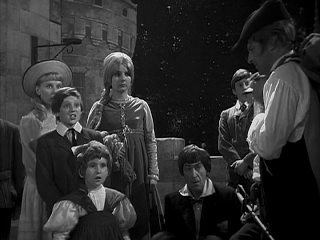
Rapunzel and the children of the Land of Fiction
The Master of the Land of Fiction is a different character to the renegade Time Lord we meet in Season 8
The inability of some viewers to comprehend that television dramas are fictional and not fact is not uncommon. Comedian, author and actor Toby Hadoke takes great delight in ridiculing such people in his stand-up comedy show, Moths Ate My Doctor Who Scarf. Hadoke, who starred as a Vicar in the soap Coronation Street in December 2000, was gobsmacked to actually receive letters from viewers asking if he might officiate at weddings. “And these people can vote” he quipped!
Toby Hadoke – Stand-up comedian, actor and author of Moths Ate My Doctor Who Scarf.
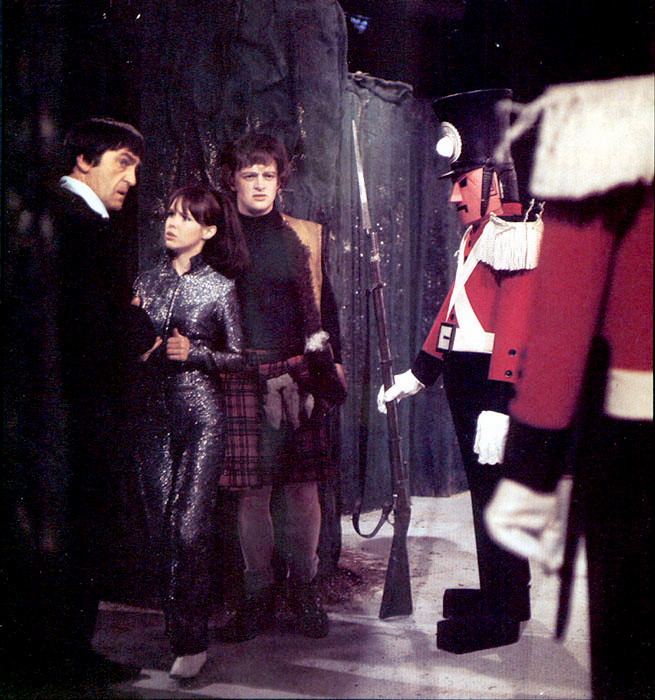
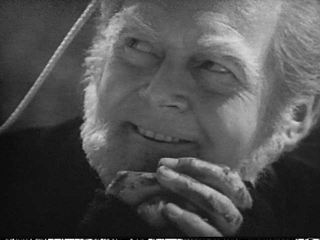
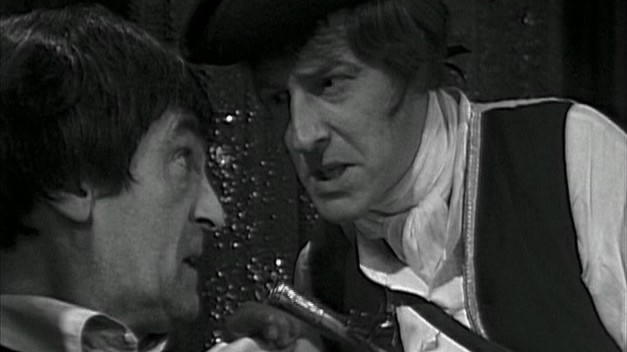
The fiction of children’s stories and classic mythology permeate The Mind Robber. Lemuel Gulliver, wind-up tin toy soldiers, Rapunzel, the Medusa, a Unicorn, Sir Lancelot and Blackbeard are amongst the characters which confront the Doctor and his crew. Gulliver, who is originally named only as “A Stranger” is brilliantly portrayed by Bernard Horsfall, who only passed away in January 2013. Horsfall went on to appear in another three Doctor Who serials, all of which were directed by David Maloney – The War Games (1969), The Planet of the Daleks (1973) and The Deadly Assassin (1976). Tall and imposing, yet always polite and obliging, the fictional character from Gulliver’s Travels spoke only words and phrases taken directly from Jonathon Swift’s 1726 novel. The juxtaposition of Gulliver’s archaic but lyrical language with the Doctor and his companion’s modern English was superb. It was only in the final episode that Ling permitted Gulliver to speak lines other than those from the novel, however his language form remained Middle English.
The Doctor is initially menaced by Gulliver
The seamless transition of Jamie from Frazer Hines to Hamish Wilson was an imaginatively simple idea that meshed themes common to both The Mind Robber and its preceding serial, The Dominators. When Hines succumbed to chicken pox early in the week of episode two’s shooting an immediate solution was required. During the course of the 60s each episode of Doctor Who was filmed at the end of a week’s rehearsal. Save for sparse location shoots, material was not pre-recorded. Recording was almost live, with only an hour and a half allocated for each 25 minute episode. Given that only three video cuts were permitted for each episode, this necessitated the filming of scenes in their correct order and performances in a play-like fashion. Filming scenes from different episodes on the one day was unheard of. Moreover, episodes were often filmed only two weeks prior to airing. This meant that when episode one of a six part serial was broadcast the production of the final episode could still be a month away.
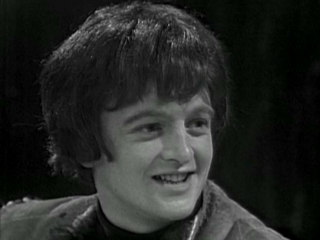
Hamish Wilson played the role of Jamie in episodes two and three
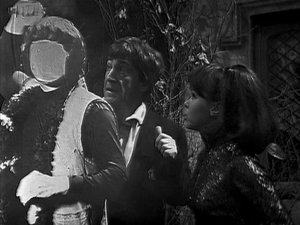
As a consequence of these production limitations the absence of a cast member presented extraordinary difficulties. The luxury of filming out of order and six months in advance of screenings did not exist, so there was no means by which the ill actor could film their scenes at a later time. Hence the extraordinary decision to retain the character of Jamie in episode two but have him played by an altogether different actor. The fictional nature of the story, in which the Doctor and his companions were constantly confronted by challenges, afforded the opportunity for Jamie’s identity change to become part of a game. Having been turned into a life size cardboard cut-out, Jamie’s face was removed and he could not be animated again until the Doctor put the puzzle pieces of his face correctly together. On a board where three or four photographs of eyes, noses and mouths. In a flustered state the Doctor chose the wrong pieces and Jamie was reanimated with a different face. When Hines returned in episode three Jamie was again transformed into a cut-out. The Doctor was successfully able to complete Jamie’s face puzzle, this time with the assistance of the very attentive Zoe. In the interim Wilson had superbly perfected Jamie’s mannerisms.
The Doctor and Zoe put Jamie’s face back together
The Doctor’s initial inability to correctly choose Jamie’s eyes, nose and mouth was reminiscent of his feigned stupidity in The Dominators. In an attempt to appear an imbecile in the previous serial the Doctor had intentionally failed a block test similar to one that a normal three year old would complete with ease. He was unable to match the wooden blocks with their correct holes and suffered electric shocks to his arms as a consequence. No longer considered a threat, the Doctor and Jamie were subsequently released by the Dominators.
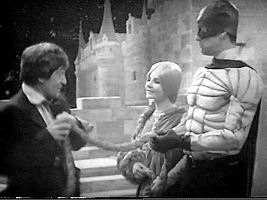
The Doctor with Rapunzel and the Karkus
The Mind Robber contains the only episode of Doctor Who not to feature a writer’s credit. Originally written as a four part serial by Peter Ling, the story was expanded to five episodes after the production fiasco that was The Dominators. Having no budget for guest cast or additional props the production crew were faced with a very similar predicament to that in the season one story The Edge of Destruction. Having access only to the three main cast and the TARDIS console, Script Editor Derrick Sherwin wrote the opening episode to accommodate these restrictions. Akin to The Edge of Destruction, these constraints resulted in a minimalist masterpiece.
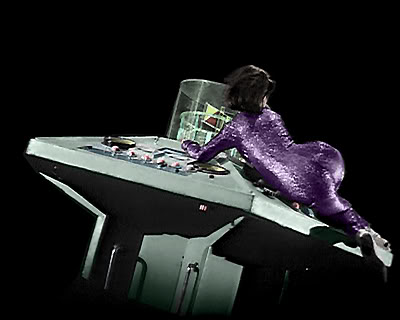
Wendy Padbury in the scene for which, unfortunately, she is perhaps best known
The TARDIS Explodes in the cliff hanger to episode one of The Mind Robber
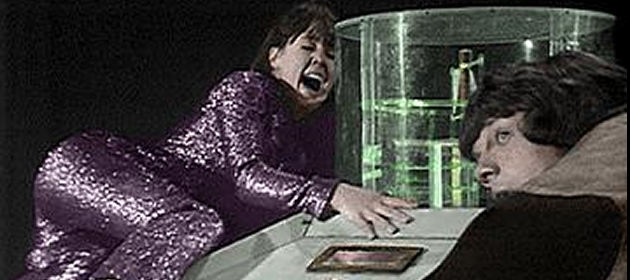
Many of the most memorable scenes in The Mind Robber were Wendy Padbury’s. The cliff-hanger of episode one featured a shiny cat-suited Zoe hanging onto the TARDIS console as it plummeted through space. That much of the scene focussed on Zoe’s bum must have been a cause for great delight amongst male viewers. Zoe also enacted a wondrous pantomime fall and proved herself proficient in martial arts when she easily defeated the cartoon book character, the Karkus, in a fight.
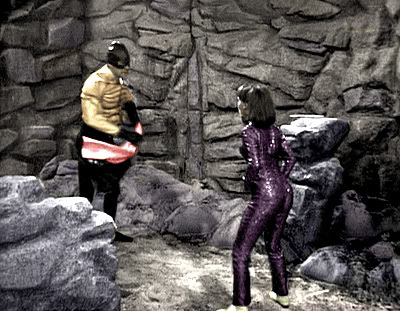
Zoe fights the Karkus
Zoe and Jamie cling to the TARDIS console after the Ship explodes
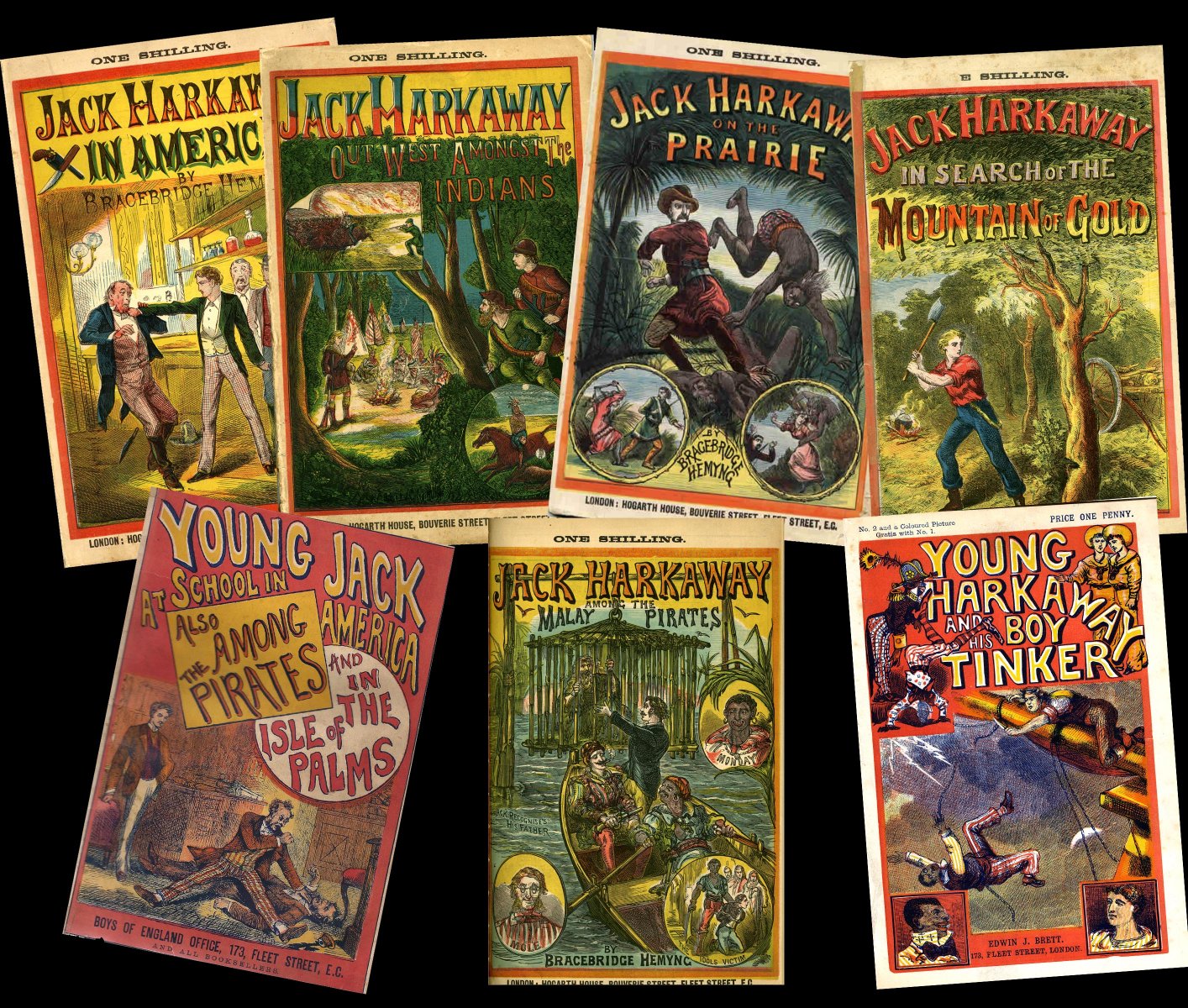
The Mind Robber wasalmost certainly the naming inspiration for the New Series Doctor Who character Captain Jack Harkness. The Master of Fiction had written 250,000 words of fiction as editor of the boys’ own magazine, The Ensign. Captain Jack Harkaway was one of the Master’s characters which like all others in the story, with the exception of the Karkus, was a fictional character in the real (non-Doctor Who) world. The Master of The Mind Robber, however, is a completely different character to the renegade Time Lord that the Third Doctor first encounters in Season Eight.
The fictional character, Captain Jack Harkaway, was undoubtedly an inspiration in the naming of the new series character Captain Jack Harkness
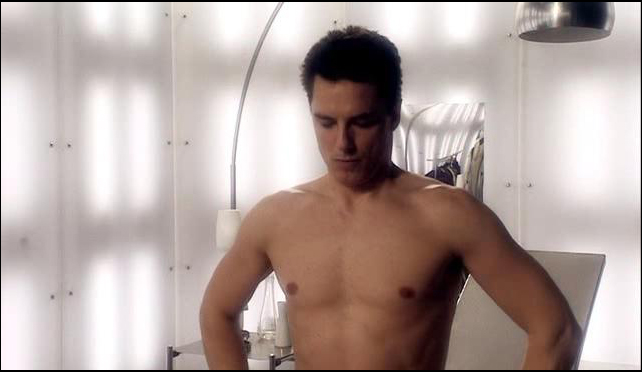
Captain Jack Harkness is not to be confused with The Mind Robber’s Captain Jack Harkaway
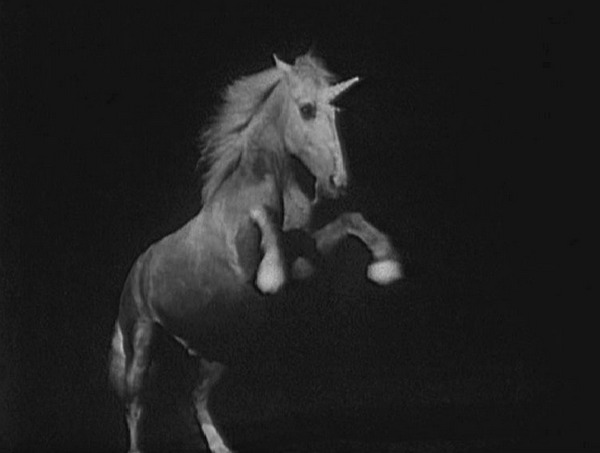
I could inevitably extol the virtues of The Mind Robber for several thousand more words however I’ll bother you not with more reading. Instead I earnestly implore you to legally acquire a copy of the story and take in its pleasures yourself. Watch Jamie and the Doctor climb Rapunzel’s hair, the snakes animating in the Medusa’s hair, and the Unicorn charging at our heroes. I can assure you that you won’t be disappointed.
The source of many a nightmare – the Unicorn
The Mind Robber was originally broadcast in the UK between 14 September and 12 October 1968
 After whipping up excitement with a press release headed Trailer, Stings and Other Things … the BBC produced a damp squid when they released two short previews preceding and following Saturday’s episode of Atlantis. The previews, of a mere five and ten second duration, feature no scenes, photographs or dialogue from the 50th Anniversary Special, The Day of the Doctor. Instead viewers simply learnt that the phenomenally unimaginative hashtag #SaveTheDay would be used to promote the Anniversary Special. The hashtag is now trending, but principally with exclamations of disappointment. Let’s hope that the promised trailer is more enticing.















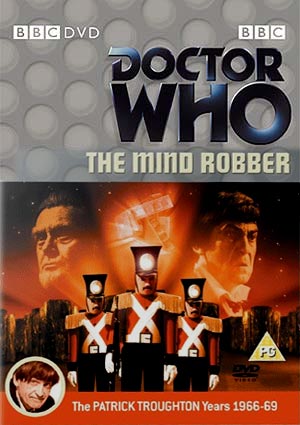
 The Doctor Who Mind Robber